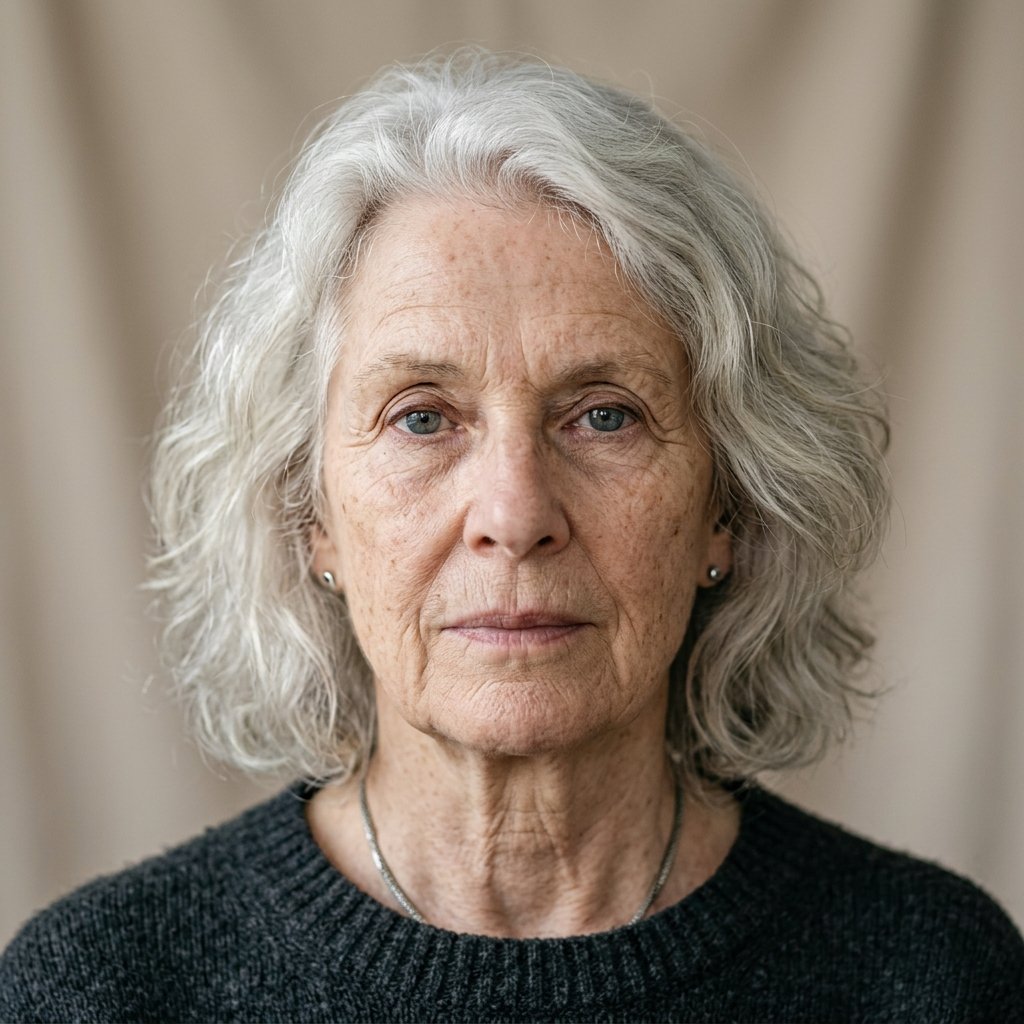
I was the last person to hear my wife’s voice, and I will carry that sound with me until the day I pass.
She stood in the doorway of our small house in Garibaldi, Oregon, with her police uniform pressed and her badge gleaming under the porch light.
It was a bitter cold evening in late October of 1977.
Ruth Callahan looked at me with those steady blue eyes that never flinched.
“Don’t wait up, Tom,” she said softly.
She reached out and squeezed my hand.
“I’ll be home before midnight. I promise.”
I pulled her close and told her I loved her.
She whispered that she loved me too.
Then she walked down the driveway, got into her patrol car, and turned onto the coastal road.
That was the last time I ever saw my wife alive.
I woke up at three in the morning with a cold knot in my stomach.
The bed beside me was still made.
The house was too quiet.
I called the station house three times.
The night sergeant told me Ruth had radioed in a routine traffic stop on Highway 101 around eleven o’clock.
After that, he said, there was nothing.
No call for backup.
No request for assistance.
Just silence.
I pulled on my jacket and drove out to the stretch of road where she was last heard from.
The fog was so thick I could barely see the hood of my own car.
I found her patrol car nowhere.
No tire tracks.
No broken glass.
No sign of a struggle.
It was as if the earth had simply opened up and swallowed her whole.
By sunrise, half the town of Garibaldi was out looking for my Ruth.
Fishermen walked the rocky shorelines.
Shopkeepers climbed the bluffs.
Volunteers searched the forest.
We found nothing.
Not a single clue.
The official report from the department was devastating.
They wrote that she had probably run away.
They whispered that maybe she had been leading a double life.
They said a young woman under pressure might simply disappear.
I wanted to scream at them.
My Ruth was not the kind of woman who ran away from anything.
She was a newly promoted officer, barely twenty-eight years old, and she believed in the law with her whole heart.
She would never abandon her badge.
She would never abandon me.
But the rumors in town grew louder.
I could see it in the eyes of my own colleagues.
They looked at me with pity.
They looked at me with doubt.
Some of them stopped meeting my eyes altogether.
For more than a decade, I had to bear those suspicions.
I went to work every day and sat at the same desk where I had once placed her photograph.
I answered calls about stolen bicycles and family arguments.
All the while, my heart was buried somewhere on that cold stretch of Highway 101.
I never stopped looking for her.
Every time a heavy rain came, I walked the cliffs.
Every time a boat brought up something odd, I ran to the docks.
Every time my telephone rang in the middle of the night, I thought it was Ruth.
It never was.
Thirteen years is a very long time to carry an open wound.
People in town learned not to mention her name around me.
They would pat me on the shoulder and say, “Time heals everything, Tom.”
But time does not heal a missing wife.
It only teaches you how to breathe with the pain.
Then, in March of 1990, the thick fog on the cliffs of Cape Meares revealed a secret that the ocean had been keeping for over a decade.
A local fisherman named Walter Henson was out on the water early that morning.
The fog was so thick that he almost missed it.
But a glint of metal caught his eye.
It was a bumper glimmering beneath the waves.
At first he thought it was an old piece of junk.
Then he saw the shape of a wheel.
Then he saw the outline of a door.
He called the Coast Guard immediately.
The rescue team took hours to reach the spot.
The surf was rough and the rocks were sharp.
When they finally pulled the corroded remains out of the water, my heart stopped.
It was not just any car.
It was a rusty police cruiser, wedged between the rocks like a steel coffin.
The paint was gone.
The windows were smashed.
The metal was eaten by salt and time.
But the unit number was still readable.
It was her car.
I got the call at noon.
I drove to Cape Meares so fast that my hands never stopped shaking.
When I arrived, the chief put his hand on my arm and told me to prepare myself.
He did not need to say anything else.
I already knew.
They brought me to the car.
I stood there looking at the twisted wreckage and did not make a sound.
Inside, the recovery team found a burned-out flashlight.
It was still on the floorboard near the driver’s seat.
The glass was blackened and cracked.
They found a citation book turned to stone by moisture.
Its pages were sealed together like a block of concrete.
They found a .40-caliber bullet casing.
It was not police issue.
It was the kind of round used in a semiautomatic handgun, and my Ruth carried a standard-issue .38.
And then they found the trunk.
The floor of that trunk was covered in dark stains.
Those stains were later confirmed to be human blood.
My wife’s blood.
Everything pointed to the fact that Ruth had not vanished of her own free will that night.
Someone had made sure her patrol car would never return to the station.
Someone had erased her from the records.
Someone had thrown the truth into the sea.
I sat down on the cold rocks and wept like I had not wept in thirteen years.
I was not crying only because I had lost her.
I was crying because the world had called her a runaway.
I was crying because I had spent thirteen years defending her honor to people who believed the worst.
I was crying because now the ocean had given her back to me.
But with her came a storm of new questions.
The discovery reopened old wounds and ignited new suspicions.
Why did she make that last traffic stop on Highway 101?
What did she see that made someone want her gone?
Why had her co-worker mysteriously disappeared from the original report?
The partner who was supposed to be on patrol with her that night was never mentioned in the final documents.
And what role did her own supervisor play, too eager to bury the investigation?
Captain Frank Aldridge had signed off on the runaway theory within two weeks.
He never pushed for a deeper search.
He never contacted me after the search was called off.
He never looked me in the eye again.
Now I wanted to know why.
The state police took over the case.
They started pulling old records.
They interviewed dozen of people who had lived in Garibaldi at the time.
They found gaps in the dispatch logs.
They found missing evidence files.
They found a pattern of silence that went all the way to the top.
What seemed like a simple patrol car accident morphed into a case that would uncover corruption, betrayal, and a web of secrets capable of bringing down half the police department.
The more the truth came out, the more I realized the town I had served for thirty years was not the town I thought I knew.
Ruth had seen something on that last night.
Something that powerful men wanted buried.
They thought the ocean would keep their secret.
They thought time would wash it all away.
But the ocean gives up its dead.
And the truth does not stay at the bottom forever.
I am now an old man.
I still live in Garibaldi, Oregon, in the same house where Ruth and I shared our last goodbye.
I still talk to her photograph every morning.
I tell her that I am sorry it took so long.
I tell her that she has been proven right.
I tell her that I never believed the lies.
Not for one single day.
If this story touched your heart, please like our page, follow us, and share it with someone who needs to remember that the truth always comes home.