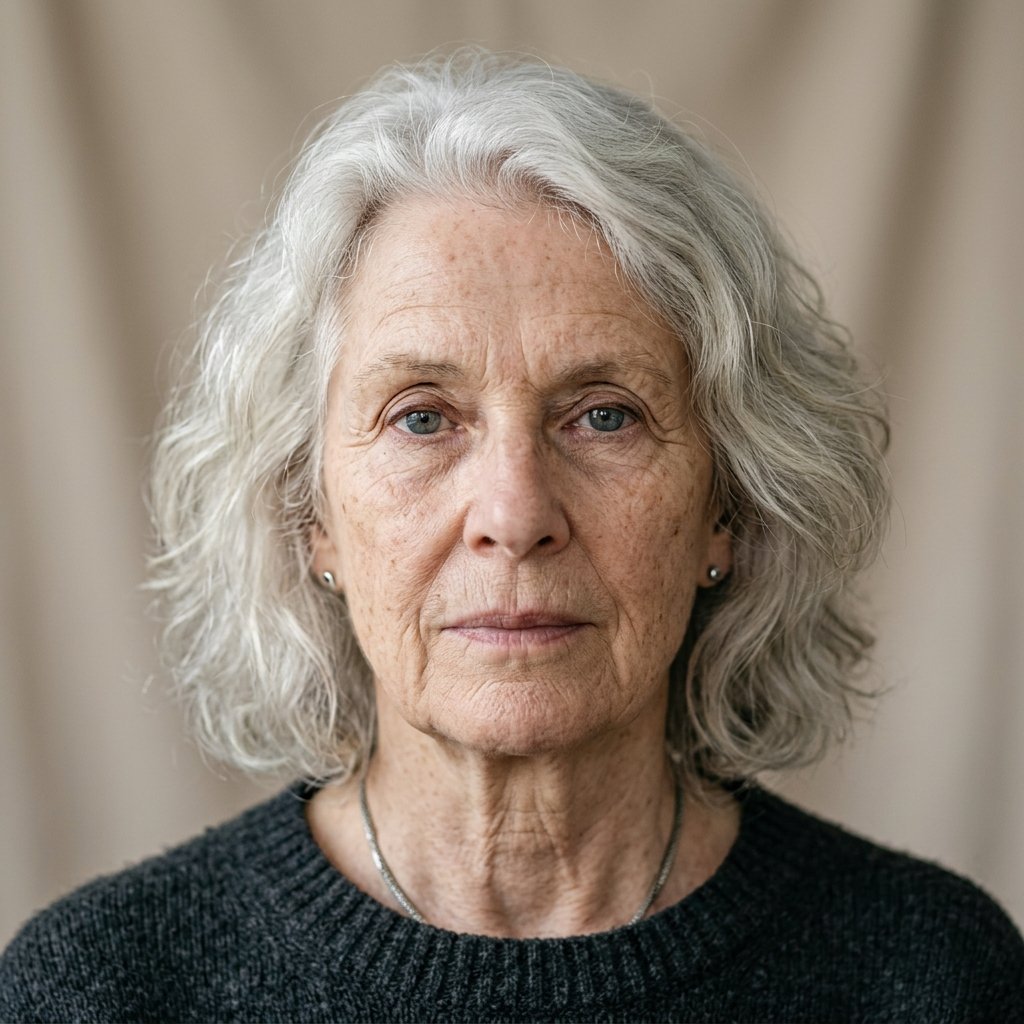
The night seemed to chew on every sound that dared to escape from between the damp rocks of the cave.
Inside, huddling under an old blanket full of holes, slept three children who trembled not only from the cold but from the fear that had clung to their bodies for days.
Their mother, Margaret, remained awake, sitting against the stone wall with her hands pressed against her chest and her eyes fixed on the dark entrance of the cavern.
She didn’t pray because the words no longer came to her.
It had been a long time since prayers had tangled in her throat, drowned by exhaustion, by shame, and by the silent rage of knowing she was alone in a world that did not forgive poor widows.
She just looked outside, hoping that nothing but the wind would enter.
But when the sun began to filter through the cracks in the stone, what they found was not danger.
It was something none of them could have ever imagined.
The year was 1962, the place a mountainous region in northern Wyoming, near a small settlement called Gray Hollow, where houses were few and made of weathered timber, and the dirt roads disappeared among hills covered in dry brush and twisted pines.
The air smelled of burnt wood, cracked earth, dust suspended in the stillness, and a silence broken only by the wind, which came down like a long sigh from the peaks.
There, people lived off small corn patches, thin cattle that grazed among stones, rains that almost never arrived on time, and work on the large ranches belonging to Harlan Granger, the local boss who controlled everything.
The water.
The land.
The money.
The seeds.
The harvesting permits.
And even the consciences of those who depended on him to survive.
In Gray Hollow, Harlan was the law, the bank, the judge, and the employer.
And whoever dared to defy him simply ceased to exist.
Margaret had arrived in that town five years earlier, holding the hand of her husband, a quiet and hardworking man named Daniel.
He was a laborer on Harlan’s ranch.
He earned little, barely enough to keep his family in a one-room shack with a packed dirt floor and a tin roof that sounded like a drum when it rained.
Margaret washed other people’s clothes in the creek, sewed whenever she could get a borrowed needle and thread, and raised her three children with an affection that poverty could not contain.
The oldest, Samuel, was 9 years old.
He was thin as a reed, serious, quiet, with eyes that looked older than his face.
He had learned not to ask for anything, not to complain, and to carry firewood without being asked.
The second, Ruthie, was 6 years old and was the one who talked the most, the one who asked everything, the one who sang softly when there was food on the table and gave names to the stones she found on the road.
The youngest, Joey, was barely 3 years old.
He still didn’t quite understand why his father was no longer there, nor why his mother cried at night when she thought no one was listening.
Daniel died four months earlier.
It was an accident at the ranch.
A poorly secured beam fell on him while he was repairing the roof of an old granary that Harlan wanted to use to store grain.
Several men carried him back, crossing the dusty road under the midday sun.
But by the time they reached the settlement, Daniel was no longer breathing.
His face was covered in dried blood and his eyes were open, looking at the sky as if he were still searching for something.
Harlan sent $10 with one of his ranch hands, saying it was for the burial.
Nothing more.
There was no apology, no compensation, nothing to make up for the life of a man who had worked for him for years, sweating under the sun, breaking his back, obeying without a word.
Margaret kept those $10 in a cloth tied to her waist and with that, she paid for a quick service and an unvarnished pine casket.
She had a little money left over, but it went toward corn, beans, and a pound of sugar for the children.
Since then, everything collapsed.
Without Daniel, Margaret lost the right to live in the shack.
Harlan needed it for another worker he had just hired.
They gave her one week to leave.
Margaret looked for work in town, knocking on doors, offering to wash, to cook, to clean pens, for anything.
But the doors closed one after another.
Some women lowered their eyes with pity.
Others whispered that she should not have spoken ill of Harlan after Daniel’s death.
But Margaret had never said a word against him.
Not publicly.
The truth was that Harlan had spread the word that Margaret was a troublemaker.
He told people she was ungrateful, that she had tried to demand money from him, that she was dangerous to employ.
None of it was true.
But in Gray Hollow, Harlan’s truth was the only truth that mattered.
Margaret sold the few things she had left.
A cast-iron skillet.
Two wool blankets.
Her husband’s belt.
A small wooden cross her mother had given her.
She traded most of it for a sack of cornmeal and a little salt.
And when the week ended, she gathered her children and left the shack without looking back.
Samuel asked, “Mama, where are we going to sleep tonight?”
Margaret squeezed his hand.
“We’re going to find a safe place,” she said.
But she didn’t know where.
She walked north because she remembered seeing a rock formation near the edge of Harlan’s land.
It was a cave.
Not a real home.
But it was hidden.
It was dry.
And it was far enough from town that no one would come to chase them away.
The first night in the cave was the worst.
Joey cried for his father.
Ruthie kept asking if they could go back home.
Samuel didn’t say anything.
He just sat near the cave mouth with a stick in his hand, as if he could protect them from whatever might come out of the dark.
Margaret wrapped all three of them in the old blanket and told them a story.
She told them about a king who lost everything but found a hidden valley where the sun never stopped shining.
It was a lie.
But it made Ruthie smile.
And that was enough.
Days passed.
Margaret left the children in the cave every morning and walked into the hills to look for wild onions, berries, or anything she could boil in a tin can.
She taught Samuel to keep Ruthie and Joey quiet if he heard voices.
She taught Ruthie to sing only when the birds were singing.
And she taught Joey to hold his breath when his tears came.
One evening, Samuel found a dead rabbit near a trap line on the edge of the forest.
It was thin and full of fleas.
But it was meat.
They cooked it slowly over a small fire hidden behind rocks.
Margaret gave the children the best pieces.
She chewed on the bones and pretended she was full.
That night, Ruthie said, “Mama, I’m still hungry.”
Margaret felt something break inside her chest.
She pulled Ruthie close.
“I know, baby,” she whispered. “Tomorrow we’ll find something better.”
But the next day brought nothing but wind and dust.
And the day after that, nothing but a handful of sour berries that made Joey’s stomach hurt.
Margaret began to wonder how much longer they could survive.
She was too proud to beg.
But hunger has a way of grinding pride into dust.
On the sixth day in the cave, Margaret made a decision.
She would walk back to Gray Hollow and beg.
Not for herself.
For her children.
She left Samuel in charge and told him not to leave the cave no matter what.
Then she walked the long road into town with her head high and her stomach empty.
She went to the general store first.
The owner, a thin man named Gerald, saw her coming through the window and quickly turned the sign in the door to CLOSED.
Margaret stood there for a long moment, staring at the painted letters.
Then she walked away.
She tried the church next.
The doors were open, but the old pastor looked at her with a strange, nervous expression.
“Sister Margaret,” he said softly. “I heard about your situation. I wish I could help. But the deacons have made it clear that we cannot interfere with Mr. Granger’s business.”
Margaret stared at him.
“My children are sleeping in a cave,” she said.
The pastor winced.
“I’m sorry,” he whispered.
And then he closed the door.
Margaret walked to the edge of town, past the small houses with their warm windows, past the saloon where men laughed and drank, past the tiny schoolhouse where her children had once learned their letters.
She stopped at the fence of Harlan Granger’s property.
His house stood on a hill, tall and white, with a wide porch and clean glass windows.
It looked like a palace compared to the cave.
Margaret stood there for a long time.
She thought about walking up that hill.
She thought about falling to her knees and begging the man who had killed her husband, at least in her eyes, to help her children.
But she couldn’t do it.
Her legs wouldn’t move.
So she turned around and walked back into the mountains.
When she reached the cave, it was almost dark.
The children were waiting for her.
Ruthie ran to her.
“Did you bring food, Mama?”
Margaret knelt down and kissed her forehead.
“Not today, baby,” she said. “But soon.”
That night, she didn’t sleep.
She sat with her back against the cold stone and stared at the cave entrance.
She thought about Daniel.
She thought about his hands, rough and warm.
She thought about the way he used to hum while he worked.
She thought about the last time she saw him alive.
He had kissed her forehead and said, “I’ll be home before dark.”
But he didn’t come home.
And now she was here, in a hole in the earth, watching her children sleep and wondering if God had forgotten their names.
She didn’t pray.
The words felt dead in her mouth.
But in the deepest part of her heart, she made a single silent wish.
Please.
Just let them live.
The next morning, the sun came through the cracks in the stone like fingers of light.
Margaret was still awake.
Her eyes were dry and heavy.
Then Samuel whispered, “Mama, someone’s coming.”
Margaret’s heart stopped.
She grabbed a sharp rock from the cave floor and crawled to the entrance.
She told Ruthie to hide behind the big stone with Joey.
Then she waited.
The footsteps came closer.
A shadow fell across the cave mouth.
Margaret raised the rock.
But the man who appeared was not Harlan.
He was old, with a gray beard and deep lines around his eyes.
He wore a worn leather jacket and carried a wooden box under his arm.
He looked at Margaret, then at the rock in her hand, then at the children peeking out from behind the stone.
“I’m not here to hurt you,” the man said quietly.
Margaret didn’t lower the rock.
“Who are you?” she demanded.
“My name is Walter,” the man said. “I was Daniel’s friend. We worked together on the Granger ranch.”
Margaret’s voice cracked.
“Then you should know we don’t have anything worth taking.”
Walter set the wooden box down on the ground.
“I didn’t come to take anything,” he said. “I came to give you something.”
He opened the box.
Inside was Daniel’s old toolbox.
Margaret recognized it instantly.
The dented metal corners.
The initials D.W. scratched into the side.
She dropped the rock.
“Where did you get that?” she whispered.
Walter took a deep breath.
“I took it from the granary before Harlan’s men could burn it,” he said.
Margaret frowned.
“Burn it? Why would they burn Daniel’s tools?”
Walter looked at the ground.
“Because of what’s inside,” he said.
He opened the toolbox.
Margaret stepped closer.
Inside, beneath a layer of rags, she saw a small leather pouch.
Walter lifted it out and handed it to her.
“Daniel made me promise to give this to you if anything ever happened to him,” he said.
Margaret’s fingers trembled as she opened the pouch.
Inside was a folded piece of paper and a key.
She unfolded the paper.
It was a letter in Daniel’s handwriting.
And what she read made the whole world tilt.
The letter said that Daniel had discovered something on Harlan’s land.
A pocket of gold in the creek bed on the north edge of the property.
Not a huge vein, but enough.
Enough to change everything.
Daniel had been quietly panning and saving for months.
He hadn’t told Margaret because he wanted to surprise her.
He had used the money to buy a small cabin through a private sale, paying in cash through a lawyer in a nearby town.
The key was to that cabin.
“I bought it for you and the kids,” the letter said. “It’s not much, but it’s ours. No one can take it from us. If you’re reading this, something went wrong. The lawyer’s name is in the pocket under the floorboard. Go to him. He has the deed. Tell him Daniel Warren sent you.”
Margaret read the letter three times.
Tears streamed down her face.
She looked up at Walter.
“Did you know about this?” she asked.
Walter shook his head.
“Not until after Daniel died,” he said. “He told me where the toolbox was. He told me to hide it. He said if Harlan ever found out about the gold, he would kill him.”
Margaret’s blood ran cold.
“Harlan killed him,” she said.
It wasn’t a question.
Walter nodded slowly.
“I wasn’t there,” he said. “But I saw the beam after the accident. The ropes had been cut. Not worn through. Cut.”
Margaret sank to her knees.
Samuel ran to her.
“Mama?”
She pulled him close and buried her face in his hair.
Then Ruthie came out from behind the stone, holding Joey’s hand.
“Mama, why are you crying?” Ruthie asked.
Margaret looked up at her children.
“These are good tears, baby,” she said. “These are good tears.”
Walter stayed with them that morning.
He shared a piece of bread from his pocket and gave Joey a small piece of candy.
Then he walked with them out of the cave and through the hills to the north boundary of Harlan’s land.
There, hidden among a stand of pines, was the cabin.
It was small and rough, but it had a real door.
A real roof.
A real window with glass.
Margaret stood in front of it and wept.
The children ran to the door and pressed their hands against the wood.
“Is this our house?” Ruthie asked.
“Yes, baby,” Margaret said. “This is our house.”
The key fit perfectly.
Inside, there was a single room with a wood stove, a table, two chairs, and a large bed against the wall.
There was a small pantry stocked with canned goods.
There was a stack of firewood outside.
There was a well with clean water.
It wasn’t a palace.
But it was a home.
And it was theirs.
Walter told Margaret to wait a few days before going to the lawyer.
He said Harlan’s men were watching the roads.
But Margaret couldn’t wait.
She wanted the deed.
She wanted it in her hands.
So the next morning, she left the children with Walter and walked ten miles to the neighboring town.
The lawyer’s office was above a small feed store.
His name was Mr. Alderman.
At first, he was suspicious.
But when Margaret handed him the letter and the key, he nodded.
“I was wondering when you would come,” he said.
He opened a drawer and pulled out a folder.
Inside was the deed to the cabin and a savings passbook.
The passbook showed a balance of $4,700.
Margaret gasped.
“Daniel saved all of this?” she asked.
Mr. Alderman nodded.
“Your husband was a remarkable man,” he said. “He told me to make sure this went to you and only you. He said if anything happened to him, I was not to notify anyone. Just wait until you came.”
Margaret left the office with the deed and the passbook pressed against her chest.
She carried them the entire ten miles back as if they were made of glass.
When she walked through the cabin door, Ruthie was singing.
Samuel was stacking firewood.
Joey was asleep on the bed.
And Walter was sitting outside, keeping watch.
Two days later, the sheriff came to the cabin.
Margaret saw him coming up the path and told Walter to take the children inside.
But the sheriff was not there to hurt them.
He had heard about Daniel’s death.
And now he had heard about Walter’s testimony.
Word had spread through the settlement that Harlan had cut the ropes on that granary beam.
A full investigation was opened.
Other ranch hands came forward.
They admitted that Harlan had ordered them to keep quiet.
They admitted that Harlan had known about the gold and had flown into a rage when he found out Daniel had been panning on the north creek.
Harlan was arrested in his own house.
Margaret watched from a distance as they led him down the hill in handcuffs.
He looked small in the daylight.
Smaller than he ever had from the ground.
“You’ll never prove it!” Harlan shouted at the sheriff.
But they did prove it.
In the end, the evidence was overwhelming.
Harlan Granger was sentenced to prison for the murder of Daniel Warren.
His ranch was sold.
His hold on Gray Hollow was broken.
And the people who had once turned their backs on Margaret began to see the truth.
Some of them came to the cabin to apologize.
Others brought food, clothes, and small gifts for the children.
But Margaret didn’t need their apologies.
She had learned that the only thing that mattered was the three little faces that looked up at her every morning.
She planted a garden behind the cabin.
She sewed new curtains for the window.
She cooked real meals on the wood stove.
And every night, she kissed her children and told them the truth.
“Your father loved us more than anything,” she said. “And he made sure we would always have a home.”
Samuel grew tall and strong.
Ruthie kept singing.
And little Joey finally stopped crying at night.
In time, Margaret used some of the money to open a small sewing business.
She bought fabric with her own hands and made dresses, shirts, and quilts.
She sold them at the general store and to families in nearby towns.
She never became rich.
But she never went hungry again.
And she never slept in a cave again.
The cave, though, never left her memory.
Years later, when Samuel asked her about it, she said, “That cave taught me something.”
“What, Mama?” he asked.
“It taught me that the darkest moments are sometimes just the threshold,” she said. “You have to walk through them to find what’s waiting on the other side.”
They never went back to Gray Hollow except to visit Daniel’s grave.
They always brought wildflowers.
Ruthie would sing a little song.
Samuel would kneel and whisper something only his father could hear.
And Joey would place his small hand on the wooden cross and say, “Thank you, Daddy.”
Margaret would stand there with her eyes closed, feeling the wind against her face.
And she would remember the night in the cave, the cold, the fear, the silence.
And then she would remember the sunrise.
And the footsteps.
And the old man with the toolbox.
And she would smile.
Because sometimes, when you think God has forgotten you, He sends a stranger to remind you that you were never alone.
If this story touched your heart, please hit the Like button, Follow our page for more incredible true stories, and Share it with someone who needs to believe in hope today.