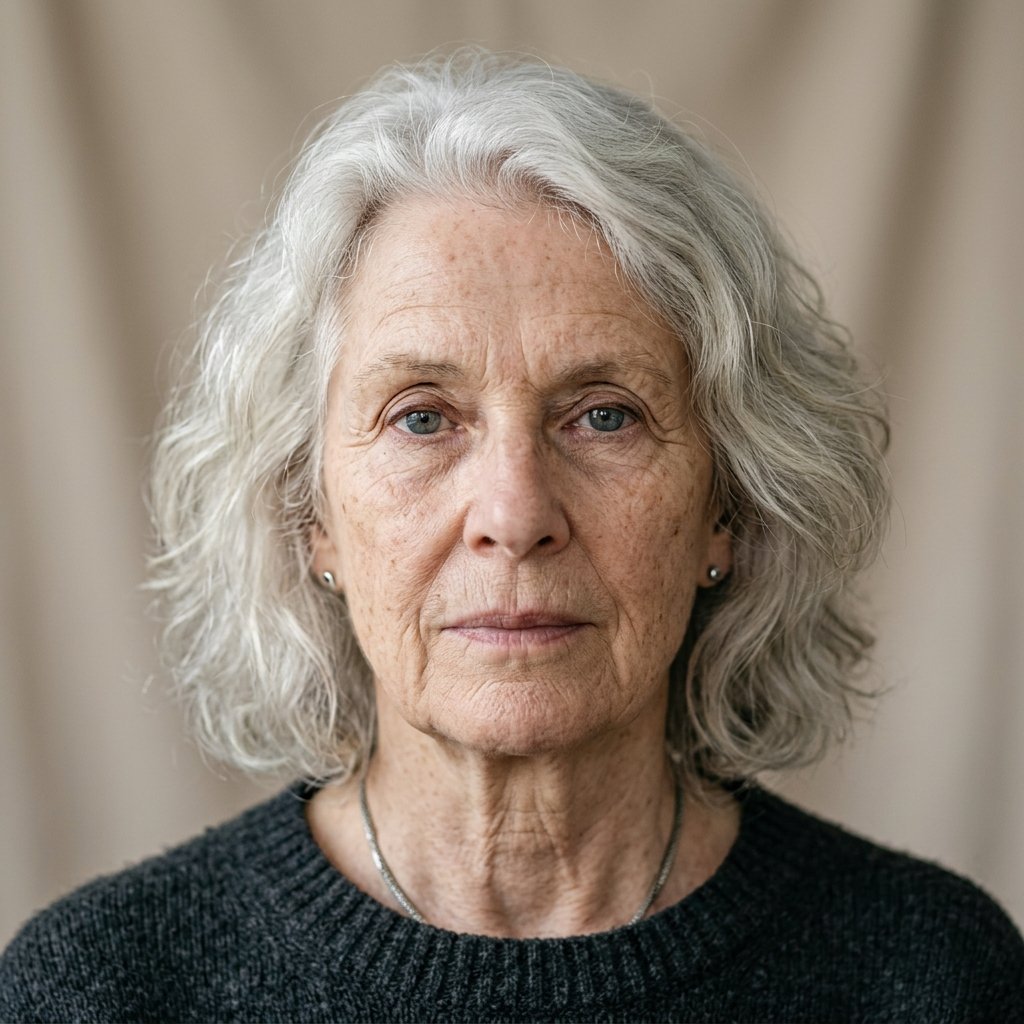
For forty years, I poured coffee for strangers at Rosie’s Diner, and not one of them ever saw me cry.
My name is Ruth Callahan. I’m seventy-four years old, and I’ve lived my whole life in Millbrook, Ohio.
I want to tell you how one bowl of soup I gave away for free, back when I had almost nothing myself, came back half a lifetime later to save me.
But first, you have to understand where I started.
I was twenty-nine when my husband, Samuel, passed away. A factory accident, on an ordinary Tuesday in October.
He kissed me goodbye that morning like he always did. By supper, he was gone.
I had two babies at home. Daniel was five. Carol was three.
I remember standing in our tiny kitchen, holding the phone, feeling the whole world go silent around me.
There was no money. There was no plan. There was only me.
So the following Monday, I put on the only clean dress I owned, and I walked into Rosie’s Diner on Main Street, and I asked for a job.
Rosie hired me on the spot. She looked me up and down and said she liked women who didn’t flinch.
I didn’t flinch. I couldn’t afford to.
I worked doubles. I worked holidays. I worked with a fever more times than I can count.
My feet ached so badly some nights that I soaked them in a basin of warm salt water while I helped the children with their homework at the kitchen table.
I never bought myself new shoes when the kids needed them first. I never took a single vacation. I never once let them hear me cry.
The diner became my second home. The smell of frying bacon and burnt coffee got into my hair, my clothes, my skin.
I knew every regular by name. I knew how they took their eggs and which ones were lonely and just needed someone to talk to.
And then came the winter of 1978.
It was one of those brutal January nights when the wind cut straight through your coat.
A boy came in around closing time. Maybe sixteen. Skinny as a fence post, in a filthy coat two sizes too small.
He had eyes that had already seen too much for someone so young.
He sat down in the corner booth and rubbed his hands together, trying to get warm.
When I came over, he stared at the menu for a long time. Then he quietly asked for a glass of water.
Just water. Because it was all he could afford.
I knew that look. It was the look of a child with nowhere on this earth to go.
I didn’t ask any questions. I went back to the kitchen and brought him a steaming bowl of beef and barley soup, a plate of warm bread, and a thick slice of apple pie.
He looked up at me, frightened. He whispered that he couldn’t pay for it.
I told him it was already paid for. That a customer had covered it earlier.
It was a lie. That night, I slipped my own tip money into the register to cover his meal.
His name was Thomas. He came back three more nights that week, always at closing time, always to the same corner booth.
And every night, I fed him and quietly pressed a few folded dollars into his palm on his way out.
On the fourth night, the cold was so bad the pipes were freezing.
I reached into the back closet and pulled out my late husband’s old wool coat. The one I could never bring myself to give away.
I put it around that boy’s shoulders and gave him the address of a church shelter two towns over.
He tried to say thank you, but the words wouldn’t come. He just nodded, and then he walked out into the snow.
I figured I’d never see him again. And for a very long time, I didn’t.
The years rolled on the way years do.
Daniel and Carol grew up. I was so proud of them I could have burst.
I paid for whatever schooling I could with money I hid in an old coffee can on top of the refrigerator.
But somewhere along the way, my children learned to be ashamed of me.
Ashamed of the diner smell in my hair. Ashamed of my cracked, swollen hands. Ashamed that their mother was ‘just a waitress.’
Daniel moved to Columbus and became an accountant. He married a woman who barely looked at me.
Carol married a dentist and settled in Cincinnati in a big house with a lawn service.
At first, the calls got shorter. Then they got rarer. Then they stopped.
I told myself they were busy. That’s what mothers do. We make excuses for the children we love.
When my knees finally gave out at seventy-one, I couldn’t stand behind that counter anymore.
Rosie had passed away years before, and the new owners let me go with a handshake and a twenty-dollar gift card.
Forty years of my life, and that was the goodbye.
But I still had my little house on Cedar Street. Paid off, brick by brick, with four decades of tips and overtime.
It wasn’t much, but it was mine. Every squeaky floorboard, every water stain on the ceiling, held a memory.
And that, it turned out, was exactly when my children remembered I existed.
Daniel showed up one afternoon with a folder full of papers and a smile I didn’t quite trust.
He said the house was ‘too much for me now.’ He said I might fall and no one would know.
He said if I signed it over to him and Carol, they could ‘manage everything’ and take the worry off my shoulders.
I was tired. I was lonely. And I was foolish enough to believe that signing those papers meant my children finally wanted to be close to me again.
So I signed. God help me, I signed.
Within a month, there was a For Sale sign staked into my front yard.
Within two, the house was sold, the money was split between them, and I was moved into a rundown boarding room on the edge of town.
The window leaked when it rained. There was a hot plate, a thin mattress, and a radiator that clanked all night and gave off no heat.
I didn’t tell a soul. Pride, I suppose. And a mother’s foolish hope that her children would knock on my door with an apology.
They never did. Not on my birthday. Not on Thanksgiving. Not on Christmas morning, when I sat alone with a can of soup and the radio for company.
Then the landlord raised the rent, and told me I had thirty days to come up with money I simply didn’t have.
At seventy-four, I sat on the edge of that thin mattress and, for the first time since Samuel died, I truly did not know what I was going to do.
A week later, I was reading the county paper by the window when a name caught my eye.
A man named Thomas Bennett was opening a brand-new community kitchen right here in Millbrook.
The photograph showed a tall man in his sixties, with silver hair and the kindest eyes I’d seen in years.
Something about that face tugged at a thread deep inside me. But I told myself I was just a lonely old woman imagining things.
The article said the kitchen would feed anyone in need, no questions asked. It said Mr. Bennett had built a chain of restaurants across three states.
And it said he’d grown up poor, and had never forgotten what it felt like to be hungry.
Well, I had nothing but time and an empty stomach. So on opening day, I put on my good coat and walked twelve blocks in the cold.
I stood in that line with my head down, praying no one would recognize the old waitress from Rosie’s.
When I finally reached the front, a young volunteer handed me a tray.
Beef and barley soup. A plate of warm bread. And a thick slice of apple pie.
My hands started to shake before my mind even understood why.
Then a gentle voice spoke right beside me. ‘Ma’am, are you all right?’
I looked up into those kind eyes, and in an instant, the years fell away.
‘Thomas?’ I whispered.
The man went completely still. He studied my face the way you’d study something you had prayed for years to see again.
‘Ruth?’ he said, his voice cracking. ‘Ruth, from the diner?’
And then that grown, successful man in his pressed suit set his clipboard down, and he wrapped his arms around me right there in front of everyone, and he wept.
He sat me down at a quiet table and held both my hands like they were made of glass.
He told me that the night I first fed him, he had made up his mind to give up on everything.
He said that my soup, and my husband’s coat, and those few folded dollars, were the only reasons he lived through that winter at all.
He made it to the church shelter. Then to a job washing dishes. Then to a little diner of his own. Then another, and another.
‘Every single restaurant I’ve ever opened,’ he told me, ‘has a booth in the corner where anyone can eat for free. Because of you.’
Then he said something that broke me open. ‘I’ve been searching for you for thirty years, Ruth. I just wanted the chance to say thank you.’
I started to cry, and this time I didn’t try to hide it.
When he gently asked how I was getting on, I finally told the truth. All of it.
The house. The papers. My children. The boarding room with the leaking window and the rent I couldn’t pay.
Thomas didn’t say much. He just listened, and his jaw tightened, and his eyes went hard and sad all at once.
The very next morning, a lawyer knocked on my boarding house door.
Thomas had hired him to look into everything. It turned out my children had rushed those papers so carelessly that parts of the transfer weren’t even done properly.
I won’t bore you with the legal details. But by spring, I had a settlement in hand.
More than the money, I had something I thought I’d lost forever. I had my dignity back.
Then Thomas offered me something I never in a hundred years expected.
He asked me to be the heart of his new community kitchen. To stand at the door. To greet folks. To make every hungry stranger who walked in feel like family.
To do the one thing, he said, that I had always been the very best at.
So now, at seventy-four years old, I have a reason to get up every single morning.
I put on a clean apron, and I stand at the door of that warm, bright kitchen, and I welcome people the way Rosie once welcomed me.
I feed the runaway teenagers with nowhere to go. I feed the tired young mothers. I feed the old men who have outlived everyone they loved.
And every one of them gets a bowl of soup, a slice of pie, and a reminder that somebody in this world truly sees them.
Thomas fixed up a small apartment for me above the kitchen. Real furniture. A soft bed. And a window that doesn’t leak a single drop.
As for Daniel and Carol, word travels fast in a small town. They heard about all of it.
The money was long gone. Carol mailed me a letter, three pages of apologies I read twice and then set gently in a drawer.
Daniel came to the kitchen one gray afternoon and stood in the doorway, unable to meet my eyes.
I’ll be honest with you. A part of me wanted to turn my back and let him feel just a fraction of what I’d felt.
But I have spent my whole life feeding people who could never pay me back.
So I made my son a bowl of beef and barley soup, and I sat down across from him, and slowly, carefully, we began to talk.
I’ve learned that forgiveness isn’t really a gift you give to them. It’s a weight you finally set down for yourself.
I don’t know if my children and I will ever be what we once were. Some things break and don’t mend the same.
But I do know this. A small kindness, given freely on a bitter cold night in 1978, kept a frightened boy alive.
And forty years later, that same kindness came walking back through the door and handed an old woman her whole life again.
I spent so many years believing my story was one of loss and hard work with nothing to show for it.
It turns out it was a story about seeds. You plant them in the dark. You forget them. And one day, when you are empty and afraid and out of options, they bloom.
My name is Ruth Callahan. I’m seventy-four years old.
And for the first time in a very, very long while, I go to sleep each night with a smile on my face.