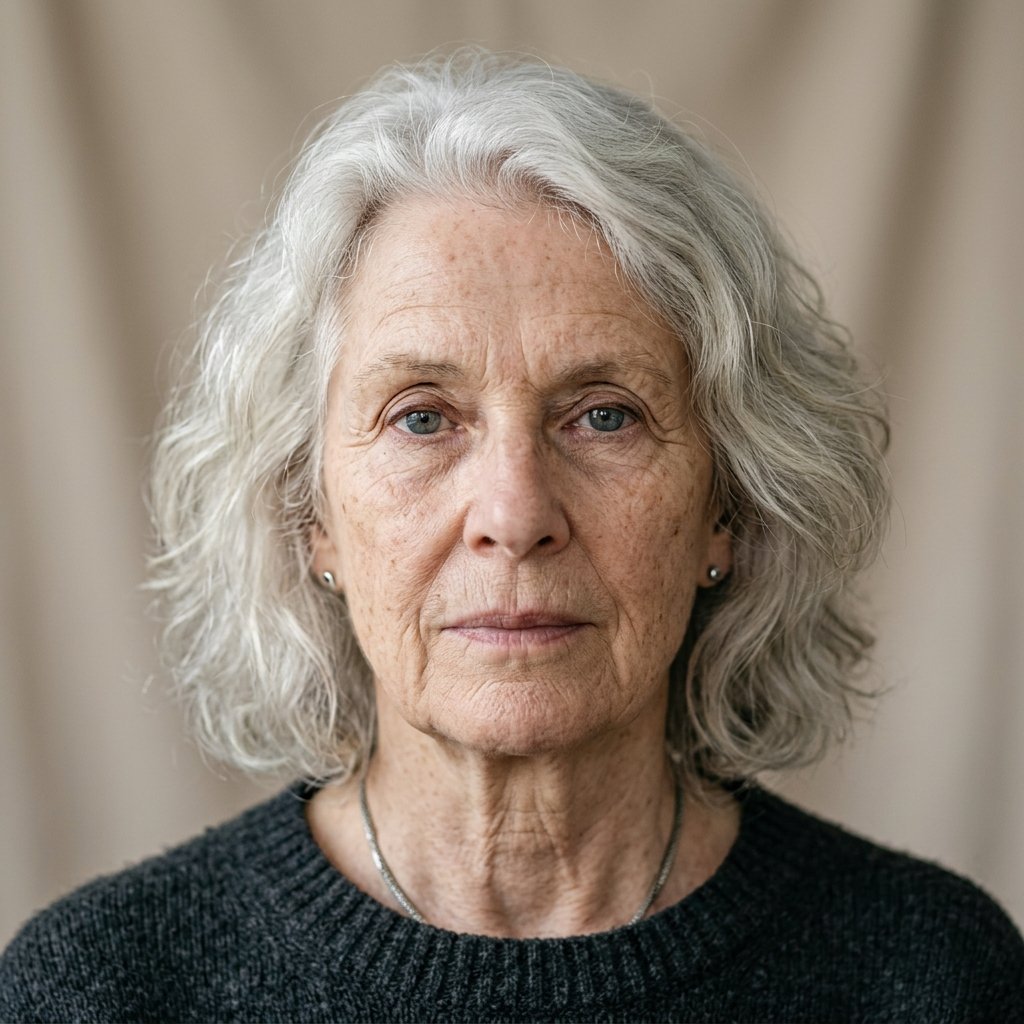
For forty years, I scrubbed other people’s floors so my own children would never have to. Then one cold December morning, I stood on the sidewalk outside my son’s house, holding a single suitcase, and realized I had nowhere left to go.
My name is Ruth Callahan. I am seventy-eight years old.
And this is the story of how I lost everything I thought I had earned, and found the one thing I never knew I was owed.
My husband Walter passed away when our children were still small. A bad heart, the doctor said. One evening he sat down at the kitchen table, told me the pot roast smelled wonderful, and he simply never got up again.
I was thirty-six. I had three children, a mortgage on a little house in Marietta, Ohio, and eleven dollars in my purse.
I remember standing in our bedroom the night after the funeral, staring at his empty side of the bed, and making myself a promise.
My children would never go without. Not while I still had two hands and a heartbeat.
So I went to work. I took the morning shift at Dot’s Diner on Front Street, pouring coffee before the sun came up.
Then I cleaned houses in the afternoons for the wealthy families up on the hill. My knees ached. My hands cracked and bled in the winter cold.
But every single night, no matter how tired I was, I cooked a warm supper and I sat with my babies and I listened to every word they said.
Daniel was the oldest. Serious, sharp, always reading. Susan was the middle child, pretty and headstrong. And James, my baby, was the tender one, the one who used to crawl into my lap and tell me not to work so hard.
Money was always thin. I wore the same brown coat for fifteen winters. I patched their clothes until there was nothing left to patch.
But I found ways. I clipped coupons. I took double shifts. When Daniel wanted to go to college, I emptied a savings account it had taken me nine years to fill.
I never told them how frightened I was. A mother doesn’t hand her fear to her children. She carries it quietly, alone, in the dark hours when the house is asleep.
And oh, how they grew.
Daniel became a lawyer with an office in Cincinnati. Susan married a banker and moved to a fine house in Columbus. James went into real estate, always chasing the next big deal.
I cried at every graduation. I sat in the front row at every wedding, in a dress I bought on clearance, prouder than any woman alive.
I truly believed I had done it. I had beaten every hardship life threw at me. My children were safe, successful, and grown.
The hard part, I thought, was finally over.
I was wrong.
As the years passed, the phone calls came less often. The visits stretched from weeks into months.
When my eyesight began to fail and the stairs in my little house became too much, I sold the home Walter and I had bought together.
I gave most of that money to my children. “For the grandchildren,” I told them. It felt right.
James offered to let me live with him and his wife, Vanessa. “You took care of us your whole life, Mom,” he said. “Now it’s our turn.”
Those words wrapped around my heart like a warm blanket. I moved into their guest room with my few boxes and my wedding photo, and I thought I would spend my final years surrounded by love.
At first, it was fine.
I cooked. I folded laundry. I read bedtime stories to my grandchildren and I thanked God every night for my good fortune.
But slowly, the air in that house began to change.
Vanessa never wanted me there. I could see it in the way her jaw tightened when I entered a room. In the way she spoke about me as if I were a piece of furniture that had been left behind.
“She leaves the lights on.” “She takes too long in the bathroom.” “She’s confusing the children.”
I tried to make myself smaller. I ate less. I stayed in my room. I said thank you a hundred times a day.
But you cannot shrink yourself small enough to fit inside a home where you are not wanted.
James stopped meeting my eyes. And I knew, the way a mother always knows, that a decision was being made about me behind closed doors.
Then came that December morning.
Vanessa knocked on my door with James standing silent behind her. She had a soft, practiced voice, the kind people use when they’ve already made up their minds.
“Ruth,” she said, “we think it would be best for everyone if you found your own place. It just isn’t working out.”
I looked at my son. My baby boy. The one who used to tell me not to work so hard.
He stared at the floor and said nothing.
I did not cry. I did not beg. Some part of me was too stunned, and another part of me was too proud.
I packed one suitcase. I left the boxes. And I walked out into the cold with the little dignity I had left.
They drove me to the bus station downtown. James mumbled that he would “figure something out.” Then the car pulled away, and I was alone.
I sat on a hard plastic bench for hours.
I watched young mothers hurry past with their children. I watched businessmen check their watches. I watched an entire world rush by, and not a single person saw me.
Seventy-eight years old. A lifetime of work behind me. And I had become invisible.
I folded my hands in my lap and I whispered to Walter, wherever he was, and I asked him what on earth I was supposed to do now.
That was when I felt someone stop in front of me.
A man, well dressed, maybe in his late forties. He stood very still, staring at my face as though he had seen a ghost.
Then, slowly, he knelt down on the dirty station floor in his expensive coat, so that his eyes were level with mine.
“Mrs. Callahan?” he said, his voice trembling. “Is that really you?”
I searched his face. I did not know him. My old eyes and my tired mind found nothing.
“I’m sorry,” I said softly. “Do I know you, dear?”
His eyes filled with tears.
“You knew me a long time ago,” he said. “When I was nobody. When I had nothing.”
And then, piece by piece, he gave me back a memory I had forgotten I owned.
Thirty years ago, there had been a boy. A skinny, quiet child of about ten who used to come into Dot’s Diner after school.
He always sat in the corner booth. He never ordered anything, because he never had a single coin in his pocket.
I learned, the way waitresses learn things, that his mother was very sick and his father was long gone. That boy was raising himself on the streets of our town.
So every afternoon, I did a small thing.
I would set a plate down in front of him, a warm meal, a slice of pie, a glass of milk. And before he could protest, I would say, “This was an order that came back to the kitchen. It’s just going to waste, honey. You’d be doing me a favor.”
It was never an order that came back. I paid for every plate out of my own thin tips. But a child’s pride is a fragile thing, and I would not wound it.
I did it for two years. Then his family moved away, and I never saw him again. I never gave it another thought.
“My name is Thomas,” the man said, kneeling before me. “You fed me every single day when nobody else in this world even bothered to look at me.”
“You made me feel like I was worth something. And I promised myself that if I ever made it, I would find you.”
He told me that the frightened little boy had grown up. That he had built a chain of family restaurants that now spread across half the state.
And that he had spent years quietly asking around Marietta about the diner waitress with the kind eyes who once saved his life with a plate of leftovers that were never leftovers at all.
“You have somewhere to go now,” he said, taking my cold hands in his warm ones. “You’re coming with me. Let me take care of you, the way you took care of me.”
I wept then. Right there on that bus station bench, I finally let myself cry.
Not from sorrow. But from the overwhelming shock of being seen, of being remembered, of being loved by the last person on earth I expected.
That was eight months ago.
Today, I live in a bright little apartment above the flagship location of Thomas’s restaurant. There are flowers on my windowsill and a photo of Walter on my nightstand.
Three days a week, I put on a nice dress and I stand at the front door and I greet every customer who walks in.
I have become the grandmother of that whole restaurant. The young waitresses come to me with their troubles. The regulars save me the good gossip.
Thomas eats lunch with me every Sunday. He calls me his second mother, and he means it.
I have purpose again. I have laughter. I have a family that did not share my blood, but chose to share my life.
My own children still have not called. Daniel, Susan, and James. Some nights, that emptiness still aches in my chest.
But I have made my peace with it.
Because I have learned something in my old age that I wish I had known sooner.
The love you give away is never truly gone. It doesn’t always come back from the ones you gave it to. Sometimes it takes thirty years, and it comes back through a door you never even knew you’d left open.
I spent a lifetime believing my worth was measured by how hard I worked for my children.
Now I know my worth was written the day I chose to be kind to a hungry little boy and expected nothing in return.
A whole life of hardship. And in the end, it was that one small, forgotten kindness that finally, gently, brought me home.
So let me ask you something, from my heart to yours.
Have you ever been shown more love by a stranger than by your own family? And do you believe, as I now do, that every kindness we give away eventually finds its way back to us?