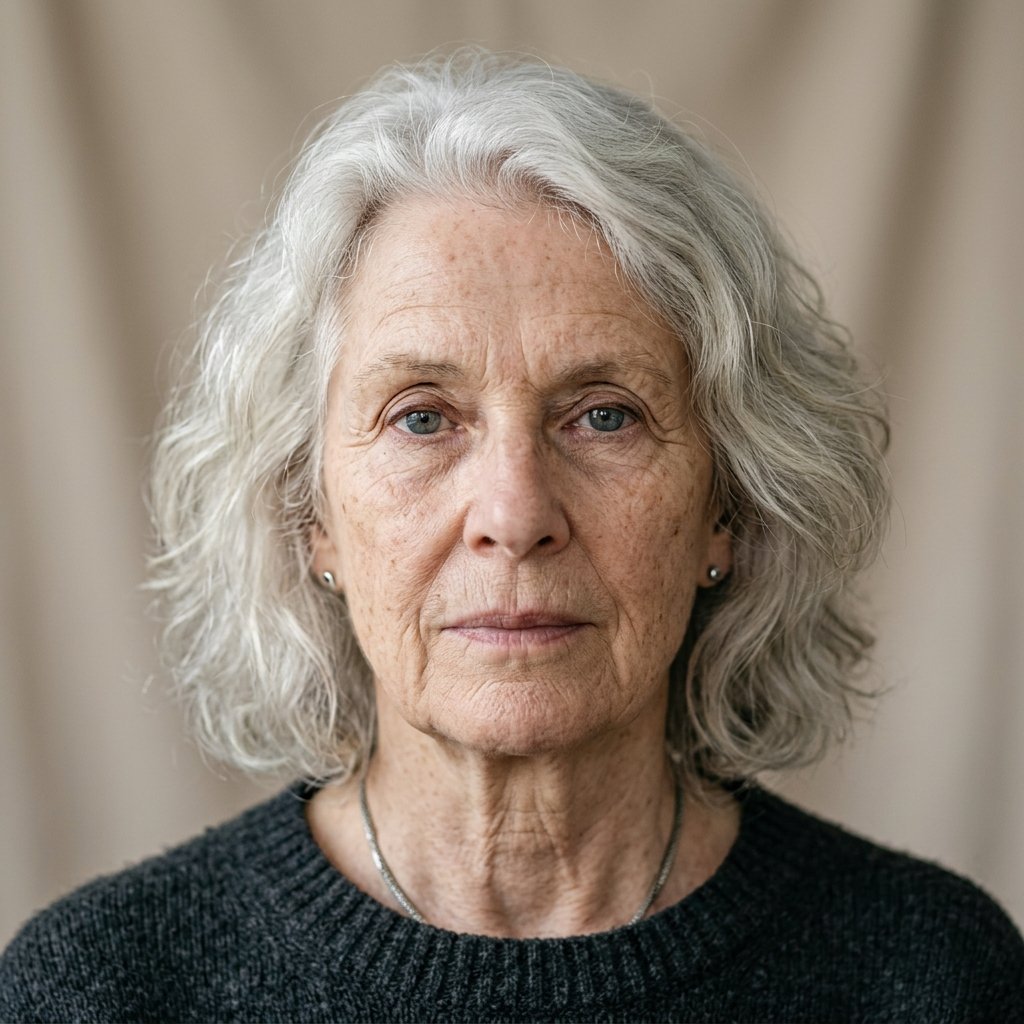
I buried my husband five years ago, but yesterday I watched him laugh at the baggage claim like death had never touched him.
For five years I brought white roses to a grave with his name on it.
Every Sunday I sat on the damp ground and told the cold granite how sorry I was.
I apologized for still being alive.
I apologized for the breakfasts I never made, the arguments I never won, and the future we lost.
Then, on a rain-bright Monday at Nashville International Airport, I saw Ethan Caldwell standing beside baggage claim.
He looked healthier than he had before the cancer supposedly hollowed him out.
His mother, Eleanor Caldwell, hugged him with both arms.
A beautiful woman in a cream coat handed him the wrist of a little boy who had Ethan’s gray eyes.
Ethan lifted the child, kissed the woman, and carried her suitcase toward the sliding doors like a man returning to the family he loved.
I stood behind a concrete pillar, unable to breathe.
My business-trip folder slid against my ribs as I raised my phone and took twelve photographs.
Ethan never looked my way.
I called Eleanor from the parking garage.
“I just saw Ethan,” I said.
Silence.
Then her voice turned gentle and poisonous.
“Abigail, grief can make people see what they need to see. You must have mistaken someone else for him.”
“He was holding a boy who has his eyes.”
“Go home. Rest.”
She disconnected.
I did neither.
I sat in the driver’s seat of my car with the rain tapping on the windshield and my whole body shaking.
For five years I had believed every lie.
For five years I had cried until my ribs hurt.
For five years I had apologized to a man who was not under that stone.
I sent the photographs to Diane Turner, the attorney who had helped save my logistics company after Ethan’s passing left me with unexplained debts.
Diane enlarged one image and said, “That is him. Don’t contact anyone again.”
Three days later, Diane called me at midnight.
“Abigail, the cemetery records for your husband’s burial were sealed by court order. The funeral home director was paid $200,000 to keep quiet.”
I gripped the phone.
“So the grave might not hold my husband.”
“It holds an empty coffin,” she said.
The next morning I drove to her office.
Diane spread photographs across her desk.
“The SUV in the background of one photo has a temporary parking permit. My investigator traced it.”
She slid a piece of paper toward me.
“The permit leads to a glass-and-stone house outside Brentwood owned by Cedar Ridge Holdings.”
I stared at the address.
“The company was formed three weeks after Ethan’s funeral,” Diane said.
“Its manager is Brianna Walsh, the woman from the airport.”
I felt the floor leave my body.
Brianna Walsh.
The name meant nothing to me.
But Ethan had clearly known her long enough to build a family with her.
Long enough to have a four-year-old son.
Long enough to fake his own death and leave me with the wreckage.
At dawn the next day, I parked across the street from the house.
It was a beautiful two-story home with floor-to-ceiling windows that reflected the gray morning light.
Ethan stood in the bright front garden.
He had one arm around Brianna.
Their little boy chased bubbles across the damp lawn, laughing in a way I had not heard in my own home for years.
Eleanor carried a glass pitcher of lemonade onto the terrace.
She moved like a woman without a single care in the world.
They looked effortless.
They looked prosperous.
They looked complete.
I sat in my car with my hands frozen on the steering wheel.
The home’s windows reflected a life financed by the insurance payment, the sale of our first house, and money that had vanished from my company during Ethan’s “illness.”
$2,500,000 from the insurance policy.
$410,000 from the sale of our home.
$300,000 drained from my business accounts over eighteen months.
All of it had built this perfect little world while I slept alone in a rented apartment and apologized to a gravestone.
I opened the car door.
My shoes pressed into the wet pavement.
Ethan glanced toward my car.
His smile disappeared.
It fell slowly, like a photograph sliding off a mantel.
Eleanor followed his stare.
The pitcher dropped from her hands.
Yellow lemonade splashed across the brick terrace in slow motion.
Glass shattered.
The little boy stopped chasing bubbles.
Brianna pulled him behind her coat.
I stepped onto the public sidewalk with my phone recording.
Ethan moved toward me.
His face had gone pale.
“Abigail,” he said.
His voice sounded exactly the same.
That same warm, familiar voice that had once promised to love me until death parted us.
I did not speak.
I just held up the phone.
He took another step.
Then Diane’s investigator pulled up between us.
The black car braked hard and the driver stepped out, broad-shouldered and calm.
“Not one step closer,” he warned.
Ethan froze.
I could see the muscles in his jaw tightening.
Eleanor stood on the terrace with lemonade dripping from her lavender cardigan.
Her mouth opened and closed like a fish pulled onto a dock.
Brianna whispered something to the boy and pressed his face into her coat.
For a long moment, the only sound was the wind moving through the maple trees.
Then Ethan spoke again.
“Let me explain.”
His words were so small.
Five years of lies, and that was what he offered.
“Let me explain.”
I said nothing.
The investigator raised his hand again.
“You’ll have your chance through legal counsel,” he said.
“Right now, you’ll stay back.”
Ethan looked at me with those gray eyes.
The same gray eyes I had seen in the face of his little boy at the airport.
Suddenly I understood something I had never allowed myself to believe.
I had not lost my husband to cancer.
I had lost him to a carefully planned escape.
The sickness, the hospital rooms, the whispered phone calls, the closed bedroom door.
All of it had been a stage.
And I had been the only audience member who did not know the play was ending.
I lowered the phone.
My hand shook so badly I almost dropped it.
“You let me grieve,” I whispered.
The words came out broken.
Ethan’s face crumbled.
“I never meant to hurt you,” he said.
I almost laughed.
“You let me stand in the rain over an empty coffin,” I said.
“You let me bring white roses to a box of dirt.”
Eleanor finally found her voice.
“Abigail, please,” she called from the terrace.
“We can settle this privately. We can make it right.”
I looked at her.
This was the same woman who had held my hand at the funeral.
The same woman who had told me God had a plan.
The same woman who had helped her son fake his death and then looked me in the eyes for five years.
“You told me I was confused,” I said.
Eleanor’s face twisted.
“I was trying to protect my son.”
“And what about me?” I asked.
No one answered.
The investigator stepped closer.
“Mrs. Hartley, we should go.”
I didn’t move.
I wanted to burn that house into my memory.
I wanted to remember every brick, every window, every blade of grass.
I wanted to remember the exact expression on Ethan’s face when he realized his secret had finally walked up his driveway.
Then I turned and got back into my car.
My hands found the steering wheel.
The investigator waited until I started the engine.
As I pulled away, I looked in the rearview mirror.
Ethan stood in the middle of the street, one hand reaching toward the back of my car.
Brianna was crying.
Eleanor knelt among the broken glass, trying to pick up the pieces of the pitcher.
The little boy waved at me.
A small, innocent wave.
He had no idea who I was.
He had no idea that his father had stolen my life to build his.
I drove straight to Diane’s office.
She was waiting at the door.
“I already filed the emergency petition,” she said.
“We have enough to freeze the insurance payout and the house sale records.”
I nodded.
My throat was too tight to speak.
“The district attorney will want to speak with you,” Diane said.
“Fraud, embezzlement, conspiracy. This will be a very long road.”
I sat down in her waiting room and stared at the carpet.
For five years I had asked God why He took my husband.
For five years I had begged for just one more day with him.
And now I understood.
God had given me one more day.
He had given me twelve photographs.
He had given me the truth.
And the truth was not that my husband had died.
The truth was that my husband had chosen to leave.
The grave had been the final lie in a long line of lies.
And for the first time in five years, I stopped apologizing for still being alive.
I sat in that chair and let the tears come.
Not tears of grief.
Tears of relief.
Because I finally knew the man I had married was never the man I thought he was.
And I was still here.
Still standing.
Still breathing.
Still alive.
If this story touched you, please like our page, share it with someone who believes in second chances, and follow us for more real life stories. Have you ever felt the ground disappear beneath your feet? Let us know in the comments.