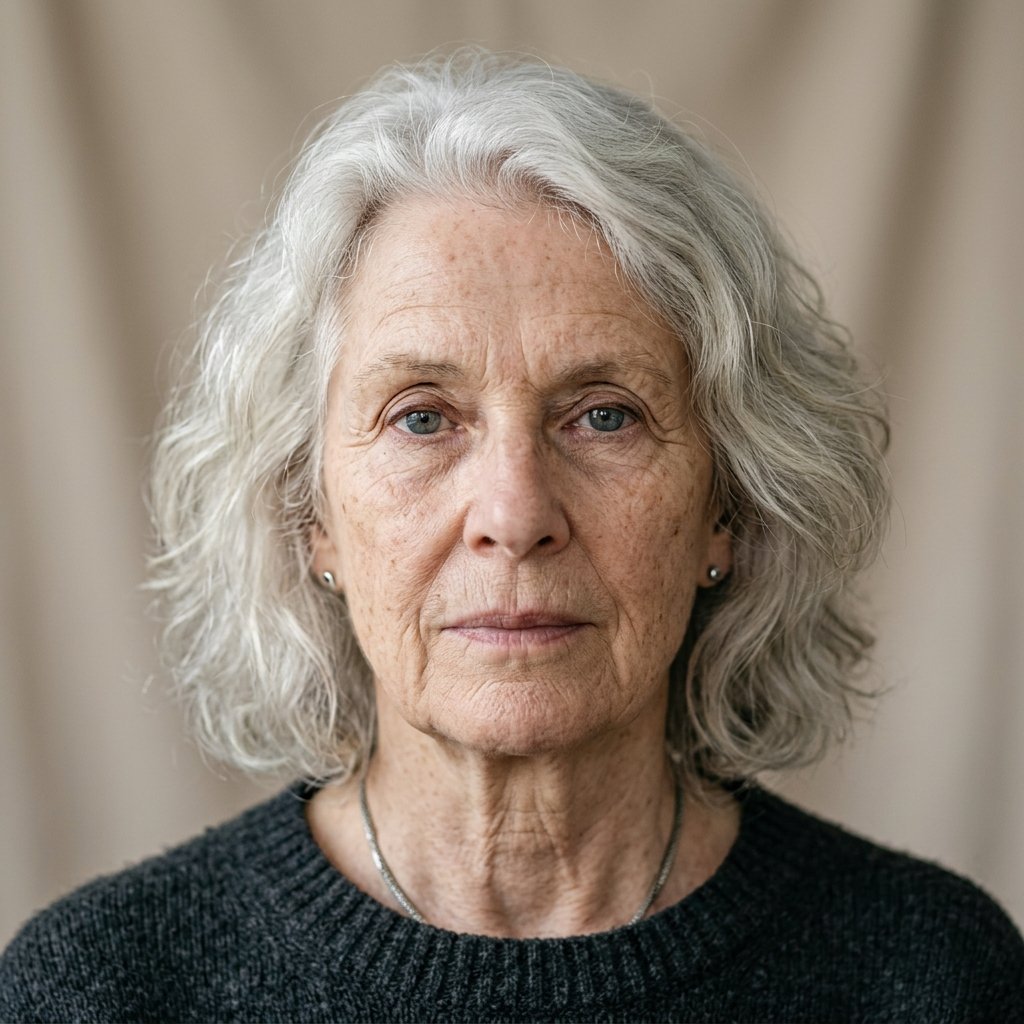
For eleven long winters, my mother wore the same faded brown coat. And I was too ashamed of her to ever ask why.
My name is Michael Reeves, and this is the story I spent thirty years too proud to tell.
My father passed away when I was seven years old. One cold January morning he simply did not wake up, and the whole world I knew went silent.
After that, it was just my mother, Eleanor, and me, in a small rented house on Maple Street in Millbrook, Ohio.
She was thirty-four then. Young, gentle, with tired eyes and hands that never stopped moving.
I remember the first night after the funeral. She sat at the kitchen table long after I pretended to sleep, counting coins from an old coffee tin.
I did not understand it then. I understand it now.
My mother took a job at Dolly’s Diner, working the early shift before the sun came up, and the late shift after most of the town had gone to bed.
In between, she took in sewing. Neighbors brought torn dresses, loose buttons, and worn-out hems, and she stitched them all by the light of a single lamp.
Her fingers were always pricked. Her back always ached. But she never once let me see her cry.
We did not have much. Some winters the heat clicked off because the bill came late, and she would pile every blanket in the house on my bed and sleep in her coat on the couch.
That brown coat. I can still see it. Frayed at the cuffs, one button replaced with a mismatched one, the collar worn soft from years of wear.
Other kids at school had new jackets every year. My mother wore that same coat until the seams could barely hold.
When I was fourteen, I asked her why she never bought herself anything nice. She just smiled and said, “Everything I have, I already spent on the best thing in my life. You.”
I was too young to understand what those words truly cost her.
When the acceptance letter from the university came, I ran into the diner screaming with joy. My mother dropped a tray of coffee cups and hugged me so tightly the whole place stopped to watch.
But college was expensive. Far more than a waitress and a seamstress could ever afford.
Somehow, the tuition was paid. Somehow, there was always enough. I never asked how. I was too busy dreaming about the future.
It was only years later that my aunt told me the truth. My mother had sold her wedding ring, the last thing she owned of my father, to pay my first semester.
When I once noticed it missing from her hand, she told me she had lost it while washing dishes. She lied to protect my pride.
I graduated with honors. I moved to Chicago. I became a lawyer at a firm with marble floors and a view of the whole skyline.
And somewhere along that shining road, I began to forget where I came from.
I met Vanessa at a company dinner. Her family had the kind of money I had only ever seen in magazines. Her father owned buildings. Her mother collected art.
I fell in love with her, but I also fell in love with the world she belonged to. A world without frayed coats and coffee tins and late heating bills.
Slowly, quietly, I started to feel embarrassed by my own mother.
When Vanessa asked about my family, I kept my answers short. I described a simple childhood. I never mentioned the diner. I never mentioned the sewing.
My mother came to visit us in the city only once. She wore her best dress, the gray one she pressed a dozen times, and she brought a jar of homemade peach preserves as a gift.
Vanessa’s mother thanked her politely and set the jar in a cabinet where it was never opened.
I watched my mother sit stiffly on that white leather couch, her worn hands folded in her lap, and instead of pride, I felt shame. God forgive me, I felt shame.
Then came my wedding day.
It was held at a grand estate outside the city, with three hundred guests and chandeliers that dripped like frozen rain.
My mother arrived early, in her gray dress and that same brown coat over her shoulders because the evening air was cool.
She did not know anyone. She stood quietly near the edge of the room, trying not to be in the way.
And then it happened. The moment I would give anything to take back.
One of Vanessa’s wealthy relatives, a man in an expensive suit, leaned toward me and asked, “Michael, who is that older woman in the plain dress by the door?”
My heart pounded. Everyone was watching. And I said the words that still burn me to this very day.
“Oh, that’s just a family friend.”
My own mother heard me. I know she did, because I saw her face for one brief second.
She did not gasp. She did not cry. She simply gave a small, gentle smile, picked up a stray plate from a nearby table, and quietly carried it to the kitchen as if she belonged among the staff.
That night, she left before the cake was cut. She kissed my cheek, told me she was proud of me, and took the last bus back to Millbrook alone.
I told myself I would call her the next week. I told myself she understood.
Weeks turned into months. Months turned into years.
I buried myself in cases and clients and the endless climb. I sent money on her birthday but never went home. I let the distance grow because the distance was easier than the guilt.
My daughter, Grace, was born four years later. My mother sent a hand-knitted blanket with a note that said, “For my grandchild, from a grandmother who loves her already.”
Vanessa thought the blanket was old-fashioned. I quietly folded it away in a closet.
And still, my mother never complained. Every letter she wrote ended the same way. “I am proud of you, and I love you always.”
Then one gray afternoon, everything changed.
My firm had donated to a community foundation, and I was asked to attend a charity gala honoring, as the invitation put it, “a lifetime of quiet service to others.”
I almost skipped it. But it looked good for the partners, so I put on my finest suit and went.
The ballroom was full of important people. I sat near the front, checking my watch, thinking of the deals waiting on my desk.
Then the host stepped to the microphone and said the foundation was proud to honor a woman whose kindness had touched more lives than anyone could count.
And he read her name aloud. Eleanor Reeves.
My heart stopped beating. The glass slipped in my hand.
From the side of the stage, an usher gently guided a small woman into the light. She wore a simple gray dress. And over her shoulders, that same faded brown coat.
It was my mother.
I could not move. I could not breathe. I just stared as three hundred strangers began to applaud the woman I had once called a family friend.
Then a young woman in a doctor’s white coat walked to the microphone, tears already shining in her eyes.
“Twenty years ago,” she began, “I was a homeless teenager who used to sit in the corner booth at a diner in Millbrook because it was warm.”
“A waitress there noticed me. She fed me every day and never once charged me. When she learned I had no family, she paid for my school books out of her own tips.”
“She told me I was worth saving. And when I said I wanted to be a doctor, she said, then be one, and do not let anyone make you feel small.”
The young doctor’s voice broke.
“That waitress had almost nothing. But she gave everything she had, to strangers, to neighbors, and to a son she never stopped loving, even when he forgot her.”
The whole room rose to its feet.
And I sat frozen in the dark, tears pouring down a face I could no longer hold still, watching my mother stand humbly in her worn coat while the world honored her greatness.
All those years, while I climbed toward a life that made me ashamed of her, she had been quietly building something far greater than money. She had been building souls.
When the ceremony ended, I pushed through the crowd like a drowning man. I found her near the door, that jar of peach preserves suddenly clear in my memory, that lie about the wedding ring, that plate she carried into the kitchen.
I dropped to my knees in front of my seventy-year-old mother, in front of everyone, and I could barely speak.
“Mom,” I sobbed. “I am so sorry. I called you a family friend. I forgot you. I was ashamed of the only person who ever gave me everything. Please. Please forgive me.”
She did not scold me. She did not remind me of a single wound I had given her.
She reached down and cupped my face in her worn hands, just like she did the morning my father died, and she whispered, “There is nothing to forgive, sweetheart. A mother’s love was never a debt.”
And then she said the words that broke me completely.
“I never needed you to be proud of me. I only ever needed you to be happy. Are you happy, my boy?”
I wept in her arms like the seven-year-old I once was.
That night, I brought her home with me. Not to a closet. Not to the edge of a room. To the center of my life, where she should have always been.
Vanessa, to her credit, wept too when she heard the whole story, and something changed in our home after that.
We cleared out the sunniest bedroom for my mother. We hung her old photographs on the wall. We put the peach preserves right on the breakfast table.
And that hand-knitted blanket I had once hidden away now lies across my daughter’s bed every single night.
My mother lives with us still. She has a garden full of tomatoes and marigolds, a rocking chair on the porch, and a granddaughter who follows her everywhere.
Grace calls her the bravest woman alive. She is not wrong.
Sometimes in the evening I watch them from the window, the old woman and the little girl, snapping green beans and laughing at nothing, and my throat tightens with a gratitude I do not deserve.
My mother wore that faded brown coat for eleven winters so that I would never feel the cold.
She sold her wedding ring so that I could chase a dream. She smiled through the cruelest words a son ever spoke, and she loved me anyway.
And now, after a lifetime of giving everything to everyone, she is finally the one being cared for. She is finally warm. She is finally home.
After all those years of quiet sacrifice, my mother is finally, truly happy.
And I have learned the lesson too late and just in time all at once. The people who love us the most rarely wear the finest coats. But their love is the warmest thing this world will ever hold.
If you still have your mother, do not wait for a gala to see her greatness. Go to her today. Sit with her. Thank her while she can still hear you.
Because one day, that faded brown coat will hang empty by the door, and you will give anything for one more chance to say the words I almost never got to say.