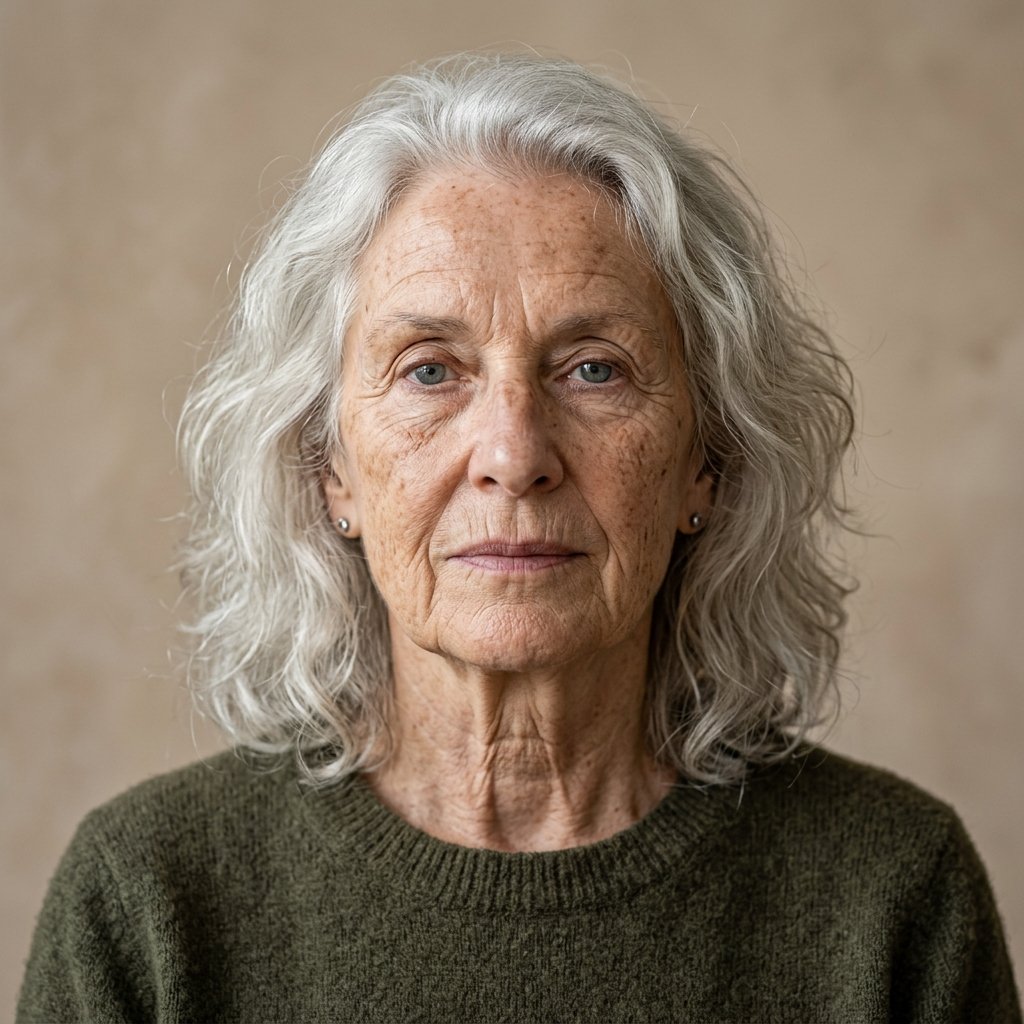
The day I became a bride was supposed to be the most beautiful day of my life.
It was August in Gracehill, Vermont, and the morning sun streamed through my bedroom window like a promise.
I sat at my vanity, staring at my reflection, my heart fluttering between joy and dread.
Because beneath the delicate lace of my veil, beneath the carefully pinned, honey-blonde wig I’d worn for the past six months, I was bald.
Completely, utterly bald.
That truth was the quiet aftershock of a battle I had never imagined I’d fight.
Two years earlier, I had been an ordinary thirty-four-year-old woman with an ordinary life— a librarian at the downtown Maplewood Public Library, a cozy rental apartment on Elm Street, and a quiet but deeply tender love with a carpenter named William Harrington.
William had hands that could build anything and a heart that could mend anything.
We had known each other since our Sunday school days at St. Mark’s Episcopal Church, though love didn’t bloom until much later.
Then came the doctor’s appointment that shattered my world.
I remember the sterile smell of the examination room, the fluorescent lights buzzing overhead, and the way the young physician, Dr. Helen Carter, paused a moment too long as she looked at my test results.
“Eleanor,” she had said gently, taking my hand, “I’m so sorry to tell you this, but you have stage three lymphoma.”
I heard the words, but for a long moment they didn’t make sense.
Lymphoma.
Cancer.
I had just celebrated my thirty-second birthday.
I had no family history, no warnings, no preparation.
I remember William driving me home that afternoon, his knuckles white on the steering wheel, the radio playing a sad ballad neither of us could bear to turn off.
That night, he held me as I sobbed until my throat was raw.
He didn’t say, “It’s going to be fine.”
He said, “Whatever comes, I will be here. Every single minute. I swear on my life.”
The months that followed blurred into a haze of hospital corridors, surgical masks, and the chemical cold of chemotherapy dripping into my veins.
My treatment was at the University of Vermont Medical Center in Burlington, a two-hour drive from our little town that William made three times a week without complaint.
I lost weight.
I lost energy.
And one dreadful morning, as I brushed what remained of my long auburn hair, clumps of it fell into the sink like autumn leaves in a cruel wind.
By the end of the week, my head was bare.
I locked myself in the bathroom and wouldn’t come out.
William sat on the floor on the other side of the door.
“Let me in, Eleanor,” he pleaded. “Please, sweetheart. It’s just hair. You are still you.”
“You don’t understand!” I shouted back, my voice cracking. “I look like a stranger. How can you love a woman who looks like this?”
“I don’t love your hair,” he said softly through the door. “I love your soul. And your soul has never been more beautiful to me than it is right now, fighting this thing. Now please, unlock this door.”
Eventually I did.
And when he saw me, he didn’t flinch.
He simply walked forward, placed his hands on my cheeks, and kissed my forehead with such reverence that I cried for an entirely new reason.
Miraculously, after fourteen months of treatment, the cancer went into remission.
The day Dr. Carter spoke those golden words—“You’re cured, Eleanor, the scans are clear”—I felt as if I had been reborn.
The birds outside the hospital window sang a symphony.
The sunlight felt different on my skin.
William drove me straight from the hospital to a little park overlooking Lake Champlain.
We stood by the water, the sunset painting the sky in shades of rose and gold, and he knelt down on one knee in the grass.
“I wanted to do this the moment you were free,” he whispered, his voice thick with emotion. “I’ve loved you since I was twelve years old, Eleanor. I loved you through the sickness, and I will love you through everything that comes after. Will you make me the happiest man in all of Vermont and marry me?”
I dropped to my knees right there on the grass and threw my arms around his neck.
“Yes!” I sobbed. “A thousand times yes!”
We began planning the wedding with a passion that felt like life itself returning to me.
I spent weeks searching for the perfect dress, finally finding a vintage-inspired ivory gown at a little boutique in Woodstock. It had delicate pearl beading and a flowing skirt that made me feel, for the first time since my diagnosis, like a fairy-tale princess.
But the issue of my hair hung over every fitting like a storm cloud.
I kept hoping, praying that some of my hair would regrow in time for the ceremony.
It didn’t.
Every morning I looked in the mirror and saw the same smooth, pale scalp, with only the faintest wisps of new growth that looked like baby duck fluff.
So I went to a specialist in Burlington who crafted wigs for cancer survivors.
Her name was Miriam, a kind Jewish woman in her seventies who had worked with hundreds of women like me.
She took my measurements, studied old photographs of me before the illness, and created a wig so natural that even my mother couldn’t tell it wasn’t my own hair.
It was the exact shade of auburn I’d once had, with gentle waves that caught the light perfectly.
Wearing it, I felt like myself again.
Like the Eleanor I had been before the diagnosis.
“You’re going to be a stunning bride,” Miriam said, patting my hand. “And remember, darling, beauty isn’t what’s on your head. It’s what’s in your heart.”
I tried to believe that.
But the one person who made it nearly impossible was my future mother-in-law, Patricia Harrington.
From the very beginning, Mrs. Harrington had been distant, polite but cold, her eyes evaluating me as if I were a piece of furniture she had not ordered for her living room.
She was a woman of old New England money, the kind who wore pearls to grocery store runs and had a family portrait hanging above the stone fireplace in their sprawling colonial house on Harrington Lane.
William was her only son, the center of her universe, and in her eyes, no woman was good enough for him.
Especially not one who had been ill.
I learned early on that Patricia had been whispering concerns to William for months.
“She’s been through so much, dear. Are you sure she can give you children? Are you certain she’s strong enough to be a proper wife? You don’t want to spend your life as a caretaker, do you?”
William had told me about these conversations, his jaw tight with anger.
“I’ve told her to stop, Eleanor,” he said. “I’ve told her that you are the only woman I will ever love, and if she can’t accept that, she won’t be welcome at the wedding.”
I didn’t want to be the cause of a rift between mother and son, so I tried to be gracious.
I invited Patricia to the dress fittings (she claimed she was busy).
I sent her a beautiful invitation with a handwritten note (she never replied).
I even called her one evening to ask her opinion on the floral arrangements.
Her voice on the phone was cold as winter granite.
“I’m sure whatever you choose will be fine, Eleanor. Just remember, the wedding is one day. Marriage is forever.”
The implication was clear: my forever might not be as long as William’s.
And unbeknownst to me, Patricia had been doing some digging.
She’d somehow found out about the full extent of my illness, that I had lost my hair, that I was wearing a wig.
A friend of a friend of a friend who worked at the medical center had let something slip, and Patricia, with her network of gossip, had pieced it all together.
She never confronted me directly.
She simply nursed her resentment, polishing it like a precious stone, waiting for the perfect moment to reveal what she saw as my greatest shame.
The night before the wedding, I barely slept.
I sat on the edge of the bed in my childhood bedroom at my parents’ little farmhouse just outside of town, the very room where I’d dreamed of this day since I was a little girl.
My mother, a gentle, gray-haired woman named Doris, came in and sat beside me.
“You’re trembling, sweetheart,” she said, taking my hand.
“I’m terrified, Mom,” I admitted. “What if people can tell? What if my wig shifts? What if someone laughs?”
She held me close.
“Then you hold your head high, my girl. You’ve faced cancer and won. Nothing can shame you unless you let it.”
I nodded, but deep inside, the fear clung to my heart like a shadow.
The morning of August 19th dawned bright and clear.
The ceremony was to be held at St. Mark’s Episcopal Church, the same little white clapboard church where William’s parents had married and where his grandparents rested in the cemetery out back.
The sanctuary was filled with white roses and baby’s breath, the pews draped with satin ribbons.
Guests began arriving in their Sunday best—neighbors, library patrons, William’s carpenter colleagues, and Patricia’s high-society friends from the country club.
I stood in the vestibule, hidden behind a wooden screen, my bridesmaids fluttering around me like a flock of pastel butterflies.
My best friend since college, Rebecca, adjusted my veil with trembling fingers.
“You look like an angel,” she whispered.
Through the open doors, I could hear the organ playing “Jesu, Joy of Man’s Desiring,” and I saw William waiting at the altar, tall and handsome in his charcoal gray suit, his sandy hair neatly combed.
Our eyes met, and he smiled at me—that same smile that had held me up through the darkest moments of my life.
I began my walk down the aisle, my father’s arm linked in mine, my heart a drumbeat of pure joy.
The guests turned, their faces soft with admiration.
Then, out of the corner of my eye, I saw Patricia.
She was seated in the very front pew, wearing a navy blue silk dress and a string of ivory pearls, her silver hair coiffed perfectly.
But her eyes were not filled with happiness.
They were burning with a strange, triumphant light.
I felt a chill, but I pushed it away and kept walking, my gaze fixed on William.
I reached the altar.
William took my hands, his grip warm and steady.
Reverend McAllister, a kindly old pastor who had known us since we were children, began the ceremony with a gentle smile.
“Dearly beloved, we are gathered here today to witness the union of two souls…”
Everything was perfection.
The candles flickered.
The stained-glass windows painted the floor in pools of jewel-toned light.
And then, without warning, in the middle of the reverend’s prayer, I heard the click of heels on marble.
I turned slightly, and there was Patricia, walking slowly up the steps of the altar with a look on her face that stopped my breath.
Reverend McAllister hesitated. “Mrs. Harrington, is everything all right?”
She ignored him.
She walked straight to me, her eyes blazing with a cocktail of contempt and victory.
And then, in one swift, violent motion, she reached up and yanked the wig from my head.
The pins that had held it in place scraped my scalp.
I gasped, my hands flying up to cover my bare head, but it was too late.
The wig dangled from Patricia’s fist like a hunting trophy.
“See!” she shouted, her voice ringing through the silent church. “See! She’s bald! I told you all, and no one believed me! My son is marrying a sick, broken woman who can’t even keep her hair!”
A wave of gasps swept through the congregation.
Some people turned away in shock.
Others simply stared, their mouths hanging open like landed fish.
And a few—Patricia’s cronies from the country club—let out snorts of derisive laughter.
The sound of it felt like a thousand tiny knives slicing into my soul.
I stood there, paralyzed, my hands pressed to my scalp, my veil askew, tears streaming down my face in hot, humiliated rivers.
Every inch of my body wanted to disappear, to dissolve into the floorboards and cease to exist.
William moved instantly, wrapping his arms around me, pulling me against his chest.
His heart was pounding so hard I could feel it through his jacket.
“Mother, what have you done?” he said, his voice low and trembling with a rage I had never heard in him before.
“I’ve exposed the truth!” Patricia declared, still holding the wig aloft. “You deserve a healthy wife, William, and instead you’re tying yourself to this—this fragile thing who could get sick again at any moment!”
Reverend McAllister was so stunned he couldn’t speak.
My father was rising from the pew, his face purple with anger.
My mother was weeping.
But then, something remarkable started to happen.
It began with Rebecca.
She stepped forward from the line of bridesmaids, her chin raised, her eyes blazing.
She reached up, took hold of her own elaborate blonde chignon, and with two deft movements, removed it.
Beneath was a shaved head, smooth and bare.
The congregation gasped anew.
Then Sarah, my college roommate, stepped forward and did the same.
Her dark wig fell away, revealing a bald scalp that gleamed in the candlelight.
Then Emily, my sister-in-law, removed her chestnut updo, showing a completely bare head.
One by one, all five of my bridesmaids reached up and uncovered the secret they had been carrying.
Every single one of them was bald.
They had, in the two weeks before the wedding, gone together to a salon and shaved their heads in solidarity with me, wearing wigs so the secret wouldn’t be revealed until the right moment.
Rebecca’s voice rang out, clear and strong.
“She’s not ashamed, Mrs. Harrington. We’re not ashamed. Eleanor is a warrior who beat cancer, and we are honored to stand beside her like this.”
The church had gone completely, utterly silent.
Patricia’s triumphant expression began to crumble, the wig still dangling from her fingers, her jaw working soundlessly.
And then came the moment that I will remember until my dying breath.
William gently released me, turned to face his mother, and reached up to his own head.
He had been wearing a handsome fedora, which he now slowly removed.
Underneath, his own sandy hair was completely gone—shaved to the skin, just like mine.
“You wanted to shame the woman I love,” he said, his voice carrying to every corner of the sanctuary. “But you can’t shame someone who is surrounded by unconditional love. I shaved my head the morning of our wedding to match Eleanor. To show her that it doesn’t matter. To show the world that beauty has nothing to do with hair, and everything to do with heart.”
He turned to me, tears glistening in his eyes, and he knelt down.
“Eleanor, I told you I would love you through everything. I meant it. You are the most beautiful woman in this room because your soul has been tested by fire and come out pure gold. I will spend the rest of my life making sure you never feel shame again.”
I couldn’t speak.
I was sobbing so hard I could barely breathe, but they were no longer tears of humiliation.
They were tears of overwhelming, breathtaking grace.
I looked at Patricia.
Her face had gone pale as the altar cloth.
The wig slipped from her fingers and fell to the floor like a discarded rag.
Her lips were moving, but no sound came out.
Then, before everyone, she sank to her knees right there on the marble steps, her navy silk dress pooling around her like a dark stain.
“I am so sorry,” she whispered, her voice cracked and broken. “Oh, dear God, what have I done? I am so, so sorry.”
She looked up at me, and I saw that the arrogance was completely gone, replaced by a raw, desperate anguish.
“I was so afraid for my son,” she sobbed. “I thought I was protecting him. But I was the one who needed protecting from my own hard heart. Please, Eleanor, forgive me. I don’t deserve it, but please…”
The congregation remained frozen, watching this utterly unexpected transformation.
I walked forward slowly, my bare head held high now, my tears still flowing.
I knelt down in front of my mother-in-law and took her trembling hands in mine.
I could see my reflection in her eyes, and for the first time, I saw not a victim, not a sick woman, not a shameful secret—but a survivor, radiant and strong.
“I forgive you, Patricia,” I said quietly, and meant it with every fiber of my being. “It’s in the past. Let’s start new, right here, right now.”
She collapsed into my arms, weeping with a grief that shook her whole body.
And then, something magical happened.
The congregation began to applaud.
It started softly, a few scattered claps, and then grew into a standing ovation that thundered through the little wooden church.
People were crying.
People were hugging.
Even Patricia’s country club friends, who had laughed minutes earlier, were now on their feet with tears streaming down their powdered cheeks.
Reverend McAllister wiped his own eyes and cleared his throat.
“Well,” he said, with a tremulous smile, “it seems we’ve already witnessed a miracle before the vows have even been spoken. Shall we continue?”
William helped his mother to her feet and gently guided her back to her seat.
Then he came to me, took both my hands, and walked me back to the altar.
And there, bathed in the colored light of the stained-glass windows, with my bald head shining for all the world to see, I married the man who had loved me when I had nothing—not even hair.
The rest of the ceremony was a blur of tears and laughter.
When the reverend pronounced us husband and wife, William kissed me with such tenderness and passion that I forgot there was anyone else in the room.
As we walked back down the aisle together, my bridesmaids—bald and beautiful—followed us, their faces luminous with joy.
At the reception in the church hall, Patricia approached me again, her eyes red-rimmed.
“I know I don’t have the right to ask,” she said, her voice still shaky, “but I would like very much to be a part of your lives. To be a real mother to you, Eleanor, if you’ll have me.”
I hugged her without hesitation.
“We all make mistakes, Patricia. What matters is what we do after.”
She nodded, and from that day forward, she was a different woman.
It took time, of course.
Trust must be rebuilt brick by brick.
But she showed up for every milestone—anniversaries, family dinners, the adoption of our two beautiful children a few years later—with a humility and a grace that amazed everyone who had known the old Patricia.
She became my fiercest defender, my dearest confidante, and the proud grandmother who would tell anyone who’d listen that her daughter-in-law was the bravest woman on earth.
Looking back on that day, I realize that the moment my wig was snatched away was actually the moment I was given the greatest gift: the chance to see love in its purest form.
William and my friends showed me that true belonging isn’t about hiding our vulnerabilities—it’s about finding those brave enough to stand with us in our most exposed moments.
And Patricia, in her shocking act of cruelty, accidentally gave us all the opportunity to witness a transformation of the human heart.
I am now sixty-seven years old, and my hair eventually grew back, soft and silver, though I often choose to wear it short as a reminder of my journey.
William’s hair returned too, and we tease each other about the “bald and beautiful” years.
Every August 19th, on our anniversary, we revisit St. Mark’s, and I walk down the aisle again in my memory, feeling the sun on my bare head and the love in my heart.
If you enjoyed this story, please take a moment to ‘Like’ our page, ‘Follow’ us for more heartfelt tales, and ‘Share’ this with someone who might need a reminder that true beauty lies not in what we see in the mirror, but in the love that surrounds us when we are most vulnerable. May your day be filled with unexpected grace.
