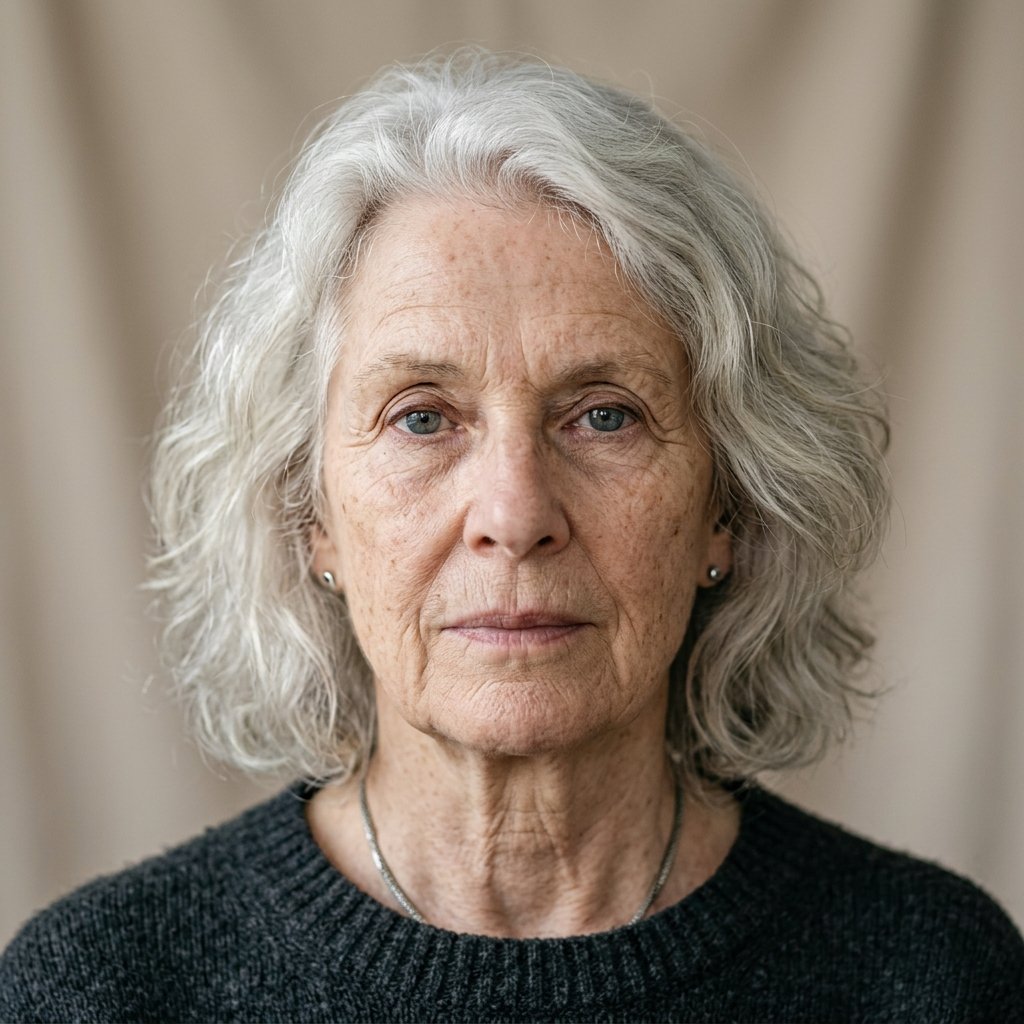
For thirty-one years, my mother wore a thin band of dull tin on her wedding finger, and not a single one of us ever thought to ask her why.
We were too young, and later too busy, to notice that the small gold ring she once treasured had quietly vanished the very winter our father was laid to rest.
My name is Rebecca, and I am the youngest of Margaret Ellison’s three children. We grew up in a narrow rented house on Willow Street, in Cedar Falls, Iowa, with a furnace that groaned all night and a roof that leaked into an old coffee can every spring.
My father, Thomas, passed away when I was only six years old. One ordinary morning he kissed my forehead, told me to be good, and went to work at the grain mill. By evening, the whole shape of our lives had changed forever.
I still remember the neighbors filling our kitchen with casseroles and hushed voices. I remember my mother standing at the sink long after everyone had gone home, her shoulders shaking, trying to cry quietly so the three of us wouldn’t hear.
She was thirty-four years old. Suddenly alone, with three children, a drawer full of unpaid bills, and a heart that had just been broken clean in two.
But here is the thing about my mother that I did not understand until far too late in my life. She never once let us see her surrender.
The morning after the funeral, she pinned up her hair, put on her steadiest face, and went looking for work. By the end of that week she had three jobs.
Before the sun came up, she cleaned the big houses on the north side of town. In the afternoons she waited tables at the diner on Main Street. And late into the night, under a single lamp, she took in sewing, stitching hems and wedding gowns until her fingers cramped into claws.
We did not have much. Our clothes came from church boxes and yard sales. Our shoes were passed from my brother to my sister to me until the soles wore paper thin.
But we were never once made to feel poor. My mother had a gift for turning nothing into something warm.
A can of beans and a bag of rice became a feast when she told us stories over it. A power outage became an adventure by candlelight. A hand-me-down dress became a princess gown because she said so, and we believed her.
There were nights, though, when she would set three plates on the table and none for herself. She would tell us, with that gentle smile, that she simply “wasn’t very hungry tonight.”
I believed her for years. I do not believe her anymore. I know now exactly what she was doing, and the memory of it breaks something inside my chest.
When my brother Daniel turned seventeen and got into the state university, there was no money for his books. Not a dollar to spare.
And yet, somehow, the money appeared. Daniel packed his bags and left for college, and I was too young to notice what had gone missing.
It was Grace, my older sister, who saw it first. One evening she caught our mother’s bare left hand under the kitchen light and asked, softly, where her wedding ring had gone.
Mother just smiled and said the tin one fit better now that her fingers had thinned. She had sold the gold band my father slipped on her hand at the altar, and she used every cent to buy her son a future.
Winter after winter, she wore the same threadbare coat so that Grace could have a warm one for school. Summer after summer, she went without so that we would never have to.
And we grew. We grew tall and strong and bright, on the fuel of her endless quiet sacrifice.
Then, one by one, we left. Daniel became a surgeon out in Denver, Colorado. Grace built a respected law practice in the heart of Chicago. And I became a schoolteacher two towns over.
I am ashamed to admit what happened next, because it is the part of my story I like least. We got busy. We got comfortable. We forgot.
The phone calls grew shorter. The visits grew rarer. We told ourselves that our mother was fine, that she was strong, that she had always been strong.
We let years slip by while she grew old alone in that same little house on Willow Street. The same groaning furnace. The same leaking roof. The same dull tin band on her finger.
We sent checks she never cashed. We mailed gifts she set on the shelf, still wrapped, saying she was saving them for a special day. The special day, I realize now, was simply the day one of us might come home.
It was Daniel who finally woke us up. He called Grace and me one night, and his voice cracked in a way I had never heard from my composed older brother.
“Do you remember her ring?” he asked us. “The gold one? She sold it for my books. And I never even said thank you.”
None of us had. In thirty-one years, not one of us had ever thanked her for the thousand things she gave up in silence.
So we made a plan. Her seventieth birthday was coming, and for the first time in more years than I care to count, all three of her children would come home together.
Daniel, though, had a secret of his own. For nearly two years he had been quietly searching. He drove to pawn shops and estate sales and antique dealers across three states, describing a small gold band engraved with two initials, T and M.
Everyone told him it was impossible. A ring sold three decades ago could be anywhere, melted down, gone forever. But my brother did not give up, because our mother had never given up on us.
And then, in a dusty little shop in a town none of us had ever heard of, a man reached under his counter and set a small gold ring on the glass. Inside the band were two letters, worn but still clear. T and M. Thomas and Margaret.
Daniel paid the man without a word and drove home with the ring pressed to his heart the entire way.
The day of the party, we gathered in her small living room. She had baked, of course, insisting on serving us as though we were still children, still hungry, still hers to feed.
We let her fuss. And then Daniel asked her to sit down.
He knelt in front of her chair, this grown man, this respected surgeon, and he placed a small velvet box in her weathered hands.
Her fingers trembled as she opened it. When she saw what lay inside, every bit of breath seemed to leave her body.
“You gave up everything,” Daniel whispered, his own tears falling freely now, “so that the three of us could become something. We just wanted to give you back the one thing you loved the most.”
She lifted the gold ring from the box and turned it in the light, reading the initials she had traced with her thumb ten thousand times before she sold it. She could not speak. She simply pressed it to her lips.
Then Grace stepped forward and laid a folded document in her lap. It was the deed to the house on Willow Street, purchased outright, paid in full, hers to keep for the rest of her days. No more rent. No more landlord. No more fear.
“You always gave us a home,” Grace said. “Now this one is truly yours.”
I had nothing so grand to offer. All I had was my voice, so I knelt beside my brother and finally said the words that were three decades overdue.
“Thank you, Mama. For every meal you skipped. For every winter you were cold. For the ring you sold and never mentioned. We saw. We finally see. And we love you more than we ever knew how to say.”
My mother wept then, the way she had wept at that kitchen sink the night our father died. The same trembling shoulders. The same quiet, private grief and joy all tangled together.
But this time, there was one enormous difference. This time, she was not alone. This time, three pairs of arms wrapped around her all at once.
She slid the gold ring back onto her finger, right beside the dull tin band she had worn for thirty-one faithful years. And she chose to keep them both.
“The tin one carried me through the hard years,” she said, smiling through her tears. “I could never throw it away. It reminds me of everything we survived together.”
We sat with her long into that night, listening to stories she had never told us. The nights she prayed. The days she was afraid. The endless, invisible price she paid so that her children could fly.
I drove home the next morning changed all the way down to my bones. I had spent my whole life believing my mother was simply strong. I never understood that her strength was really just love, worn thin and given away, one silent sacrifice at a time.
So now I visit every single week. I hold her hand. I ask her the questions I was always too busy to ask before, and I write down every answer.
Because I have learned the one lesson that matters most. Love is never measured by what we take from the people who raise us.
It is measured by what they quietly gave up for us, and never once asked us to notice.