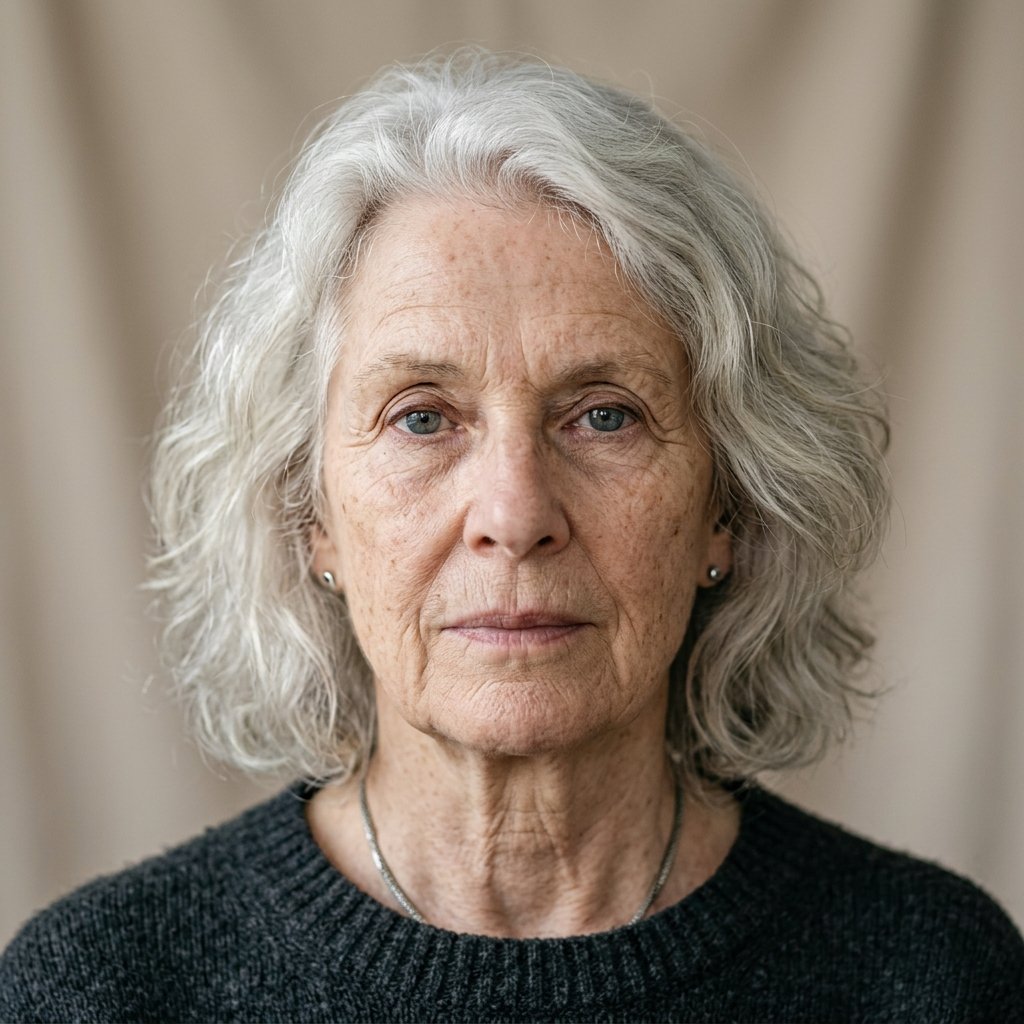
I have been blind since birth, but I did not need eyes to know that my own father hated me.
That is not something a child should ever have to feel, but I felt it every single day of my life under his roof.
My name is Eleanor Whittaker. I was born in a small, forgotten town called Cedar Creek, West Virginia, a place full of whispering neighbors and long, judgmental stares.
My mother passed away when I was only five years old. I remember the sound of her voice, the softness of her hands on my cheeks, and the way she used to tell me that I was her most precious gift.
After she died, something inside my father, Harold Whittaker, turned cold and hard like the winter ground.
He looked at me and saw only a burden. A shameful secret to be hidden behind closed doors.
My two older sisters, Margaret and Patricia, were blessed with lovely faces and bright, sparkling eyes. Everyone admired them.
But I was the blind one, the broken one. And in my father’s eyes, I was not even a daughter.
He never once called me by my name.
He only called me “that thing.”
When guests visited, I was shoved into a back room and told not to make a sound.
At mealtimes, I was not allowed to sit at the table with the family. I ate alone in the dark, my fingers finding my food like an animal.
I never understood why love had to be conditional on something I could not control.
But I learned to live with it, because what other choice did I have?
Time passed in that house like slow, dripping water. I grew older, but my father’s resentment only deepened.
My sisters would walk past me in the hallway and giggle, their footsteps light and careless. They whispered about suitors and parties and new dresses, things I could only imagine.
I spent my days in my small room, running my fingers over the pages of an old braille book. It was the only friend I had.
One morning, when I was twenty-one years old, my father entered my room without knocking.
I heard the heavy thud of his boots on the wooden floor. He stopped just a few feet from me.
Then he threw something into my lap. It was a folded piece of cloth, rough like a burlap sack.
“You’re getting married tomorrow,” he said without a single trace of emotion.
I froze. My breath caught in my throat.
The words made no sense at all. Married? To whom? I had never even been allowed to speak to a man outside my family.
“A beggar from the church steps,” my father added, his voice flat and final.
“You’re blind. He’s poor. You’re perfect for each other.”
I felt the blood drain from my face. My hands trembled in my lap.
I wanted to scream, but no words came out. The room spun around me, even though I could not see it.
I had no choice. My father had never given me a choice, not once in my entire life.
The next day, they married us in a small, rushed ceremony.
Of course, I did not see the man’s face, and no one dared describe him to me. I only knew that his hands were warm and calloused, and his voice was deep and soft.
My father shoved me toward him and told me to take his arm.
I obeyed, like a ghost inside my own body. I moved without feeling, without will.
People laughed behind their hands. I could hear their muffled snickers echoing off the walls.
“The blind girl and the beggar,” they whispered. “What a perfect match.”
After the wedding, my father handed me a small bag with a few old clothes and pushed me toward the man again.
“She’s your problem now,” he said, turning away without looking back.
I never heard his footsteps fade so quickly. I never felt so completely abandoned.
The beggar, whose name was Joseph, guided me silently down the road.
He did not speak for a long while. I only felt his arm steady beneath my hand, his pace slow and patient, as if he were afraid I might stumble.
We walked for what felt like an eternity. The air changed from the dusty smell of town to something cleaner, wilder.
Finally, we stopped. I heard the creak of an old wooden door.
“We’re here,” he said softly.
We entered a small, dilapidated hut on the edge of town. It smelled of damp earth and wood smoke.
The floor was uneven beneath my feet, and the roof creaked in the wind.
“It’s not luxurious,” he said, his voice almost apologetic, “but you’ll be safe here.”
I sat down on an old woven mat in the corner, holding back tears with every ounce of strength I had.
That was now my fate: a blind woman married to a beggar, in a hut made of mud, wood, and hope.
But something strange happened from that very first night.
Joseph prepared tea for me with gentle hands. I heard the clink of the tin cup, the soft whistle of the kettle, the careful pour.
He placed the warm cup in my hands and sat down across from me.
“Are you cold?” he asked.
I shook my head, though I was freezing.
He must have seen through my lie, because a moment later, he draped his own blanket over my shoulders.
“I’ll sleep by the door,” he said. “Just to be safe.”
He slept there like a guard dog watching over his queen. I could hear his quiet breathing on the other side of the room all night.
In the morning, he asked me what I liked to eat, what stories I loved, what dreams I had as a little girl.
No one had ever asked me such questions before. No one had ever cared about the answers.
I found myself answering slowly, hesitantly, then more freely. I told him about my mother, about the braille books, about the way I used to imagine the color of the sky.
He listened without interrupting. He made me feel heard.
Days turned into weeks.
Joseph accompanied me to the river every morning. He described the sun rising over the hills, the way the light hit the water, the birds flying low over the trees.
His words were so vivid, so poetic, that it felt as though I could see those things in my mind.
“The water is silver today,” he would say. “And there’s a heron standing near the bank. It’s watching us.”
I could almost picture it. I could almost feel the cool water on my skin, the wind on my face.
He sang while I washed clothes by the riverbank. His voice was low and steady, like a lullaby for the soul.
At night, he told me stories of stars and faraway lands, of brave heroes and kind kings.
I laughed for the first time in years. The sound startled me, as if my own joy had been locked away so long I forgot it existed.
Little by little, my heart began to open.
And in that small, peculiar hut, the unthinkable happened—I fell in love.
It was not the love of a starved girl for the first person who showed her kindness. It was something deeper, something real.
I loved the way he spoke my name. I loved the way he guided my hand to his arm without a word. I loved the way he made me feel like I was not a burden.
One afternoon, as I reached out my hand to find his, I asked him a question that had been resting in my heart for weeks.
“Were you always a beggar?”
He hesitated. The silence stretched between us like a shadow.
Then he answered quietly, “Not always.”
But he said no more. And I did not press him. I thought maybe his past held pain he was not ready to share.
I let it go. I trusted him.
Until one day, everything changed.
I had gone alone to the market to buy vegetables. Joseph had given me precise instructions, which I memorized carefully: left at the oak tree, straight until the smell of baked bread, then right at the blacksmith’s anvil.
I made it without trouble. I bought what I needed, my fingers feeling each potato, each onion, each carrot for firmness and shape.
But on the way back, someone grabbed my arm roughly.
“Blind rat!” shouted a voice I knew too well.
It was my sister, Margaret.
“You’re still alive? Still pretending to be the beggar’s wife?” she sneered.
I felt tears threaten to fall, but I stood firm. I would not let her see me break.
“I’m happy,” I said, and for the first time, I meant it with my whole heart.
Margaret laughed cruelly. The sound cut through the air like a knife.
“You don’t even know what he looks like,” she said. “He’s trash. Just like you.”
Then she leaned closer, her breath hot against my ear, and whispered the words that broke my heart into a thousand pieces:
“He’s not a beggar. Eleanor, you were deceived.”
She released my arm and walked away laughing, leaving me standing there in the middle of the street, clutching my bag of vegetables, my world spinning.
Deceived? What did she mean? Joseph was not a beggar? Then who was he?
I staggered home, my feet finding the path only from memory. My mind raced with fear and confusion.
When I reached the hut, I sat on the mat and waited. I did not cry, not yet. I needed the truth.
That night, when Joseph returned, I heard his footsteps pause at the door. He must have sensed something was wrong.
“Eleanor?” he called softly. “Are you all right?”
I did not answer. I sat still, my hands folded in my lap, my heart pounding like a drum.
He came inside and knelt in front of me. I could feel his warmth near my knees.
“Tell me the truth,” I whispered, my voice shaking. “Who are you really?”
The silence that followed was almost unbearable. I could hear the crickets outside, the wind through the cracks in the walls.
Then Joseph took my hands in his. They were trembling.
“It wasn’t the right time,” he said slowly, “but I can’t keep lying to you anymore.”
My throat tightened. I braced myself for heartbreak.
He took a deep breath, and I felt his grip on my hands tighten just slightly.
“I’m not a beggar,” he said.
Then he spoke the words that would change everything.
“I’m the Governor’s son.”
I sat there frozen, unable to speak, unable to breathe. The Governor’s son.
The man who had slept on a dirt floor beside me, who had sung to me by the river, who had given me his own blanket, was the son of the most powerful man in the state.
I did not know whether to laugh or cry.
All this time, he had been living in disguise, pretending to be poor, hiding his true identity. And I, the blind girl cast away by her own father, had unknowingly married not a beggar, but a man of wealth and power.
But why? Why would he do such a thing?
Before I could ask, he spoke again, his voice thick with emotion.
“I needed to know if someone could love me for who I am, not for my father’s name,” he said. “I left my family’s estate and lived as a beggar to find a true heart. And then I met you.”
Tears streamed down my face. Not from sadness, but from overwhelming, impossible relief.
All the cruelty I had endured, all the pain, all the loneliness, had led me to this moment.
And in that small, humble hut on the edge of Cedar Creek, with the moonlight filtering through the cracks, I realized that the greatest truth of all was not about his wealth or his name.
It was that love had found me, exactly when I least deserved it, exactly when I had nothing left.
And that love was worth more than all the money in the world.
I reached out and touched his face with my fingertips, tracing the curve of his jaw, the shape of his lips, the warmth of his skin.
“I don’t care who you are,” I whispered. “I love you.”
He pulled me into his arms, and I felt his tears against my cheek.
From that day forward, I learned a truth more powerful than anything my father or sisters could ever understand: sometimes the people the world throws away are the ones destined for the greatest blessings.
And sometimes, the blind see more clearly than anyone else.
Thank you for reading my story. If this touched your heart, please like our page, follow us for more real-life stories, and share this with someone who needs a little hope today.