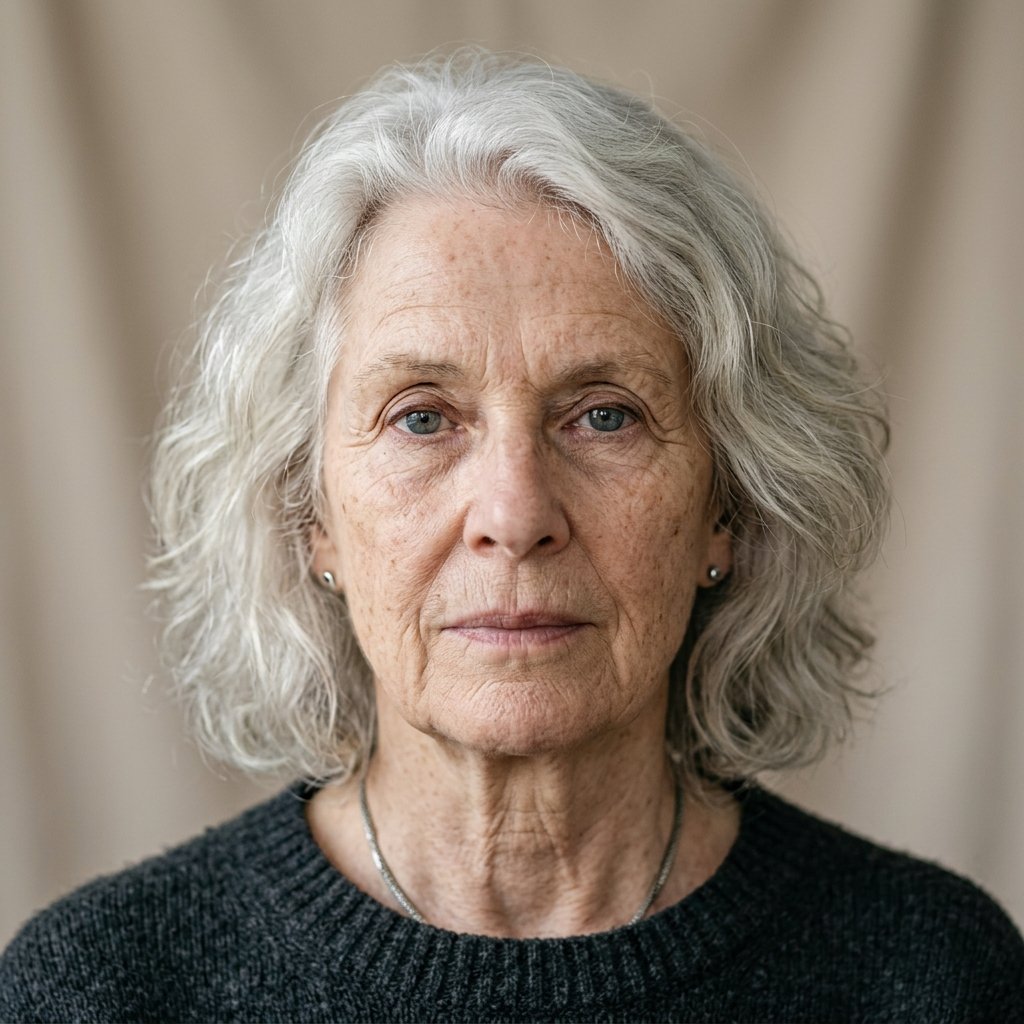
I never wanted the job.
I needed it.
The bills were stacked on the kitchen table like a silent accusation, and every time I walked past them, my chest got a little tighter.
My husband, Mark, had become a ghost in our own house.
He came home late, scrolled on his phone, and answered me in one-word sentences that felt like small slaps.
My kids didn’t need me anymore either.
My son was off at college in Michigan, too busy to call, and my daughter had just gotten her first apartment near downtown Cleveland with a boy I barely knew.
The house on Sycamore Drive had never felt so big.
It echoed with the kind of quiet that makes you feel invisible.
So when my friend Nancy mentioned that an elderly man on Maple Street needed an afternoon caregiver, I jumped at it.
Not because I was a hero.
Because I was drowning.
Nancy said his name was Arthur Bennett.
He was eighty years old, a retired civil engineer who had traveled the world, and he lived in that huge old Victorian house at the very end of the road.
The one with the iron gate covered in ivy.
Everyone in town knew the house but few people had ever been inside.
“He’s a widower,” Nancy told me over coffee. “No kids nearby. Just needs someone to make his tea, organize his pills, and read him the newspaper because his eyes are too weak now.”
She paused and gave me a long look.
“Honestly, Sarah, I think he’s just lonely.”
I remember thinking that I was lonely too.
Maybe that was the real reason I said yes.
The first time I crossed that iron gate, a strange shiver ran down my spine.
It wasn’t fear.
It was respect.
It felt like stepping into a world that had been frozen in time while the rest of the planet rushed forward without me.
The front path was cracked but clean, and the porch creaked under my feet like an old song.
Before I could knock, the heavy wooden door swung open.
There he was.
Arthur Bennett.
He leaned on a dark wooden cane, but even hunched slightly, I could tell he had once been a very tall man.
His hair was as white as fresh snow, and his gray eyes had a brightness that startled me.
He didn’t look at me like the other elderly people in the neighborhood did.
There was no resentment in his gaze, no quiet waiting for the end.
He looked curious.
Like he was trying to figure me out before I even opened my mouth.
“So you’re the one who’s going to look after me,” he said.
His voice was low and deliberate, each word placed carefully.
“Yes, Mr. Bennett. My name is Sarah. Nancy recommended me.”
“Ah, Nancy,” he said, and a faint smile cracked his weathered face. “Always sticking her nose into everyone else’s business.”
I laughed a little.
“Come in,” he said, stepping back. “The cold follows you if you stand there too long.”
The house was a living museum.
Dark wood floors, heavy furniture, and shelves packed with engineering books and classic novels that smelled like dust and history.
Sepia-toned photographs hung on the walls.
A beautiful woman with soft curls. A young man in a military uniform. A bridge under construction.
Everything smelled old, but not in a bad way.
It smelled cozy, like those small-town houses that keep secrets in every corner.
I made tea in his huge kitchen while he sat at the table, watching me move.
I could feel his eyes on me, but it wasn’t creepy.
It was the look of someone pausing to appreciate what they hadn’t had nearby for a long time.
A woman’s voice. The clink of a spoon against porcelain. The simple energy of someone being present.
“You walk with haste,” he said suddenly.
I turned, surprised.
“Excuse me?”
“You move like time is a weight on your shoulders,” Arthur repeated.
I let out a nervous laugh.
“It’s probably habit. At home, I’m always running from one place to another.”
“There is no rush here,” he said quietly. “Here, if you like, you can learn to walk slowly.”
I didn’t know how to answer.
So I just nodded and set the teacup down in front of him.
But his words stayed with me all the way home.
For the first few weeks, I treated the job like a transaction.
I would arrive at noon, make his tea, sort his medication into those little plastic compartments, and read the Cleveland Plain Dealer to him because his eyes got tired after a few paragraphs.
I would leave at five.
I would drive back to my empty house and sit in the driveway for ten minutes before going inside.
But something shifted slowly.
I started arriving a little earlier.
I started staying a little later.
Arthur had a way of asking questions that didn’t feel invasive, but somehow made you want to tell the truth.
One Tuesday afternoon, I was organizing his pills when he said, “You’re very good at hiding it.”
I froze with a bottle of blood pressure medication in my hand.
“Hiding what?”
“The sadness,” he said simply. “Most people wear it on their faces. You don’t. But it’s in your hands.”
I looked down at my fingers.
They were trembling slightly.
“My husband doesn’t see me anymore,” I heard myself say.
The words came out before I could stop them.
Arthur didn’t flinch.
He didn’t offer empty comfort.
He just nodded slowly.
“That’s the loneliest kind of invisible,” he said. “To be unseen in your own home.”
I bit the inside of my cheek to keep from crying.
“Yes,” I whispered. “It is.”
After that, the afternoons became something different.
We talked about everything.
He told me about his wife, Eleanor, who had died six years ago from ovarian cancer.
He told me about the bridges he helped design in Oregon and Pennsylvania, and the time he spent in a small village in Guatemala helping to build a water system.
He told me about his son, who lived in Seattle and called once a month if he remembered.
“He’s a good man,” Arthur said one day. “Just busy living his life. I understand that. But understanding doesn’t fill an empty room.”
I thought about my own kids.
How their rooms at home were still decorated with old posters and forgotten trophies.
How I hadn’t changed their sheets in months because I couldn’t bear to wash away the last traces of them.
“Do you ever get used to it?” I asked.
“No,” Arthur said.
He didn’t look sad.
Just honest.
“But you learn to make room for other things,” he continued. “A good book. A hot cup of tea. The sound of someone walking through your front door who actually wants to be there.”
He looked at me then, and his gray eyes softened.
“Like you.”
My throat tightened.
I wanted to tell him that I had only taken this job for the money.
That I wasn’t some angel.
That I had been at the lowest point of my life when Nancy called.
But instead, I just said, “I’m glad I’m here.”
And I meant it.
Mark noticed the change before I did.
We were sitting at the dinner table, eating in silence, when he suddenly looked up from his phone.
“You seem different,” he said.
I paused with my fork halfway to my mouth.
“Different how?”
“I don’t know,” he shrugged. “Lighter, maybe. You’re not snapping at me as much.”
I wanted to laugh.
I wanted to scream.
Maybe I wasn’t snapping because I had finally found a place where I didn’t feel like a burden.
“I got a job,” I said. “Taking care of an older man. It’s been good for me.”
“Oh,” Mark said, already looking back at his phone. “That’s nice.”
And just like that, the conversation was over.
But for once, it didn’t break me.
Because the old me would have sat there and analyzed his indifference for hours.
The new me just remembered Arthur’s voice.
“You cannot force someone to see you,” he had told me. “But you can stop disappearing for their sake.”
Six months into the job, I realized I was no longer counting the hours until I could leave.
I was counting the hours until I could arrive.
I started bringing little things.
A fresh peach from the farmer’s market.
A photo of my kids.
A story about something ridiculous I’d seen at the grocery store.
Arthur would listen with his chin resting on his cane, a faint smile playing on his lips.
One afternoon, he asked me to sit with him on the back porch.
The garden was overgrown but still beautiful in a wild way.
Rose bushes tangled with wildflowers, and a stone birdbath sat crooked in the grass.
“I used to sit out here with Eleanor for hours,” he said. “She loved the cardinals. Every time one landed, she’d grab my arm like a child.”
I pictured him younger, with dark hair and a strong back, laughing with a woman in the golden light.
“Do you miss her terribly?” I asked.
“Every day,” he said. “But it’s not the same as it was. At first, it felt like drowning. Now it feels like swimming in water I’ve learned to love.”
I shook my head. “I don’t know how you do it.”
“You already are,” he said.
I looked at him, confused.
“You’ve been drowning in your own life, Sarah,” he said quietly. “And you kept getting up. You kept showing up, making tea, organizing pills, reading newspapers. You kept moving. That’s all it is. You just keep moving.”
A single tear slid down my face.
I didn’t wipe it away.
For the first time in years, I let someone see me cry.
And Arthur didn’t look away.
He just handed me a folded handkerchief from his pocket and said, “It’s clean. Eleanor always insisted.”
I laughed through the tears.
Then came the day that changed everything.
It started like any other Thursday.
I let myself in with the key Arthur had given me months ago.
“Good afternoon, Arthur,” I called out from the foyer.
There was no answer.
“Arthur?”
My heart sped up.
I walked quickly through the living room and into the kitchen.
Empty.
I checked the study, the bathroom, the front porch.
Nothing.
Finally, I climbed the stairs for the first time in the entire six months I had worked there.
His bedroom door was cracked open.
I pushed it gently and found him sitting on the edge of his bed, still in his pajama shirt and slacks, staring at a framed photograph of Eleanor.
“Arthur?” I said softly.
He didn’t look up.
“I thought I heard her this morning,” he whispered. “I was sure she was in the kitchen singing that old song she loved. But when I called out, there was nothing.”
I sat down next to him.
The bed dipped slightly under my weight.
“I’m sorry,” I said.
“It’s the cruelest trick,” he said. “The mind gives you a memory so vivid, it feels like the person is still here. And then you reach for them, and your hand closes on air.”
I took his hand without thinking.
It was warm and papery, the skin thin as tissue.
“I know it’s not the same,” I said. “But I’m here.”
He finally looked at me.
His gray eyes were glassy, but no tears fell.
“I know you are,” he said. “And that’s the only reason I got out of bed this morning.”
We sat like that for a long time.
Two broken people on the edge of a bed in an old house at the end of Maple Street.
Neither of us wanting to let go.
A few weeks later, Arthur’s health began to decline.
It wasn’t dramatic.
No sudden heart attack, no ambulance with flashing lights.
Just small things.
He needed more help standing.
His breath became shorter after walking from the kitchen to the living room.
He napped more often, and sometimes he would wake up disoriented, calling out for Eleanor.
I started staying later.
Then I started coming on weekends.
Mark asked me once why I was spending so much time with an old man who wasn’t even family.
I looked at him across the kitchen island and said, “Because he’s the only person in this world who makes me feel alive.”
Mark’s face went blank.
“That’s a strange thing to say,” he muttered.
“Not to me,” I replied.
That night, I slept in the guest room for the first time in our marriage.
And honestly, I slept better than I had in years.
Arthur declined through the autumn.
By early November, he was bedridden most days.
A hospice nurse named Gloria came three times a week, and I did everything else.
I made his tea the way he liked it.
I read to him from a worn copy of “The Old Man and the Sea.”
I opened the curtains so he could see the last of the orange leaves falling from the maple trees.
One evening, as the light turned golden and soft across his bed, Arthur reached out and touched my arm.
“Sarah,” he said, his voice barely above a whisper. “Come sit with me.”
I pulled a chair close to his side and took his hand.
“I need to tell you something,” he said.
“I’m listening.”
“I never had a daughter,” he began. “I always wanted one. Eleanor and I tried, but after our son, she couldn’t have more. It was a quiet grief we carried together. We never spoke of it much, but I think about it more now.”
He paused to catch his breath.
“You have been that for me,” he continued. “The daughter I never had. The person who showed up when I had given up on being seen.”
My vision blurred with tears.
“You saved me too,” I said. “You know that, don’t you? I took this job for the money. I came here because I had nothing left. But you gave me a reason to get up in the morning. You saw me when my own husband couldn’t.”
Arthur smiled weakly.
“Then we saved each other,” he said.
I pressed my forehead to his hand and sobbed.
That night, I called Mark.
“I’m not coming home tonight,” I said.
“Why not?”
“Because Arthur needs me.”
There was a long pause.
“You’re choosing him over your own family?” Mark asked.
I took a slow breath.
“My family chose not to need me a long time ago,” I said. “I’m just finally accepting it.”
Mark started to argue, but I hung up.
I sat in the chair beside Arthur’s bed until the sun came up.
Three days later, Arthur died.
It was peaceful.
I was holding his hand, and Gloria was on the other side of the bed.
He opened his eyes one last time, looked at me, and smiled.
“Thank you,” he whispered.
And then he was gone.
I didn’t scream or fall apart.
I just sat there, holding his hand, as the house settled into a silence I had never heard before.
Later, I learned the details of his will.
Arthur had been wealthier than anyone in town realized.
A lifetime of careful investments and engineering contracts had left him with nearly $2,500,000 in assets.
He left a small portion to his son.
He left $50,000 to Nancy for being a good neighbor.
And then, to me, he left the house.
The entire Victorian house on Maple Street.
Every brick, every book, every sepia-toned photograph.
I fell to my knees when the lawyer told me.
“But I didn’t do it for this,” I kept saying. “I didn’t do it for this.”
The lawyer, a kind man named Mr. Coleman, handed me a letter.
It was in Arthur’s handwriting.
I opened it with shaking hands.
“Dear Sarah,
If you’re reading this, then I am finally with Eleanor again.
I know you will say you didn’t do anything to deserve this.
You will probably cry and tell the lawyer that you only did your job.
But I need you to understand something.
You did not just do your job.
You brought light into a house that had become a tomb.
You sat with me when my mind played cruel tricks.
You held my hand when I missed my wife so much I could not breathe.
You let me see you cry, and you let me see you heal.
That is not labor, Sarah.
That is love.
And love deserves to be repaid, not because it asks for payment, but because it transforms both people.
This house is yours.
Live in it.
Fill it with laughter again.
Open the windows and let the fresh air in.
And when you walk through the rooms, walk slowly.
Remember that you are not a guest.
You are home.
With all my love,
Arthur”
I sat in the lawyer’s office and cried until my ribs hurt.
But they were not tears of sadness.
They were tears of release.
For the first time in years, I felt like I had a place where I belonged.
A month after Arthur’s funeral, I moved into the old Victorian house.
Mark and I separated.
It wasn’t bitter.
It was just over.
He said he didn’t understand me anymore.
I told him he never really tried.
He moved into an apartment near his office, and I stayed in the house with the iron gate and the ivy and the shelves full of books.
My daughter came to visit once.
She stood in the living room and looked around with wide eyes.
“Mom, this place is incredible,” she said.
“It is,” I agreed. “It was very loved.”
“What are you going to do with all his stuff?”
I smiled.
“I’m going to live with it,” I said. “And I’m going to read every single one of those books.”
She laughed.
It was good to hear her laugh.
Now, every morning, I make tea for one.
I sit on the back porch and watch the cardinals.
And I walk slowly.
Just like Arthur taught me.
Sometimes, I still hear his voice in the quiet moments.
“There is no rush here.”
And I know, deep in my bones, that I didn’t just take a job to care for an old man.
I found a home that healed the parts of me I had already given up for dead.
If this story touched your heart, please give it a Like, Follow our page, and Share it with someone who might need to feel seen today. Thank you for reading.