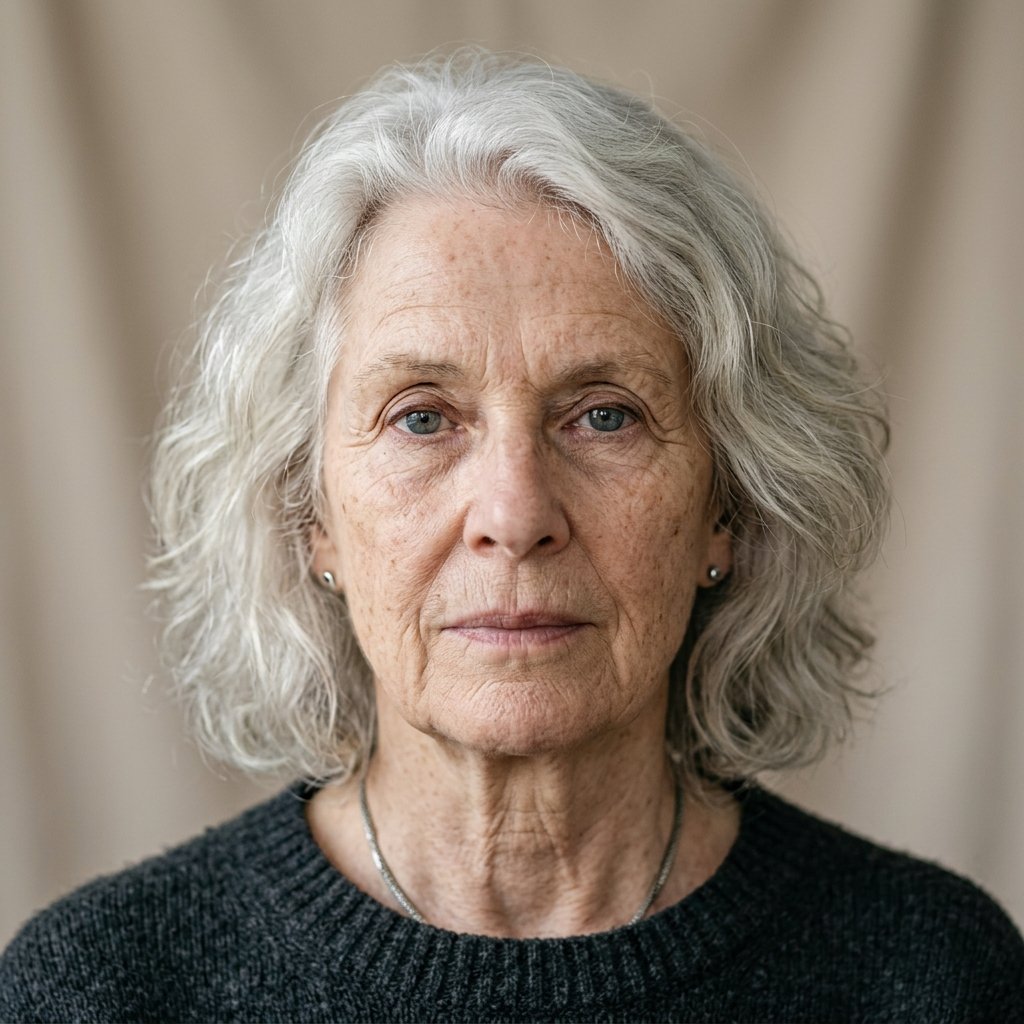
I had no idea that the man who drove my father for eight years was hiding a secret that would shatter everything I believed about my dad.
It all began ten years ago, when my father, Harold Thompson, was diagnosed with glaucoma in his hometown of Ashville, Ohio.
By the time the doctors caught it, the damage was severe.
Within two years, his world had dimmed to shadows and then vanished almost entirely.
My mother, Eleanor, had passed away five years before that.
They had built their life together in that old white house on Maple Street for over forty years.
Every corner held a memory.
Dad refused to leave.
I lived nearly a thousand miles away in Tampa, Florida, with my own family.
I begged him to move closer to me.
I called him every single night, pleading with him to sell the house and come live with us.
“Evelyn,” he would say in that gentle, unwavering voice, “your mother is still in these walls. I can’t leave her.”
I knew it was not just stubbornness.
It was the only home he had ever truly loved.
So we made an arrangement.
His neighbor, Russell Miller, had known our family for decades.
He was a kind, retired widower who lived alone just two doors down.
He felt almost like an uncle to me.
Since he had plenty of time, he agreed to drive Dad wherever he needed to go every Thursday.
I paid him a fair amount each month to handle the medical appointments, pharmacy visits, grocery shopping, and any other errands Dad could not manage alone.
The arrangement gave me tremendous peace of mind.
I knew Dad was in good hands with someone who genuinely cared about him.
Every day, without fail, I would call Dad in the evening.
Those phone conversations became the best part of my entire day.
He would tell me about the meals he had learned to prepare completely by touch and sound.
“I made my famous meatloaf yesterday,” he would chuckle. “Needed a little help from Russell to set the oven, but the mixing was all me.”
He described the audiobooks he was enjoying.
He loved history and would listen to long biographies of presidents and war heroes.
He told me about the checkers games he played with Russell after their Thursday trips.
“I win every single time,” he would declare proudly, and I could hear Russell laughing in the background, sometimes shouting, “Harold, you cheat blind or not!”
I shared stories about my job, my two children, and all the ordinary details of my life.
He would ask about my daughter’s piano lessons and my son’s baseball games.
He never got tired of hearing about the little things.
To him, those ordinary moments were treasures.
Then, only a few days ago, I received a call from Russell.
My father had passed away peacefully in his sleep.
Losing him felt like losing the final place where I had ever completely belonged.
A piece of my own heart stopped beating when I heard those words.
I flew to Ohio immediately, tears blurring my vision the entire flight.
The funeral was small and deeply intimate.
A few neighbors, some old friends from church, and Russell.
I stood at the front, gripping my husband’s hand, trying to hold myself together.
When they lowered his casket into the ground next to my mother’s grave, I nearly collapsed.
After the service, the mourners gradually left the cemetery.
The sky was a flat, weary gray, and a cold wind rustled the remaining autumn leaves.
I remained beside his grave, staring at the newly turned earth, unable to move.
I felt hollow and utterly alone.
Long after the final car had disappeared down the gravel lane, I was still there, frozen in place.
That was when Russell approached me.
I didn’t hear his footsteps until he was standing right next to me.
At first, he said nothing at all.
He simply held out a sealed envelope with my name written across the front in my father’s familiar, careful handwriting.
My breath caught in my throat.
I reached for the envelope.
But Russell did not let go.
His grip tightened, and for the first time in all the years I had known him, I noticed that his hands were trembling badly.
His eyes were red, and his face was etched with a sorrow I couldn’t understand.
Then he looked directly at me with an intensity that made my heart pound.
“Evelyn,” he said, his voice unsteady, “your father made me promise that I would tell you the truth after he was gone.”
A cold wave of dread washed over me.
“What truth?” I whispered, my voice cracking.
Russell glanced toward my father’s grave, then back at me.
“Those Thursday trips were not what you believed they were,” he said.
I stared at the envelope suspended between us, my mind racing.
“If you weren’t taking him to the doctor,” I asked, my voice rising with panic, “where on earth did you go every single week?”
Russell held the envelope for one final, agonizing moment.
Then he released it into my hands, and I clutched it against my chest.
He took a deep, shuddering breath.
“Your father made me promise to show you the place he visited every week,” he whispered, “and explain why he never wanted you to know.”
I felt the world tilt beneath my feet.
“Show me?” I repeated faintly. “Russell, please, just tell me now. I can’t bear any more secrets.”
But he shook his head slowly.
“It’s not something I can tell you here,” he said. “You need to see it with your own eyes. Tomorrow morning, I’ll take you there, just like I took Harold.”
A million terrifying questions exploded in my brain.
What could possibly be so important that my own father hid it from me for eight entire years?
Was he visiting someone? A place? A person I didn’t know existed?
I thought I knew everything about my father’s quiet, simple life.
But clearly, I had been blind to something enormous.
Russell placed his hand gently on my shoulder.
“He loved you more than anything, Evelyn,” he said. “Never doubt that for even a second. Everything he did, he did out of love. You’ll understand tomorrow.”
He turned and walked away toward his old pickup truck, leaving me alone in the cold cemetery with nothing but an envelope and a heart full of shattered certainties.
I stood there for a long time, the wind cutting through my coat.
I looked down at the envelope, tracing my father’s handwriting with my finger.
I was terrified to open it.
But I knew I had to.
Slowly, I broke the seal and pulled out a single sheet of paper.
It was a letter written in his own hand, slightly shaky but clearly composed with incredible care and patience.
“My dearest Evelyn,” it began.
“If you’re reading this, then I have gone home to be with your mother. I know you’re hurting, and I know you will have a thousand questions. Please forgive me for keeping this secret. I did it not to hurt you, but because I wanted to protect you from a burden I chose to carry myself. Russell will explain everything and show you exactly where we went every Thursday. Trust him, as I always have. And know this above all: you were the greatest joy of my life. Every decision I made, I made with your happiness in my heart. I will love you forever. Dad.”
I pressed the letter to my face and sobbed.
A burden? What burden? My father had struggled his entire life, but he had always been so strong and so full of quiet dignity.
What could he possibly have needed to hide?
That night, I barely slept.
I lay in my childhood bedroom, surrounded by faded wallpaper and the smell of old wood, and I tortured myself with guesses.
Maybe he was seeing a specialist and didn’t want to worry me about his health.
Maybe he was involved in some charity or volunteer work that he felt shy about.
Maybe he had found love again, a quiet companionship with a woman from the church group, and hadn’t known how to tell me.
None of it made sense.
The next morning, Russell arrived at the house right on time, just as he had every Thursday for eight years.
He looked tired, as if he too had tossed and turned all night.
We drove in silence through the streets of Ashville, past the familiar old pharmacy, the grocery store, the park where I had played as a child.
Then we turned down roads I didn’t recognize.
We drove for almost forty minutes, past cornfields and quiet farmhouses, until we reached a small, peaceful-looking town I had never seen before.
Russell pulled into the parking lot of a modest brick building.
There were flower gardens out front and benches beneath shady old oak trees.
The sign above the entrance read: “Oakwood Residential Care Facility.”
I stared at the sign in complete confusion.
“Russell, what is this place?” I asked, my voice barely a whisper.
He turned off the engine and looked at me, his eyes glistening.
“For the past eight years,” he said, “every single Thursday, your father came here to sit with a man named Samuel.”
My mind went blank.
“Samuel? I don’t know any Samuel. Who is he?”
Russell took a deep breath.
“Samuel is your brother,” he said.
The world stopped.
“That’s impossible,” I said. “I don’t have a brother. I’m an only child. My parents never—”
But then Russell told me the whole truth.
Before my parents had me, they had a son named Samuel.
He was born with a severe condition that left him with profound cognitive disabilities.
My parents cared for him at home for the first five years of his life, but his needs became too great.
And they were very young, with very few resources.
So they made the heartbreaking decision to place him in a full-time care facility where he could receive the specialized attention he needed.
They never told anyone.
Not their friends, not our extended family, and certainly not me.
When I was born, they decided to give me a normal childhood, free from the weight of that secret.
They believed they were protecting both me and Samuel from a complicated and painful situation.
But my father never forgot his son.
Every Thursday, after he lost his sight, he came to Oakwood.
He would sit beside Samuel for hours.
Sometimes he would talk to him, telling him stories about our family, about me, about the life he was missing.
Sometimes he would simply hold his hand in the silence.
Samuel cannot speak, but the nurses told Russell that he would smile whenever my father walked into the room.
Somehow, he knew.
I sank against the car seat, absolutely overwhelmed.
My father, who couldn’t see the face of his own child, had been making this journey every week out of pure, unconditional love.
He had carried this secret for over fifty years.
And I never knew.
Russell walked me inside.
I met Samuel.
He was a gentle man in his early sixties, with soft gray hair and my father’s eyes.
When I sat beside him and took his hand, he turned his head toward me and gave the most peaceful, radiant smile I have ever witnessed.
And in that moment, I understood.
Love is not always visible.
Sometimes it is hidden in the quiet sacrifices we make for the people we cherish.
My father’s world was dark, but his heart was full of the most brilliant light.
If you made it this far, I would be truly grateful if you could tap ‘Like’ and ‘Follow’ our page for more stories that touch the heart. And if this story moved you, please ‘Share’ it—you never know who might need to be reminded that the deepest love often lives in the quietest places.