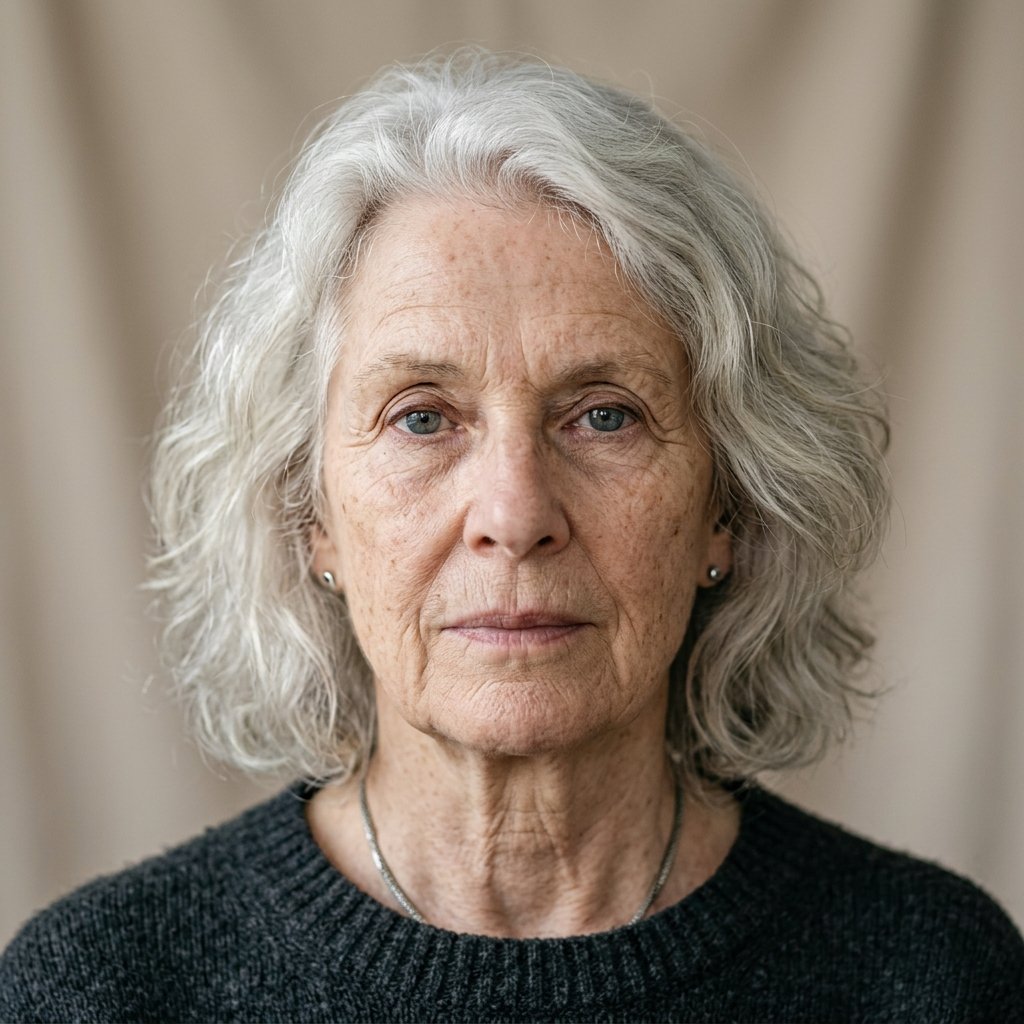
I buried my sweet Robert in the cold Vermont earth on a gray Tuesday morning, and then I flew home to Ohio alone.
I had slept only a handful of hours in three days.
My eyes were so swollen I could barely see the gate numbers.
When I landed at Cleveland Hopkins, the airline clerk informed me my luggage had been lost somewhere over New York.
I stood in the arrivals terminal in my rumpled black dress, still wearing the same shoes I had worn to the graveside, clutching only my handbag and a small paper bag with a soggy sandwich I couldn’t bring myself to eat.
I scanned every face that walked by.
Businessmen in suits, mothers pushing strollers, young couples holding hands.
Not one of them was there for me.
My family had my flight number.
I had called them twice to confirm the time.
I had asked, no, I had quietly pleaded, for someone to please come.
I am seventy-four years old.
I had just laid the love of my life into the ground in a strange town where he was born, surrounded by distant cousins I barely knew, while my own children stayed home.
They said they were too busy.
So I stood there, a widow of three days, invisible.
After thirty minutes, I found a payphone and dialed my son James’s number with trembling fingers.
He picked up on the third ring.
I could hear the television blaring in the background.
“Mom, just take a cab,” he said, his voice flat and annoyed.
“James, I haven’t slept. I buried your father yesterday. Please, could you drive down?”
He let out a long, impatient breath that crackled through the receiver.
“Dad is gone. You can’t expect the whole family to keep managing your grief for you. We have our own lives. Just grab a taxi.”
Behind his voice, I heard laughter and my grandson Kevin shouting.
“Tell Patricia I’m getting Grandpa’s truck! She can’t have it!”
My heart tightened so sharply I felt it in my throat.
Robert had not even been in the ground a full day, and they were already fighting over his pickup truck.
I whispered goodbye and hung up before James could hear me start to cry.
Then I called my daughter Patricia.
She answered with a mouthful of something crunchy.
“Mom, you knew Dad was sick for a long time. This didn’t come out of nowhere. You’re a grown woman. Find a taxi. I’m not driving an hour to the airport just because you don’t want to pay thirty dollars.”
I heard her husband, Mark, in the background muttering, “Is she still whining?”
Patricia laughed a little.
“I’ll call you later,” I said, and I disconnected before she could say another word.
I tried my sister Dorothy next.
She told me she had a card game that evening and couldn’t possibly miss it.
I called my niece Susan.
She let it go to voicemail.
I even tried my fourteen-year-old granddaughter, Hannah, who had always been my sunshine.
She texted me back a single line: “Sry grandma busy lol.”
That was the moment the last bit of warmth drained out of my heart.
I was a stranger to every person who shared my blood.
A taxi finally pulled up, driven by a kind young man who noticed I had been crying.
He didn’t say a word.
He just handed me a box of tissues and turned the radio to a soft classical station.
I will never forget his silent mercy.
When we pulled onto Maple Street, my street, the neighborhood looked the same as always.
The big oak tree was turning a brilliant red.
The Johnstons’ dog barked from behind their fence.
My little yellow house looked peaceful in the late afternoon sun.
But the moment I stepped through the front door, I froze as though I had walked into a stranger’s home.
Small paper labels were tied with blue yarn onto nearly everything in the living room.
Robert’s antique toolbox had a tag with “KEVIN” written in my grandson’s messy handwriting.
My mother’s pearl necklace, which sat in a glass case on the mantle, had a sticky note: “HANNAH.”
The old wooden rocking chair, the one Robert had bought me when I was pregnant with James, the one where I had rocked both my babies to sleep every single night, had a bright orange tag that said “DOROTHY” in my sister’s cursive.
They had come into my house while I was burying my husband.
They had walked through my rooms.
They had opened my drawers.
They had decided who would own the remnants of my life as though Robert and I were already a memory that no longer required permission.
Patricia emerged from the hallway, holding a bowl of ice cream.
She looked at me with a flicker of irritation, not a trace of warmth.
“You’re finally back,” she said. “Why did it take you so long? We had to make our own dinner last night. The kids were complaining.”
I stared at her.
I could not find a single word.
“Well, I’m going to finish my show,” she said, and she turned and walked back to the den without another glance.
I stood in the center of that room, surrounded by paper labels that declared my life was already being divided like a charity auction, and I felt something break inside me.
But it was not despair.
It was certainty.
I had made the right choice.
You see, four days before, on the very night Robert passed in that small hospital room in Burlington, I sat alone in the chapel and I made a phone call.
My dear friend Evelyn, who has been my attorney for thirty years, answered on the first ring.
“Evelyn,” I whispered into the phone, “I need to change everything. Every single document. I need to do it now, before I come home.”
She did not ask why.
She simply said, “Tell me what you want, Margaret.”
And I told her.
I told her that I wanted to donate every penny of our savings, the full value of this house, every piece of jewelry, every antique, every stock certificate, and every acre of land, to St. Jude Children’s Research Hospital in Memphis, Tennessee.
Every dime would go to children fighting for their lives.
In Robert’s name.
And nothing, absolutely nothing, would go to my family.
The will was changed.
The trust was dissolved.
The paperwork was filed.
And then I called the local news station, WKYC in Cleveland, and told them I had a story they might want to share: a grieving widow honoring her husband’s memory with the largest single donation St. Jude had ever received from one individual in Ohio.
They were very interested.
A reporter named Sharon arrived the day before my family came to divide my belongings.
She interviewed me in this very living room, not knowing that in twenty-four hours, strangers would be tagging my furniture.
I wore my favorite blue dress, the one Robert always said made me look like a spring morning.
I spoke clearly into the camera about a man who had worked forty years as a mechanic, saved every dime, and always said he wished he could help sick children.
Sharon cried a little when I described his hands, rough and greasy, but so gentle when he held our newborn babies.
The segment was scheduled to air the evening after I returned.
I did not tell a soul.
The night I came home, I did not confront anyone.
I carried my tired body upstairs, shut the bedroom door, and lay down on the quilt my grandmother had sewn in 1942.
I did not take off my coat.
I lay there in the darkness, staring at the ceiling, listening to Patricia and James and the grandchildren argue downstairs over who would get the good china.
And I smiled.
A quiet, peaceful, final kind of smile.
The next evening, I cooked a large dinner.
I made Robert’s favorite pot roast, with carrots and onions and a thick, rich gravy.
I set the dining table with the good china, the one they had been fighting over.
I lit two candles.
I invited everyone to sit down.
They came eagerly, thinking this was the beginning of the distribution.
James slouched in his chair and immediately said, “So Mom, let’s talk about Dad’s truck. I’ve got the key already.”
Patricia argued, “I need it for Mark’s landscaping business. You don’t even have a license!”
Kevin, my grandson, demanded the toolbox.
Hannah whined about the pearls.
My sister Dorothy announced she would be taking the rocking chair home that night.
They laughed.
They joked.
They passed the mashed potatoes and talked about their plans for my money, my home, my life, as though I were a ghost already fading from the room.
I said nothing.
I just lifted my fork and began to eat.
And then the six o’clock news jingle chimed from the television in the corner.
I had turned it on at exactly five fifty-nine.
My granddaughter Hannah was scrolling on her phone and barely glanced up.
Then the anchor said, “Coming up tonight, a Cleveland widow makes an incredible gift in her husband’s memory. You won’t believe what she gave away. Stay tuned.”
Patricia snorted. “Old people and their money. Probably gave away a hundred bucks to a cat shelter.”
They all laughed again.
The commercial break ended.
And the screen filled with my living room.
The camera showed my blue dress, my white hair, my tired but steady hands folded on my lap.
Hannah dropped her phone.
She shrieked so loudly the neighbor’s dog started barking.
“Oh my God! Grandma’s on television!”
Every head whipped toward the screen.
Every fork stopped mid-air.
The reporter, Sharon, was saying, “Tonight we bring you a story of profound love and profound loss. Margaret Thompson, a seventy-four-year-old widow from Willow Creek, has just returned from burying her husband of fifty-two years in his hometown in Vermont. But while she was grieving, she made a decision that will touch thousands of lives.”
The camera cut to me, speaking softly.
“My Robert always dreamed of helping children who were sick,” I said on the screen, my voice calm and steady. “So I am giving everything we ever owned to St. Jude. The house, the land, the savings, his pension, every single thing. All of it.”
The silence at the dinner table was so complete I could hear the clock tick in the hallway.
Then the eruption began.
James shot to his feet, his chair crashing backward.
“What have you done?! Have you lost your mind?!” His face was purple, veins bulging in his neck.
Patricia was crying, but it was angry crying, her mascara running in streaks. “You can’t do this! This is our inheritance! This is ours! You’re just an old woman, you can’t give away our future!”
Kevin screamed, “My toolbox! She gave away my toolbox!”
Dorothy clutched her chest as if she were having a heart attack. “The rocking chair? Margaret, that chair was supposed to be mine! You promised me years ago!”
I set down my fork very gently on the edge of my plate.
The clink of silver against porcelain was the only soft sound in the storm of their fury.
I looked from one red, twisted face to another.
I saw James, who told me to take a cab and that my grief was a burden.
I saw Patricia, who told me I should have seen Robert’s death coming and that I was an inconvenience.
I saw Kevin and Hannah, my grandchildren, who had never sent a card or a flower or a simple text of love, but who had raced here to stick their names on my belongings before my husband’s body was cold.
I saw Dorothy, my own sister, who chose a card game over meeting me at the airport.
And for the first time since I said goodbye to Robert in that quiet Vermont cemetery, I spoke with a voice that did not shake.
“Every single one of you,” I said, “told me that I was not your concern. You told me to take a cab. You told me my grief was a bother. You walked into my home and divided my life like spoils of war before my husband’s grave had even settled. You laughed at my pain. You dismissed my exhaustion. You did not ask me if I was all right. Not one of you. Not a single, solitary one of you.”
My eyes, dry for the first time in weeks, swept the room.
“So I decided to give my money to children who will pray for the love of a stranger because they have no one else. I decided to honor Robert’s name with mercy, not with greed. I decided to make my death a blessing for the innocent, not a payday for the ungrateful.”
James was shaking, his hands balled into fists. “We’ll fight this. We’ll take you to court. You’re not in your right mind. We’ll say you’re senile!”
I stood up slowly, pushing my chair back with quiet dignity.
I looked straight into my son’s eyes, the boy I had once rocked in that very rocking chair, and I said, “You may try. But the papers are signed. The donation is irrevocable. And the news has already aired. The whole town knows. The whole town will remember your father as a hero. And they will remember you as the children who left their mother alone at the airport with nothing but a lost suitcase and a broken heart.”
I walked to the front door and opened it wide.
The cool autumn air rushed in, carrying the scent of fallen leaves and distant woodsmoke.
“Now,” I said, “I would like you all to leave my house. And since I will be donating this house to St. Jude at the end of the month, I suggest you start making your own dinner arrangements from now on.”
Patricia was sobbing, grabbing at my sleeve. “Mommy, please, we’re sorry, we didn’t mean it!”
I looked down at her hand on my arm and remembered the sound of her laughter when her husband called me a whiner.
“You meant every word,” I said softly. “And now you will live with every word. Goodnight.”
One by one, they stumbled out into the darkness.
James glared at me with a hatred so deep it should have shattered me, but all I felt was relief.
Dorothy wailed about the rocking chair all the way down the driveway.
The grandchildren were already texting, probably telling their friends their grandmother had gone crazy.
I shut the door and locked it.
I walked back to the dining room, past the table still covered with half-eaten pot roast and overturned wine glasses.
I turned off the television.
The screen went dark, and the reflection I saw was an old woman standing alone in a quiet house.
But it was not the reflection of a broken woman.
It was the reflection of a woman who had been invisible, who had been forgotten, who had been treated like a burden, and who had just reminded the entire world that she still had one final, glorious act of love left to give.
Not to those who demanded it.
But to children who would never know her name, but who would live because of it.
I sat down in the old rocking chair, the one I had never let Dorothy take, and I rocked gently in the silence.
I thought of Robert.
I thought of his rough hands.
I thought of the way he always said, “Maggie, you’re the strongest woman I ever met.”
And I whispered into the empty room, “I miss you, my darling. But I hope I made you proud tonight.”
Somewhere in the distance, a car engine roared to life and faded down the street.
My phone buzzed with furious messages I would never read.
But I just kept rocking, smiling that same quiet, peaceful, final smile.
Because for the first time in fifty-two years, I was alone, but I was not lonely.
I was free.
And somewhere in the city, a sick child would wake up tomorrow with a chance at life that bore Robert Thompson’s name.
That was enough.
That was everything.
If you were moved by my decision, I would be honored if you would share this story. Sometimes the greatest gift we can give is to those who truly need it, not those who simply expect it. Please press ‘Like’ and ‘Follow’ our page if you believe in the power of a mother’s final lesson, and share this with someone who might need to hear that it is never too late to choose dignity over despair.