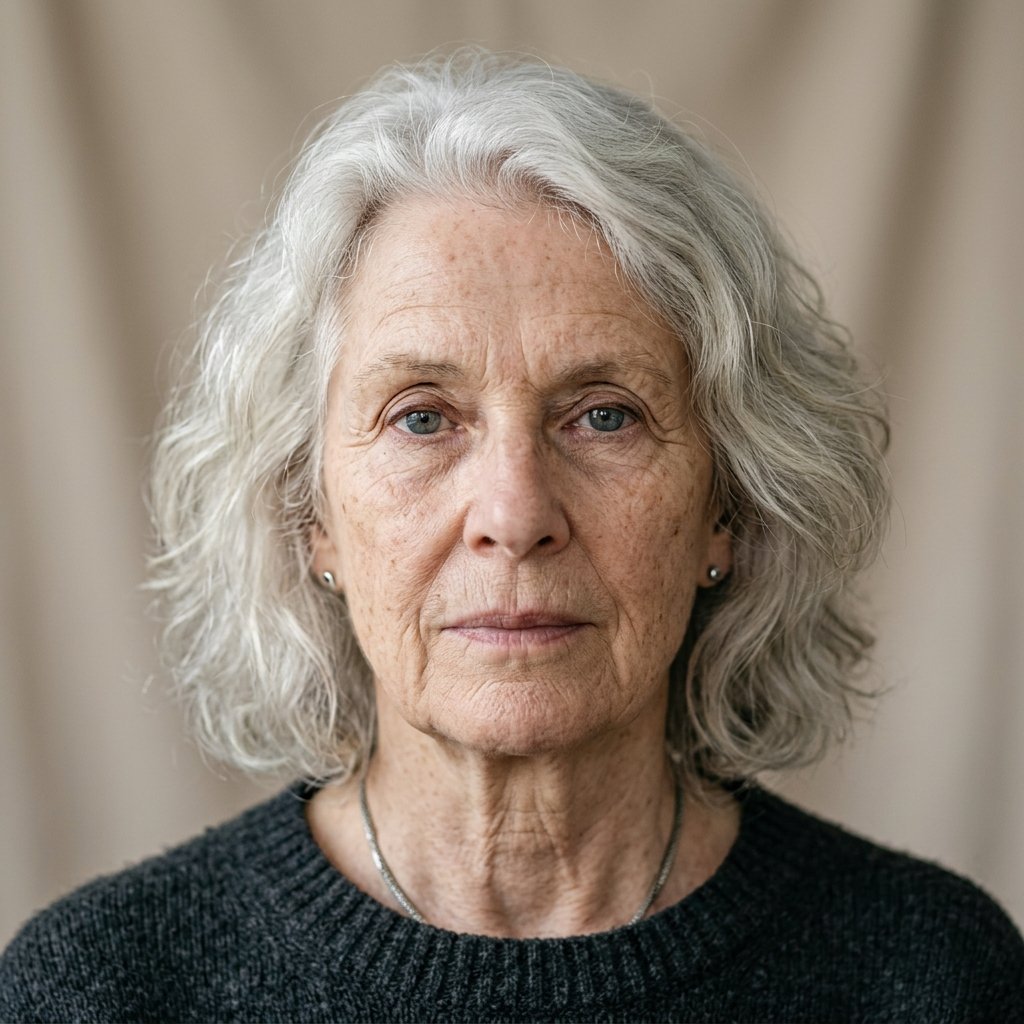
For fifty-two years, I believed the only man I ever truly loved had walked away from me without a single word of goodbye.
I was wrong. And the truth, when it finally arrived, nearly brought me to my knees.
My name is Eleanor Whitfield, and this is the story of how I lost the love of my life, and how forgiveness gave him back to me when I was seventy-one years old.
It began in the summer of 1968, in a little town called Millbrook, Vermont.
Back then, the world moved slower. We wrote letters by hand. We sat on porches at dusk. And falling in love felt like the most serious thing a young person could ever do.
I was nineteen. He was twenty-one. His name was Thomas Bennett.
He had a crooked smile and a way of looking at me that made me feel like I was the only girl in the entire state.
We met at a church social. He spilled a whole cup of lemonade on my Sunday dress, and instead of getting angry, I laughed until my sides hurt.
He laughed too. And that was it. From that afternoon on, we were never really apart.
We spent that whole summer under the great oak tree in my father’s backyard. Thomas would carve little shapes into scraps of wood while I read aloud to him.
One evening, he took my hand and said, “Eleanor, one day I’m going to marry you. I don’t have much yet, but I’ll build us a good life. I promise.”
I believed him with every piece of my heart.
But Thomas had almost nothing. His family struggled, and jobs in Millbrook were scarce. So that autumn, he made a hard decision.
He took work laying railroad track out West, in Colorado. The pay was good, and he swore he was doing it for us. For our future.
“I’ll write you every week,” he told me the morning he left. “And when I’ve saved enough, I’ll come back for you. Wait for me, Eleanor.”
I stood at the train station and watched him go, waving until the smoke disappeared over the hills.
And I waited. Oh, how I waited.
The first weeks, I ran to the mailbox every single morning. My heart would race as I flipped through the envelopes.
But there was never one from Thomas.
Days turned into weeks. Weeks turned into months. Still, nothing came.
I wrote him letters and sent them to the address he had given me. I poured out my heart onto page after page. I told him I loved him. I begged him to answer.
Silence.
By winter, I was a shadow of myself. I barely ate. I cried into my pillow so my parents wouldn’t hear.
My father, a stern but loving man named George, finally sat me down at the kitchen table.
“Eleanor,” he said gently, “a man who truly loves a woman does not leave her waiting like this. He has moved on. You must too. I only want to protect you from more heartbreak.”
I didn’t want to believe him. But as the months passed with nothing, his words began to feel like the only explanation.
Thomas had forgotten me. He had built a new life out West, without me in it.
So, slowly, I let him go. I buried that love so deep inside me that I almost convinced myself it had never happened.
A year later, I met Harold Whitfield.
Harold was steady, kind, and patient. He drove forty minutes just to bring me flowers. He never once raised his voice in all the years I knew him.
He knew I carried an old wound, and he never asked me to explain it. He simply loved me anyway.
We married in the spring of 1970. And though a small corner of my heart stayed locked and quiet, I built a beautiful life with him.
We had three children. Two girls and a boy. We had a modest house with a garden and a porch swing.
Harold was a good husband and a wonderful father. I want to be clear about that. I loved him truly, in the way you love someone who chooses you every single day for forty-six years.
But there was always that quiet ache. On rainy afternoons, or when I heard an old song, my mind would drift to a summer under an oak tree, and to a young man who promised me forever.
Harold passed away peacefully in the winter of 2016. I held his hand until the very end, and I grieved him deeply.
After that, my days grew quiet. My children checked on me. My grandchildren visited. But the house felt so large and so empty.
I thought my story of love was finished. I thought the best chapters were all behind me.
I was so very wrong.
It happened last spring, on an ordinary Tuesday.
I drove into town to buy a new latch for my garden gate. I walked into the little hardware store on Main Street, the bell jingling above the door.
And then I heard a voice.
“Excuse me, do you carry brass hinges?”
I froze. The whole world seemed to stop turning.
I would have known that voice anywhere. Even after fifty-two years. Even lower and rougher with age.
I turned around slowly, my heart pounding against my ribs.
And there he was.
Thomas Bennett. Older now, his hair silver, leaning on a wooden cane. But those eyes. Those same warm eyes that had looked at me across a church hall so long ago.
He saw me too. The color drained from his face. His hand gripped the counter.
“Eleanor?” he whispered. “Eleanor, is that really you?”
I could barely speak. “Thomas.”
We stood there, two old strangers who had once meant everything to each other, tears filling both our eyes.
There was a bench just outside the store. We went and sat on it, and we did not move for three hours.
At first, we spoke of small things. Our families. Our children. The town, and how much it had changed.
But I could feel the enormous question hanging in the air between us. Finally, I could not hold it back any longer.
“Thomas,” I said, my voice shaking, “why did you stop writing to me? Why did you never come back?”
He looked at me, and his face crumpled with a pain I did not understand.
“Stopped writing?” he said. “Eleanor, I wrote you every single week. For nearly a year. Forty-one letters. I never once got a reply.”
My breath caught in my throat. “That’s not possible. I never received a single one. Not one, Thomas.”
We stared at each other, the impossible truth beginning to take shape.
“When you didn’t answer,” he continued, his voice breaking, “I thought you had changed your mind. I thought you didn’t want a poor railroad man. But I couldn’t give up. So I saved every penny, and in the spring, I came back to Millbrook to ask for your hand.”
I could not breathe. “You came back?”
“I knocked on your father’s door,” he said softly. “George answered. He told me you were already promised to a better man. He told me you had asked him to send me away. He told me to never come back and never contact you again.”
The world tilted beneath me.
“I begged him,” Thomas said, wiping his eyes with a trembling hand. “I asked to see you just once. He refused. He said you deserved a man with money and standing, not a laborer with dirt under his fingernails. So I left. I honored what I believed were your wishes.”
I sat frozen on that bench as fifty-two years of my life rearranged themselves in an instant.
Thomas had never abandoned me. He had loved me faithfully. He had come back for me.
And my own father had turned him away at the door. My father had burned every letter that man ever sent me, so I would never know the truth.
A sob tore out of me right there on Main Street.
“He lied to me,” I whispered. “All these years. My father lied to us both.”
Thomas gently took my hand, just as he had under that oak tree. “He did what he thought was right, Eleanor. Fathers do foolish things when they’re afraid for their daughters.”
I wanted to be furious. I wanted to drive to the cemetery and shout at a headstone. Fifty-two years. Two whole lives, redirected by one man’s fear and pride.
But my father was long gone. And so was Harold. And so was most of my life.
Thomas seemed to read my thoughts. He squeezed my hand and said the words that changed everything.
“Eleanor, we can spend whatever time we have left hating the past. Or we can finally start living. I choose you. I always chose you.”
And in that moment, sitting on an old bench with the man I had mourned for half a century, I made a choice too.
I chose to forgive.
I forgave my father, for his fear disguised as love. I forgave the cruel years for what they had taken. And I forgave myself, for giving up when I should have kept knocking on doors of my own.
Because I finally understood something. Anger would only steal from us the little time we had left. But forgiveness could give us a future.
We began to see each other every day after that.
Thomas told me he had never married. “After you,” he said simply, “my heart just wasn’t free to give to anyone else.”
My children were stunned when I told them the story. My oldest daughter cried for an hour. My son drove straight over to shake Thomas’s hand.
“Mom,” my youngest said, “you deserve this. You deserve every single day of it.”
Eight months later, Thomas Bennett and I were married.
We held the wedding in the same little white church where we had once dreamed together as teenagers.
My children walked me down the aisle. My grandchildren scattered flower petals along the floor.
And when the pastor asked Thomas to say his vows, he pulled a small, worn wooden carving from his pocket.
It was a little heart, the very one he had carved under the oak tree in 1968. He had kept it all those years.
“I made you a promise a lifetime ago,” he said, tears rolling down his weathered cheeks. “I’m sorry it took me so long to keep it. But here I am, Eleanor. Better late than never.”
At seventy-one and seventy-three years old, we became newlyweds.
People love to say that it is too late to start over when you are old. That love is only for the young.
I am here to tell you that is not true.
Love does not check a calendar. It does not care about wrinkles or gray hair or the years you have lost.
It only asks one thing of you. That you find the courage to open the door when it knocks again.
Thomas holds my hand every single night now. And every morning, I wake beside him, grateful beyond words that the truth reached us before it was too late.
Sometimes, in the quiet, I think about my father. I don’t hate him anymore. I picture him in heaven, watching us, and I believe he finally understands.
I believe, if he could, he would weep and ask for my forgiveness. And I would give it to him gladly.
Because forgiveness did not just set my father free. It set me free.
It gave me back the love I thought was gone forever. And it taught me the greatest lesson of my long life.
It is never, ever too late to be happy. And it is never too late to let go of the weight you were never meant to carry.
Thomas and I don’t know how many years we have left. At our age, every day is a gift we open together.
But whatever time remains, we will spend it the way we always should have. Side by side, under the shade of an old oak tree, exactly where we began.