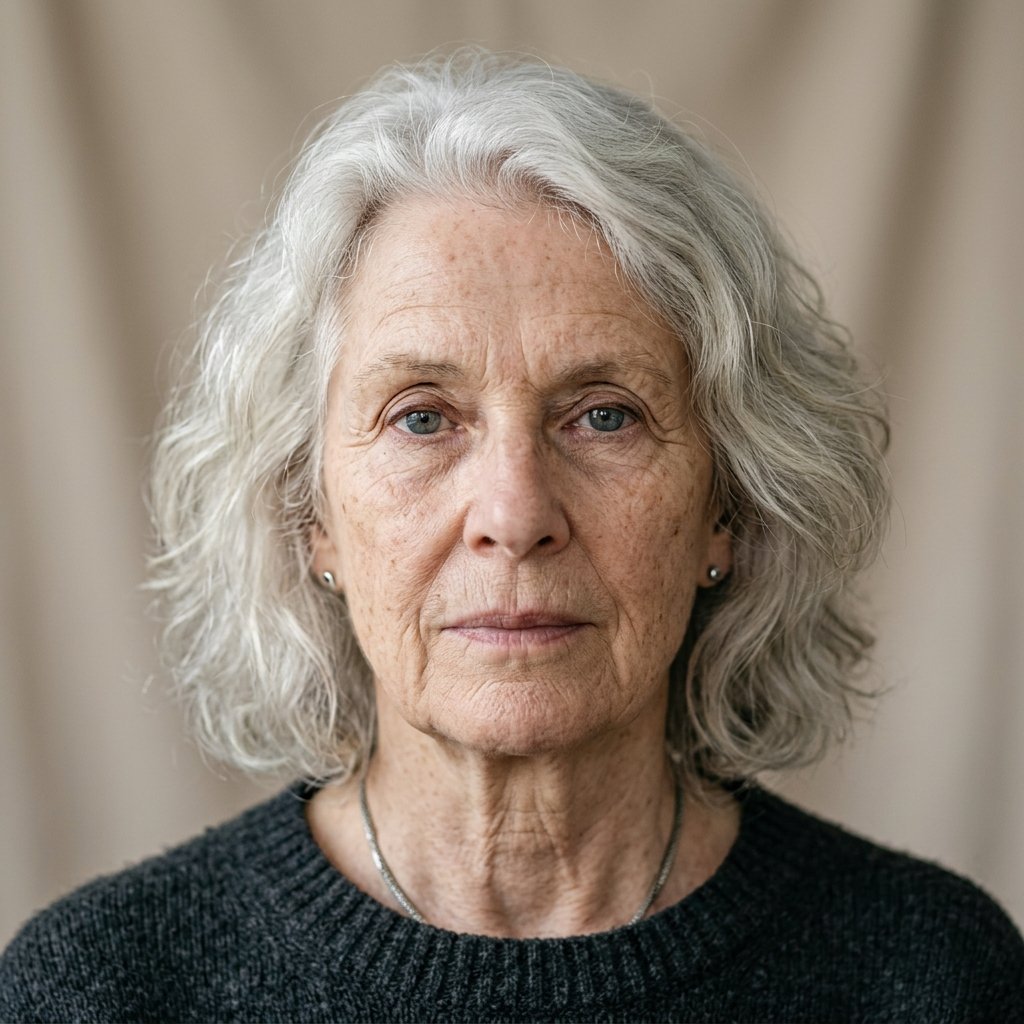
For eleven years, my mother set four plates at her supper table every single night. And every single night, she ate alone.
I didn’t know that then. I found out later, and the knowing has never once left me.
Her name was Eleanor Whitfield. She lived her whole life in the same white farmhouse on the edge of Cedar Falls, Iowa, the one with the crooked porch step my father always meant to fix and never did.
She raised three of us in that house. Daniel was the oldest, steady and stubborn. Ruth was the middle child, all fire and feeling. And I was the youngest. My name is Thomas.
Our father, Walter, was the glue. When he was alive, that kitchen was the warmest place on earth. Bread rising on the counter, the radio playing low, Mama humming while she cooked.
Then one cold February, Daddy’s heart gave out in the barn. He was sixty-three. And just like that, the glue was gone.
Grief does strange things to a family. It should have pulled us closer. Instead, it split us wide open.
The fight was about the farm. Daniel wanted to sell the land and split the money. Ruth wanted to keep it. I just wanted the shouting to stop.
But it didn’t stop. It got uglier by the day. Terrible words were said around that same kitchen table where we’d once laughed until our sides hurt.
Mama sat quietly through most of it, her hands folded, her eyes wet. She said only one thing. She said, “Your father would be heartbroken to hear you speak this way.”
Maybe that was the moment we should have stopped. But pride is a loud thing, and it drowns out wisdom.
Within two months, we had scattered like leaves in a hard wind. Daniel took a job in Denver. Ruth followed a boyfriend to Atlanta. And I loaded my truck and drove all the way to Portland, telling myself I just needed space.
I told myself I’d call when the anger cooled. I told myself a few weeks, maybe a month.
But the anger didn’t cool. It curdled. It slowly turned into something worse, something quieter and heavier. It turned into shame.
And shame, I’ve learned, is a coward. It doesn’t fight. It just hides. It kept me away for over a decade.
At first there were reasons. Work was busy. Money was tight. The drive was long. The reasons were real enough to believe if you didn’t look too hard.
But underneath them all was the same ugly truth. I couldn’t face her. I couldn’t face what I’d let happen to our family.
The three of us talked, barely. A stiff text on Christmas. A forwarded photo. Never about Mama. Never about home.
When her name came up, we soothed our own consciences with a lie we all agreed to believe. “She’s still angry,” we’d say. “She doesn’t want to see us. Give her time.”
It was easier than admitting the truth. We had walked out on the woman who gave us everything, and none of us had the courage to walk back.
Years passed the way they do when you’re not paying attention. One turned into five. Five turned into ten. My hair started to gray. My own children grew tall.
My daughter Emma was nineteen last spring. She’d grown up hearing almost nothing about her grandmother, and it bothered her in a way it never bothered me.
One April morning, without telling a soul, she got in her little car and drove nearly two thousand miles to Cedar Falls. She wanted to meet the grandmother she could barely remember.
What she found in that farmhouse cracked our whole family open like an egg.
Mama was there. Older, of course. Thinner. Her hair had gone completely white. But she opened the door, and when Emma said, “Grandma, it’s me, Thomas’s girl,” my mother wept so hard she had to sit down.
Emma stayed three days. And in those three days, she saw everything the rest of us had run from.
Our childhood bedrooms were untouched. Ruth’s porcelain dolls still lined the shelf. Daniel’s football trophies still gathered dust. My old baseball glove sat on the dresser exactly where I’d left it at eighteen.
Mama had dusted those rooms every week for eleven years. She had washed the sheets on beds no one slept in, just in case. Just in case we came home.
But it was the kitchen drawer that undid us.
Emma opened it looking for a serving spoon and found a worn shoebox tied with a faded blue ribbon. Inside were letters. Hundreds and hundreds of them.
My mother had written a letter to each of her children every single week for eleven years. One to Daniel. One to Ruth. One to me. Fifty-two a year, times three, times eleven.
She never sent a single one. She didn’t have our addresses. We had moved so many times, and we had never given them to her.
So she wrote them anyway. She poured her heart onto paper and folded each one and tucked it away, just so she could feel like she was still talking to us.
Emma read some of them aloud to me over the phone that night, her voice breaking on every line.
In one, Mama wrote about the tomatoes coming in and how Ruth used to eat them off the vine like apples. In another, she wrote about a rainstorm and how Daniel used to be afraid of thunder.
And in one to me, she wrote, “I made your favorite pot roast today, Thomas, even though there was no one to eat it. The house smelled like it used to. For an hour, I could almost pretend you boys were just out in the fields and would come stomping in for supper.”
The last letter in the box was dated only three days before Emma arrived.
It was addressed to all three of us. And it read, “My darlings, I am not angry. I was never angry. I know you think I am, and it breaks my heart that you carry that. I only ever wanted you home. If I should go before you read these words, please know that I waited every day with love, never with blame. A mother’s door is always open. Come home.”
Emma finished reading and neither of us could speak.
I hung up the phone and I sat in the dark of my kitchen and I sobbed like I hadn’t sobbed since my father’s funeral.
Eleven years. Eleven years of believing a lie I had told myself, when the truth had been sitting in a shoebox the whole time. She had never stopped loving us. She had never stopped waiting.
I called Daniel at midnight. He answered on the second ring, and I could barely get the words out. When I did, my big, stubborn brother went completely silent, and then I heard him crying too.
Daniel called Ruth. And for the first time in eleven years, the three of us were on the phone together, all crying, all saying the same thing. We have to go home. Now.
We didn’t wait for morning. Daniel drove from Denver. Ruth caught the first flight to Des Moines. I got in my truck at one in the morning and pointed it east and drove straight through, seventeen hours, stopping only for gas.
We all arrived at dawn, within an hour of each other, three cars pulling up the gravel drive of that old farmhouse just as the sun was coming over the cornfields.
And there she was.
Mama was on the porch, in the same rocking chair where she used to shell peas, a quilt over her knees against the morning chill. Emma stood beside her, having stayed those extra days.
When my mother saw three cars turn into her drive, she went perfectly still. Then she pressed both her trembling hands to her mouth.
We got out of our cars and we couldn’t move fast enough. Daniel reached her first. Then Ruth. Then me.
And my mother, that tiny white-haired woman who had waited eleven years, whispered through her tears, “You came. You all came. You finally came home.”
The three of us, grown adults with gray in our hair, fell to our knees on that old porch like little children. We held onto her legs, her hands, the hem of her dress. We begged her to forgive us for every stolen year.
She wouldn’t hear a word of apology. She just kept touching our faces with her thin hands, laughing and crying at the same time, saying our names over and over like a song she’d been afraid she’d forget.
“Daniel. Ruth. Thomas. My babies. My babies are home.”
That night, for the first time in over a decade, every plate at Eleanor Whitfield’s supper table was full. All three children. Four grandchildren. The kitchen warm and loud and alive again, exactly the way it was meant to be.
Mama made her pot roast. This time, there was someone to eat it.
We stayed for two weeks. We fixed that crooked porch step Daddy never got to. We walked the fields. We sat up late listening to her tell the stories we’d been too proud to come back and hear.
We promised her we would never disappear again. And we didn’t.
My mother passed away peacefully seven months later, on a quiet morning in November, in her own bed, in her own home. All three of her children were holding her hands. Her grandchildren were in the room.
Her last words, spoken with a soft smile, were, “Now I have everything.”
We buried her beside Daddy, under the big oak at the edge of the property she’d fought to keep.
I still have my stack of letters. Five hundred and seventy-two of them. I read one every Sunday, and I let my mother talk to me, the way she talked to me all those years when I wasn’t there to listen.
I will carry the weight of those lost years for the rest of my life. There is no undoing them.
But I thank God, every single day, that a nineteen-year-old girl was braver than three grown men, and that we came home before it was too late.
If there is someone you’ve let pride or shame keep you from, please, don’t wait. Don’t tell yourself there’s still time.
Go home while the porch light is still on. Because one day, it won’t be.