The last thing my daughter ever said to me was spoken through tears at my husband’s funeral reception. Except she didn’t say it to my face. She said it in a voicemail I would not hear for seven long years.
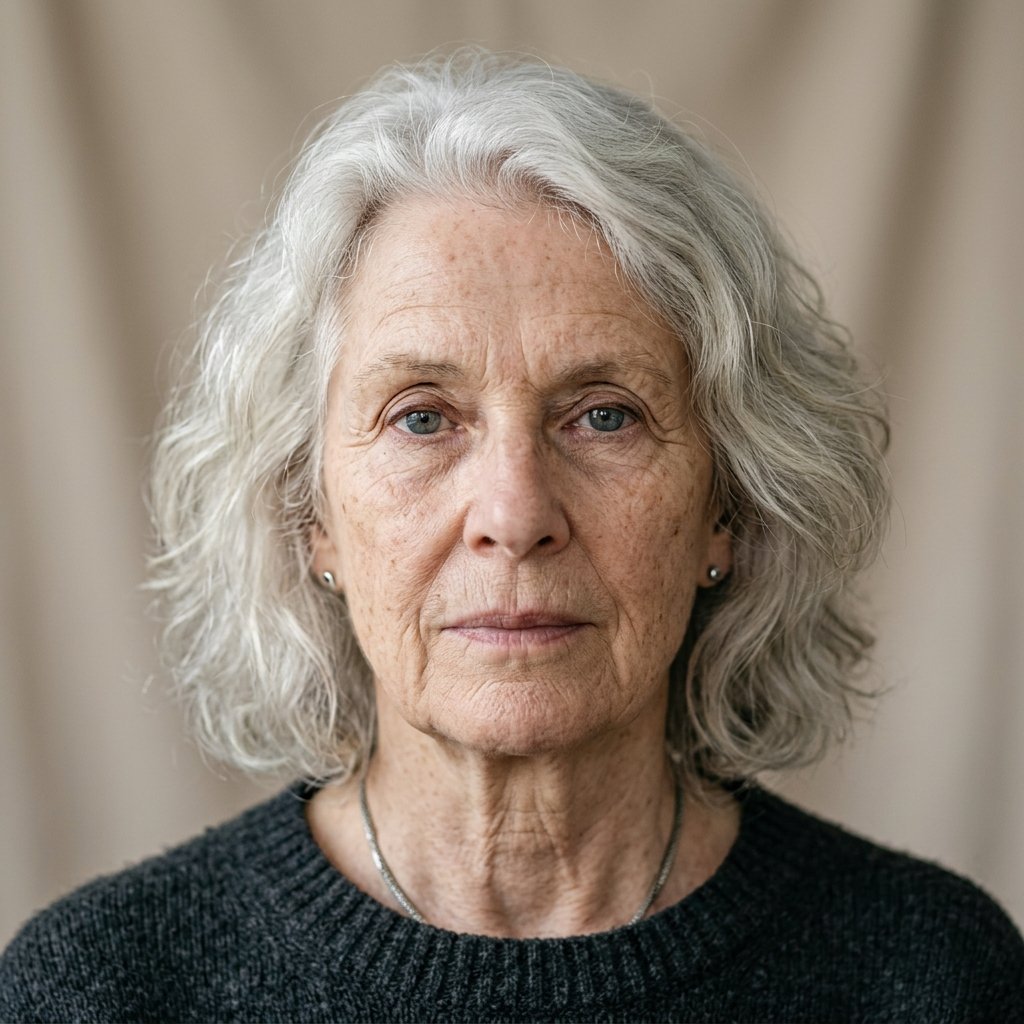
My name is Eleanor Hartwell. I am sixty-eight years old, and I live in a quiet little town called Millbrook, Ohio, where the maple trees turn the color of fire every October and everybody knows everybody’s business.
Seven years ago, my whole world came apart.
My husband Robert, the man I had loved since I was nineteen years old, passed away suddenly one cold morning in November. His heart simply stopped while he was reading the newspaper at our kitchen table, his coffee still warm in his favorite blue mug.
Forty-one years of marriage, gone in the time it takes to turn a page.
I don’t remember much about the days that followed. Grief has a way of wrapping you in fog. People came and went. Casseroles piled up in my refrigerator. Neighbors squeezed my hand and said things I couldn’t hear.
But through all of it, there was one thing I noticed. One thing that cut deeper than losing Robert himself.
Our only daughter, Katie, did not come home.
Katie had always been my headstrong one. She left Millbrook at eighteen with fire in her eyes and a suitcase full of dreams. She built a life for herself out in Denver, a good career, a husband named Daniel, a future.
We had our disagreements over the years, the way mothers and daughters do. She thought I was too controlling. I thought she was too distant. But I never once doubted that she loved her father.
So when the funeral came and went, and her chair sat empty beside me, something inside me broke that grief alone could not have broken.
She didn’t come to bury her own daddy.
My sister Ruth, who had flown in to help me through it all, kept patting my hand and shaking her head. “Don’t you worry about Katie,” she’d say. “She’s made her choices. You just focus on yourself now, Eleanor.”
I remember standing at the graveside as they lowered Robert into the cold ground, scanning the row of faces, praying I’d see hers among them.
She wasn’t there.
And in that moment, in the deepest pit of my sorrow, I made a decision that would poison the next seven years of my life.
I decided my daughter had abandoned us.
I told myself she cared more about her fancy job and her big-city life than about the man who taught her to ride a bicycle and walked her down the aisle at her wedding.
The grief and the anger tangled together until I couldn’t tell one from the other. And when the fog finally started to lift weeks later, that anger was the only thing left standing.
So I did what proud, wounded people do.
I stopped calling. I stopped writing. When Katie’s name came up, I changed the subject.
Months passed. Then a full year. Then two.
The silence became a wall, and every passing season added another brick to it.
I heard through distant relatives that she’d had a baby boy. A grandson I had never met. But by then my pride had grown so tall and so thick that I couldn’t see over it.
“She never even told me herself,” I’d say bitterly. “If she wanted me in that child’s life, she’d have called.”
What I didn’t know, what I refused to even consider, was that she had called. She had called more times than I could ever imagine.
The years rolled on the way they do when you’re older. Slow days, fast months. I filled my time with church and gardening and the local quilting circle.
But every holiday, every quiet Sunday evening, I felt the shape of the family I’d lost sitting beside me like a ghost.
I turned sixty-eight last spring. And that is when everything changed.
It was an ordinary Tuesday. I walked down my gravel drive to fetch the mail, expecting the usual bills and grocery flyers.
But tucked between them was an envelope unlike any other.
It was covered in crayon. Bright blue scribbles, a lopsided yellow sun, and my name written in the careful, wobbly letters of a child just learning to hold a pencil.
“Grandma Eleanor Hartwell.”
My heart began to pound. I stood there in my slippers, the morning dew soaking through, and I tore it open with trembling fingers.
Inside were two things.
The first was a short note in that same childish hand. It read: “Dear Grandma, I found this letter in Mommy’s box. She cries when she reads it. I think you should have it. Love, Sam. I am seven.”
Sam. My grandson. The boy I had never held.
The second thing was an older letter, the paper soft and worn from being folded and unfolded a hundred times. The ink was smudged in places, as though tears had fallen on it long ago.
It was written in Katie’s handwriting. And it was dated the very week her father died.
I lowered myself onto the porch step because my legs would no longer hold me, and I began to read.
“Mom, I don’t know if you’ll ever see this. I’ve called the house so many times and no one picks up. I’m writing because I’m so scared and I don’t know what else to do.”
“The baby came early, Mom. Three whole months early. He’s so tiny. The doctors say the next few nights will tell us if he’s strong enough to make it.”
“I want to be there for Daddy’s funeral. You have no idea how much I want to be there. But I can’t leave my son. If I leave and something happens to him, I will never forgive myself.”
“I keep calling and calling and the phone just rings. I need my mother. I need you to tell me it’s going to be okay. Please, Mom. Please call me back.”
The paper slipped from my hands.
I don’t know how long I sat on that porch, but the mail scattered around me in the wind and I never moved to catch it.
Seven years.
Seven years I had spent believing my daughter had chosen her career over her family, when the truth was she had been sitting in a hospital hundreds of miles away, holding her newborn son’s tiny hand, begging God to spare him.
And begging her mother to answer the phone.
The phone.
That old answering machine on the kitchen counter that I never once thought to check in those first terrible weeks of grief. The little red light I had ignored because I couldn’t bear to hear one more voice offering condolences.
How many of those messages had been Katie? Crying for help in the middle of the night while I slept just a room away?
And then a colder thought crept in.
My sister Ruth. Ruth, who had stayed at my house that whole month. Ruth, who answered my phone and screened my calls because she said I was “too fragile.”
I called Katie that very afternoon. My hands shook so violently I misdialed twice.
When she answered, her voice was cautious, guarded. “Hello?”
“Katie,” I whispered. “It’s your mother. I got your letter. The one Sam sent.”
There was a long, terrible silence on the line. Then I heard her begin to cry.
“I called you, Mom,” she said, her voice cracking. “I called you every single day. Aunt Ruth answered and told me you didn’t want to speak to me. She said you blamed me for not coming to Daddy’s funeral. She said you needed space.”
My blood turned to ice.
“I never said that, sweetheart,” I told her, weeping now myself. “I never knew you called. I never knew about the baby. I thought, oh God, Katie, I thought you didn’t come because you didn’t care.”
We cried together on that phone for nearly an hour. Two women who had spent seven years grieving a relationship that was never truly broken, only misunderstood.
A misunderstanding that one honest conversation could have healed in a single afternoon.
The next morning I packed a bag and I drove the fifteen hours to Denver without stopping to think twice. I did not call ahead. I simply had to see her face.
When she opened that door and saw me standing there with her old letter pressed to my heart, neither of us said a single word.
She fell into my arms, and I held my daughter for the first time in seven years, both of us sobbing in the doorway like two souls pulled back from the edge of drowning.
Behind her, peeking around her leg, stood a little boy with his grandfather’s eyes.
“Are you my Grandma?” Sam asked softly.
I knelt down, my old knees protesting, and I opened my arms. “Yes, baby,” I said. “I’m your Grandma. And I am so, so sorry it took me this long to find you.”
He ran into my arms, and I swear I felt Robert smiling down on us in that moment.
We spent that whole night at Katie’s kitchen table, talking until the sky turned pink outside the window.
We talked about Robert. We talked about the terrifying nights in that hospital when Sam weighed barely three pounds. We talked about all the anger and all the hurt and all the years we’d let slip away.
And finally, gently, we talked about Ruth.
I won’t pretend forgiving my sister came easy. She swore she’d only meant to shield me during my darkest days. Maybe she believed that. But some kindnesses do more damage than any cruelty ever could.
What I know now, sitting here at sixty-eight, is this.
Silence is the loudest lie we ever tell. Assumption is the thief that steals more from us than any burglar ever could.
I lost seven years with my daughter and my grandson. Seven years of first steps and first words and skinned knees and bedtime stories. I will never get those years back, and that regret will live in my chest until the day I join Robert.
But I have today.
Sam calls me every Sunday now, his little voice bursting with stories about school. Katie and I talk more honestly than we ever did before, no walls, no assumptions, just truth spoken plainly.
If there is one thing I have learned, one thing I would beg every mother and every child to hear, it is this.
Do not let your pride write a story that only the truth has the right to tell.
Pick up the phone. Ask the question. Say the hard thing out loud.
Because the people we love most are so often the ones we are quickest to condemn, and the answer that could have saved everything is usually just one conversation away.