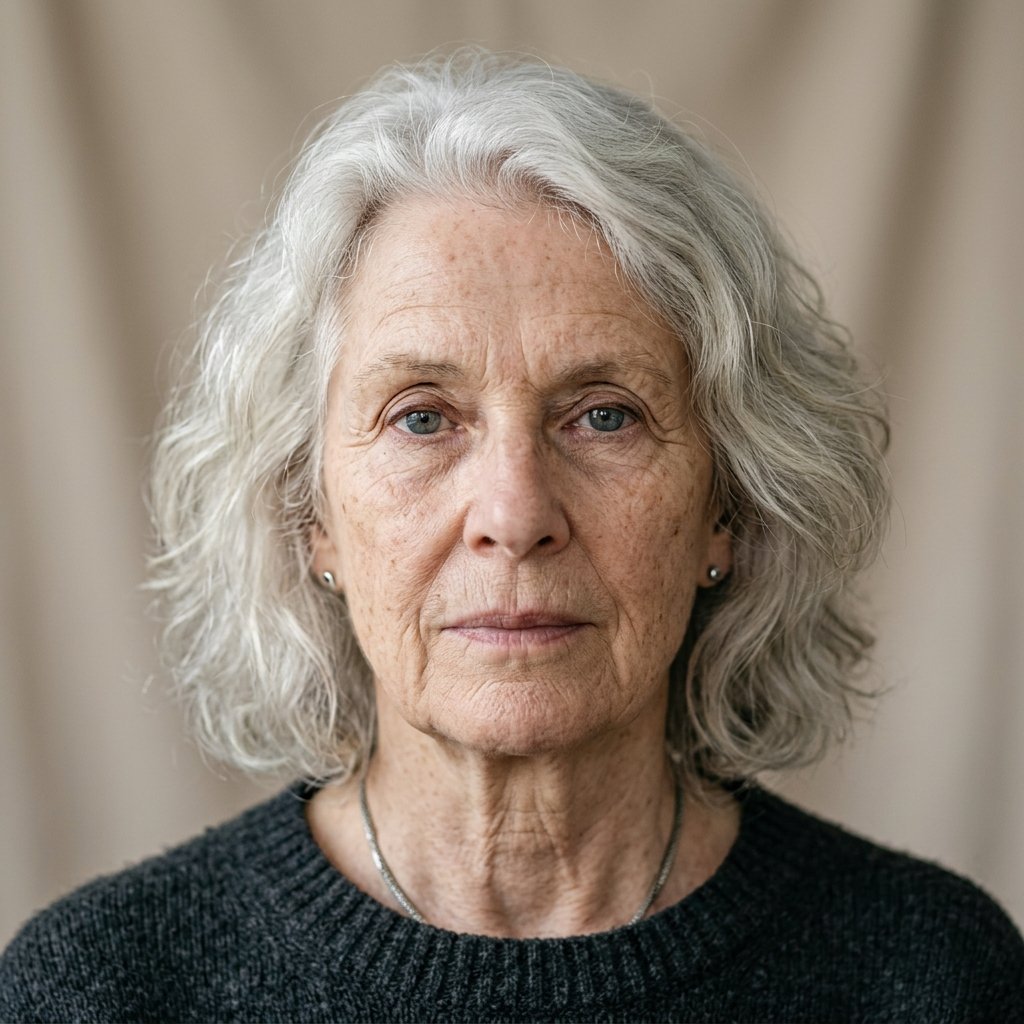
I waited forty-one years for my husband to say two simple words. He finally said them in a hospital hallway at two in the morning, when he thought I was fast asleep.
My name is Margaret, but everyone in Fairview, Ohio has called me Maggie since I was a barefoot girl chasing fireflies on Birch Street.
I married Raymond Whitfield in the summer I turned twenty-two. He was a machinist at the plant on Route 9, a man with rough hands, a straight back, and a pride so thick you could lean a ladder against it.
My mother warned me. She said, “Maggie, a hard man can be a good man, but only if he lets you in.” I told her I’d be patient. I told her love could soften any heart if you gave it enough years.
So that is exactly what I did. I gave it years. I gave it decades.
And for most of them, I waited.
I waited through dinners so silent you could hear the clock ticking in the hall. The only sound at that table was Raymond’s fork scraping the plate, and then that little sigh he gave when the pot roast wasn’t seasoned quite the way his mother used to make it.
“It’s fine,” he’d say. “It’s fine, Maggie.” As if fine was a gift he was handing me.
I raised our two children in that small white house. Danny, who had his father’s stubborn jaw, and Ruth, who had my quiet eyes. I sewed their clothes, packed their lunches, sat up through their fevers, and clapped the loudest at every school recital while Raymond checked his watch.
When his mother, Eleanor, grew too frail to live alone, I moved her into our spare room. I bathed her, fed her, read her the newspaper when her eyes failed, and held her hand the night she passed.
And through all of it, in forty-one years, I never once heard my husband tell me I had done a good job.
Not once.
What I heard instead was, “Anybody could’ve done that, Maggie.” Or, “Don’t go looking for a medal.” Or my least favorite, delivered with a wave of his hand, “It’s what a wife is supposed to do.”
I told myself he showed his love in other ways. He worked hard. He never drank away the paycheck. He fixed the porch step and shoveled the walk. But a woman can freeze to death standing next to a man who never once turns to warm her.
Somewhere in my forties, I started keeping a little notebook. It had a soft blue cover, worn smooth at the corners from riding in the bottom of my purse.
On the left-hand pages, I wrote down the words that stung. Not out of spite. I think I was just trying to prove to myself I wasn’t imagining it, that the ache in my chest was real.
But on the right-hand pages, every single day, I forced myself to write one line of hope. “Maybe tomorrow he’ll notice.” “He carried the groceries today without being asked.” “He almost smiled at breakfast.”
That little blue notebook was my confession and my prayer, all stitched together. It was the only place I ever let the tears fall on paper instead of into a dish towel at the kitchen sink, where I cried quietly most nights so Raymond wouldn’t hear and call me foolish.
The children grew up and moved away, as children do. Danny to Denver, Ruth to a little town outside Nashville. The house got quieter, if that was even possible.
Raymond retired from the plant, and I dared to hope. I thought, now we’ll have time. Now he’ll rest, and soften, and finally see me sitting right across from him.
Instead he got sharper. Bored men can be cruel men. He’d follow me from room to room finding fault. The dust on the shelf. The channel I’d left on. The way I hummed while I cooked.
“Do you have to make that noise, Maggie?”
I stopped humming. It’s a small thing, giving up your own song. But you’d be surprised how many small things a woman lays down over the years without anyone noticing the pile.
Then came the coldest morning of last February.
I was standing at the counter, cracking eggs into a bowl, when a pain seized my chest like a fist made of iron. The bowl slipped. I remember the sound of it shattering on the linoleum, and then the floor rising up to meet me.
The last thing I saw was Raymond’s slippers running toward me, faster than I’d ever seen that proud man move in his life.
When I woke, I was in a bed at Fairview General, wires taped across my chest, a machine beeping out the rhythm of a heart that had nearly quit on me.
And there was Raymond, gripping the bed rail with both hands, his knuckles white, his eyes red and wild. He looked like a man watching his whole life slide toward the edge of a cliff.
“You’re awake,” he breathed. “Thank God. Thank God, Maggie.”
The doctor said it was my heart, and that I’d have to stay a few days. I asked Raymond to run home and bring my reading glasses and my things, so I’d feel less like a stranger in that cold white room.
He went. And in my purse, tucked beneath my wallet, he found the little blue notebook.
Now, Raymond was not a man who snooped. But he told me later that when he saw it, something told him to open it. Maybe it was fear. Maybe, for the first time in his life, it was a longing to understand the woman he’d shared a bed with for four decades.
He sat down on the edge of our empty bed, and he read.
He read every left-hand page. Every dismissal. Every sigh. Every night I’d written, in shaky pen, “Cried again. He didn’t ask why.”
And then he read the right-hand pages. Forty-one years of a woman refusing to give up on him. “Maybe tomorrow he’ll notice.” Page after page after page of hope that he had never once earned.
A young nurse told me the rest, weeks later, with tears in her own eyes.
She said that around two in the morning, she found an old man standing alone in the dim hospital hallway outside my room. His shoulders were shaking. He had the notebook pressed against his chest like it was the most fragile thing in the world.
And he was whispering, over and over, “Thank you, Maggie. Thank you for staying. I’m so sorry. I’m so sorry.”
Here is what he never knew.
I wasn’t asleep.
The door was cracked open, and I heard every broken word my husband said into the dark. Forty-one years I had waited to hear a thank you. And when it finally came, it came from a man who thought no one in the world was listening.
I closed my eyes and let the tears run sideways into the pillow, and for the first time in longer than I could remember, they were not tears of loneliness.
The man who drove me home from that hospital was not the man who had carried me in.
It started small, the way real change always does.
The first morning back, I woke to the smell of coffee. Raymond had made it, and he’d made it right, with the splash of cream and the half spoon of sugar I’d been fixing for myself for forty-one years while he drank his black.
He set the cup on my nightstand, and his hand trembled a little. “I wasn’t sure I remembered how you take it,” he said quietly. “I paid attention this time.”
He learned to do the dishes. He’d stand at that same sink where I’d cried so many nights, humming, badly, off-key, until one evening I realized he was humming so I’d feel free to hum along.
At my follow-up appointments, he held my hand in the waiting room. This proud man who’d never reached for me in public in his life laced his fingers through mine and didn’t let go.
He started saying “please” and “thank you” like they were words dipped in gold. When I made supper, he’d take the first bite, close his eyes, and say, “Maggie, nobody on this earth cooks like you.” And he meant it. I could see that he meant it.
One night in early spring, the radio was playing an old slow tune, the kind we’d loved when we were young.
Raymond stood up from his chair. He held out his hand to me, and his eyes were wet.
“Dance with me,” he said.
I just stared at him. Because on our wedding day, in the church hall on Maple Street, he had refused to dance. He’d said he was too tired, too old-fashioned, that dancing was foolishness. I had sat in my white dress and watched other couples sway while my new husband checked his watch.
I never forgot it. I never told him it broke my heart.
But somewhere in that blue notebook, on a page from long ago, I had written it down.
And he had read it.
So there we stood, forty-one years later, two gray-haired people in a small kitchen in Fairview, Ohio. He pulled me close, one hand on the small of my back, the other holding mine against his chest.
We swayed, slow and clumsy, to a song about time and love. And he pressed his face into my hair, and I felt him tremble, and he whispered the words I will carry with me for the rest of my days.
“I wasted so much time, Maggie. I had a good woman right in front of me, and it took nearly losing you for me to open my eyes. Can you ever forgive an old fool?”
I could have said so many things. I could have listed the years. I could have made him pay.
Instead I looked up at the man I’d waited a lifetime for, and I told him the only truth that mattered.
“We still have tonight, Raymond,” I said. “And tonight is enough.”
We danced until the song ended, and then we danced through the next one too.
Raymond passed away peacefully this past May, with his hand in mine and my name on his lips. We had one good year. One tender, gentle, grateful year.
People ask me if I’m angry that it took so long. If I’m bitter about all the cold decades I gave to a man who woke up only at the very end.
I’m not. Because I got to see him change. I got to watch a hard man become soft, a silent man become kind, a proud man learn to say thank you and mean it with his whole heart.
Most people never get that. Most people bury their regrets. Raymond got to lay his down while I was still here to hold him.
I still have the little blue notebook. But I don’t write the hurting words on the left anymore. There’s no need.
I only write on the right side now. And every entry says the same thing.
“He noticed. He finally noticed. And it was worth the wait.”
So tell me, friend. Was I foolish to stay all those long years, or was I wise to never give up on the man I loved? And have you ever watched someone finally become the person you always prayed they could be?