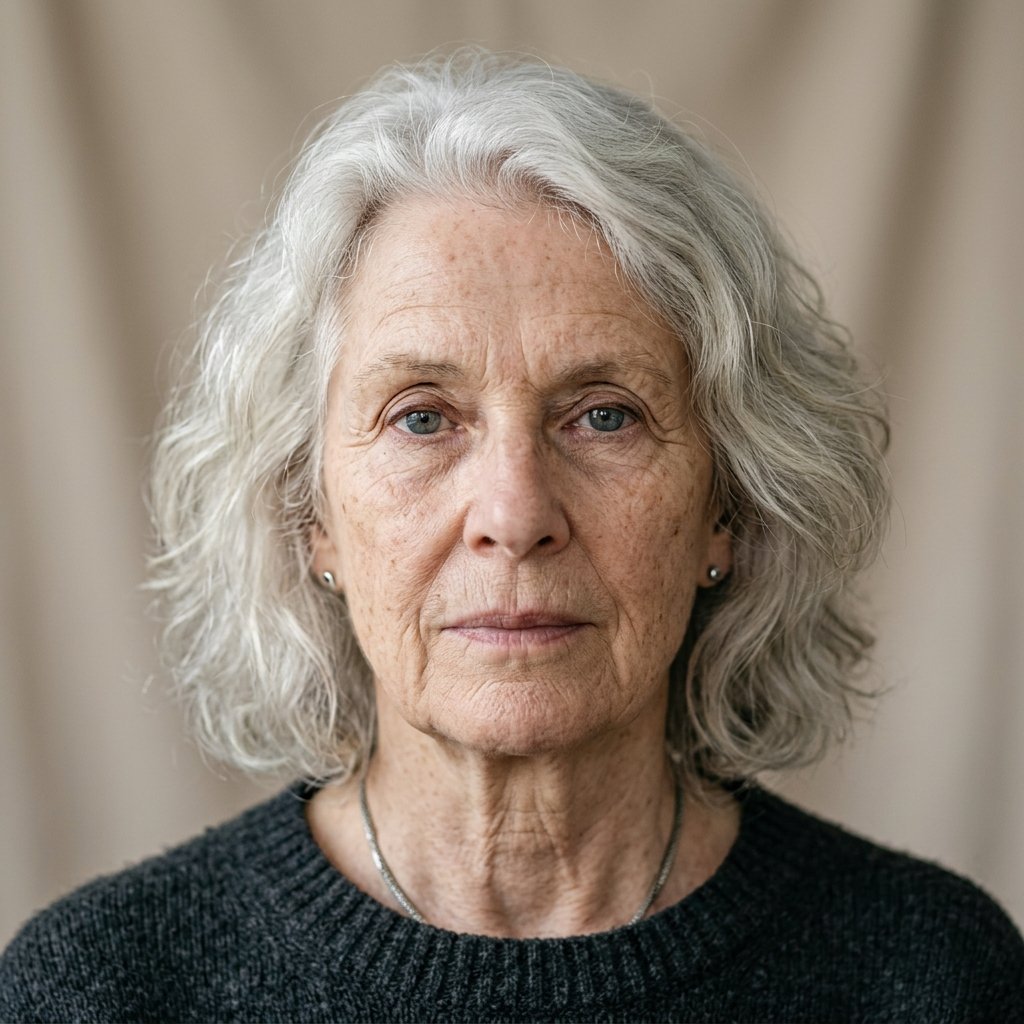
The morning I saw Walter Hensley again, after sixty years of believing he had abandoned me, I dropped my coffee cup and it shattered across the diner floor.
I was eighty-one years old. My hands had trembled for a decade. But they had never once trembled the way they did in that moment.
He was sitting in the corner booth of Dolan’s Diner, right here in Cedar Falls, the same little town where we both grew up. His hair had gone white and thin. His shoulders had folded inward the way old men’s shoulders do.
But those eyes. Lord help me, I would have known those eyes if I lived to be two hundred.
A waitress rushed over with a broom, apologizing as if the broken cup had been her fault. I barely heard her. My whole body had gone cold and hot at the same time.
Because sitting fifteen feet away from me was the man who never showed up to marry me.
Let me take you back, because you can’t understand the storm in my chest without knowing what came before it.
It was 1965. I was twenty-one and Walter was twenty-three, and we were the kind of young that believes the whole world was built just for the two of you.
He worked at his father’s hardware store on Main Street. I taught piano to the neighborhood children in my mother’s front parlor.
He used to leave little folded notes tucked under the windshield wiper of my car. Silly things. A drawing of a duck. A single line of a song we both loved.
When he asked me to marry him, he did it on the wooden bridge over Miller’s Creek, down on one knee in the mud, ruining his only good trousers.
I said yes before he even finished the question.
There was only one problem, and his name was my father.
My father was a proud man. A banker. He had plans for me that involved a lawyer’s son from two towns over, a boy with a family name and a future my father could brag about at church.
Walter, in his eyes, was just a shopkeeper’s boy with dirt under his fingernails and no money in the bank.
He never said it to my face. My father was too polished for that. But I saw the way his jaw tightened every time Walter came to the house.
Still, I didn’t care. I was going to marry the man I loved, and my father could learn to live with it.
The wedding was set for a Saturday in June, at First Community Church on Elm Street. My mother sewed my dress by hand. I remember the smell of the lilacs my aunt arranged on every pew.
And I remember standing at the back of that church, my arm looped through my father’s, waiting for the doors to open and the music to carry me down the aisle to Walter.
But Walter wasn’t there.
The organ played the opening song. Then it played it again. Then a third time.
People started to murmur. I saw my mother twisting her handkerchief. I saw the minister check his watch and look away from me.
An hour passed. Then another.
My father leaned close to my ear, and I will never forget the words he whispered. “Some men aren’t the marrying kind, Eleanor. Better you learn it today than in ten years.”
Walter never came. No note. No phone call. No explanation.
I walked back out of that church still in my wedding dress, and something inside me quietly closed like a door swinging shut in an empty house.
I didn’t cry in front of anyone. I saved that for the dark.
For weeks I waited for him to come and explain. I told myself there had to be a reason. An accident. A change of heart he was too ashamed to admit.
But the store said he’d left town. His family had moved on to a cousin’s place in another state, they said. And just like that, Walter Hensley disappeared from my life.
Two years later, worn down and lonely, I married Thomas Bell, a kind and steady man who fixed clocks for a living.
And here is the truth I don’t often admit. Thomas was a wonderful husband. We had three children. We laughed at the same jokes for forty-nine years.
But on the quietest nights, when the house was still, a small corner of my heart still stood in that church, waiting for a man who never walked through the doors.
Thomas passed away seven years ago. I nursed him through his last winter, held his hand at the very end, and I grieved him the way you grieve a life well shared.
Which brings me back to that diner, and the broken coffee cup, and the trembling hands that betrayed me across the room.
I don’t know what came over me. Grief, maybe. Or sixty years of a question that never got answered.
I walked straight to his booth. My cane tapped the tile with every step. And when he looked up and saw me, his mouth fell open and his eyes filled with tears in an instant.
“Eleanor,” he breathed, like my name was a prayer he’d stopped saying long ago.
All the anger I’d buried rose up in me at once. I gripped the back of the chair to steady myself.
“You have no right to cry,” I said. “You left me standing in a church in front of everyone I knew. Do you have any idea what that did to me?”
And then he did something I never expected.
He reached into the inside pocket of his old coat with shaking fingers and pulled out an envelope. It was yellowed with age, soft at the corners from being carried too long.
My name was written across the front in his handwriting. And the flap had never been opened.
“I wrote this the night before the wedding,” he said, his voice cracking apart. “I got scared, Eleanor. Not of you. Of failing you. I wanted you to know I’d love you even when I had nothing to give.”
I stared at the envelope. My hand refused to reach for it.
“I brought it to your house that morning,” he went on. “I wanted to read it to you before the ceremony. Your father met me at the door.”
My blood ran cold.
“He told me you’d changed your mind,” Walter said. “He said you’d realized I would never be enough, and that you were too kind to tell me yourself. He said the merciful thing I could do was leave and never come back.”
The diner seemed to tilt around me.
“I didn’t believe him at first,” Walter whispered. “But he took the letter from my hand and said he’d give it to you, so you’d have my goodbye. And then he shut the door in my face.”
He laid the envelope on the table between us.
“He mailed it back to my mother’s house a month later,” he said. “Unopened. That’s how I knew it was true. I thought you never even wanted to read my words.”
I sank into the seat across from him because my legs would no longer hold me.
Sixty years. Sixty years of believing he had abandoned me. And all that time, he had believed I had rejected him.
One lie, spoken by a proud old man on a June morning, had stolen two entire lifetimes from us.
My father had died at peace, surrounded by family, never once confessing what he’d done. He had watched me marry another man and smiled through the whole ceremony.
With trembling fingers, I finally picked up the envelope. The old glue gave way easily.
Inside was a single page, the ink faded but still readable, written by a frightened twenty-three-year-old boy who loved me more than he knew how to say.
I won’t share every word. Some things belong only to the two of us now.
But the last line broke me open completely. It said, “Whatever happens, Eleanor, I will spend my whole life grateful that you let me love you at all.”
I cried in that diner in a way I hadn’t cried since I was a girl.
And here is where I had a choice to make. I could spend whatever years I had left hating my father’s memory. I could let the bitterness over everything we lost swallow the little time we still had.
Or I could do the harder, braver thing.
I reached across that sticky diner table and took Walter’s trembling hand in mine, the way I had wanted to on that June morning sixty years before.
“We can’t get those years back,” I told him. “And I can’t undo what my father did. But I forgive it. I forgive all of it. Because I don’t want to spend my last chapter angry at the dead.”
He pressed my hand to his cheek and wept.
We sat in that booth until the sky went dark and the waitress finally, gently, told us they were closing.
We talked about everything. His late wife, a good woman he’d married out of loneliness in another state. My Thomas. Our children. The strange, painful comfort of two people who had built full lives while quietly carrying the same wound.
Walter had come back to Cedar Falls to sell his childhood home. He hadn’t planned to stay more than a week.
He stayed the rest of his life instead.
We were married that autumn, both of us well over eighty, in that same little church on Elm Street where he never came all those years ago.
The pews weren’t full this time. Just our children, our grandchildren, and a handful of old friends who remembered the story and had waited sixty years to see it end differently.
This time, Walter was standing at the front when I walked in. And he was weeping before I even reached him, just the way he had wept in the diner.
When I finally arrived at his side, he leaned in and whispered, “You came. You actually came.”
And I whispered back, “I never stopped coming, Walter. I just took the long way around.”
Forgiveness didn’t erase the pain of the years we lost. It didn’t give us back our youth or the children we might have raised together.
But it gave us back the love we both believed had died on a June morning long ago.
We have three quiet, precious years together now. We take our coffee on the porch every morning. He still leaves little notes tucked around the house for me to find.
Sometimes I think about how close I came to walking out of that diner without saying a word. How close I came to letting an old lie keep its grip on me until the very end.
I’ve learned that the heart can hold a door open for six decades, waiting patiently for the truth to finally walk through it.
And I’ve learned that it is never, ever too late to forgive, or to be loved again.