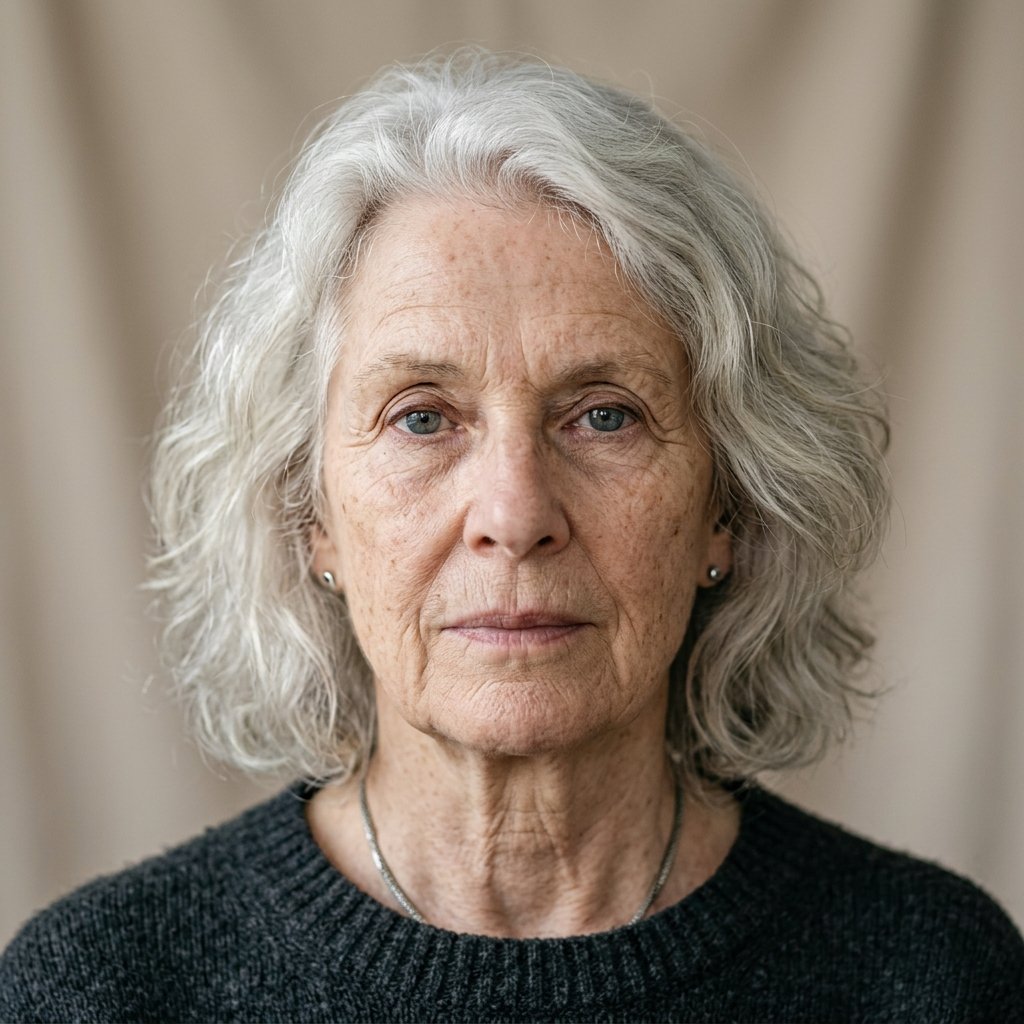
“Walking away from you was the best decision of my life, Eleanor. A woman who can’t have children has no real worth. My son was given to me by your own best friend.”
Gregory announced it loudly enough for the entire corridor of St. Anthony’s Medical Center to hear, right outside the pediatric wing. A nurse pushing a cart paused briefly, then looked away. An older woman in the waiting area clutching a tiny blue baby blanket lowered her eyes.
I had just stepped out of my routine annual check-up when his voice cut through the air like a blade I thought I’d long buried.
A year had passed since our divorce was finalized. I had rebuilt my life piece by piece, alone in a small apartment over a bakery on Maple Street. I had stopped crying. I had found a strange, quiet peace.
And yet here he was, with that same arrogant smirk, wearing an expensive azure button-down and a watch that cost more than my car. Leaning against the wall like he owned the place.
Beside him stood Patricia, my former dearest friend since our freshman year of college. She was holding a little boy who looked to be almost one year old. He was sleeping soundly, his tiny cheek pressed against her shoulder, completely oblivious to the ugliness swirling around him.
She held his bottle with one hand and kept touching a pair of pearl earrings with the other.
My pearl earrings.
The ones my grandmother had given me the day I opened my first community health clinic. I remembered her worn hands pressing the small velvet box into mine, her voice trembling with pride. “These are for you, my Eleanor. You’ve earned every bit of beauty in this world.”
Patricia had once admired them on my dresser, saying they were “so classic, so full of soul.”
Now they dangled from her ears as if my heritage was simply a hand-me-down she was entitled to claim.
“Gregory, maybe we should go,” she murmured, feigning discomfort.
But I knew Patricia. We had shared dorm rooms, secrets, and dreams for over fifteen years. I knew the difference between genuine shame and this performance. That tiny upward twitch at the corner of her mouth was not embarrassment.
It was triumph.
Gregory took a step closer to me. “You look exhausted. Still living in that cramped little place above the bakery?”
I didn’t answer.
After the divorce, they took everything. The house in Maplewood Heights. Our shared circle of investor friends. The foundation we had built together to fund rural clinics. They even stole the narrative of my own life, twisting it so that I was the unstable one, the bitter woman who couldn’t conceive and made everyone miserable with her treatments and mood swings.
Three days after my final failed IVF procedure, Gregory slid the divorce papers across the kitchen island.
“At least walk away with some dignity,” he had said, switching to that overly polished tone he always used when he wanted to sound magnanimous while crushing my spirit.
I signed.
Not because I wasn’t devastated. I was hollowed out, a shell of the woman I used to be. I signed because I hadn’t slept through a full night in months, and I had spent years listening to doctors and my own husband tell me my body was broken. There was a weariness in my bones so deep that fighting back felt like trying to swim against a tidal wave.
That same evening, Patricia brought me a bowl of homemade chicken soup.
She held me while I sobbed.
She cried with me.
She whispered that maybe some women were just meant for a different kind of life.
Two weeks later, she moved into Gregory’s house.
Six months after that, they announced their pregnancy on social media with a smiling photo and a caption about “true love finding its way.”
People celebrated them. People called it destiny, a blessing, as if their betrayal was somehow romantic and justified.
“Just leave her alone,” Patricia said now, her voice flat and unconvincing.
Gregory let out a short, cruel laugh. “Why would I? A year ago she was sobbing about how I abandoned her. Look at her now. I have a family. I have a son. And she’s still alone with nothing but medical files and her own sad thoughts.”
The baby stirred slightly in Patricia’s arms. She guided the bottle back to his lips, but her hands were shaking visibly.
I looked at the little boy. I felt no anger toward him. He was innocent in all this. His long lashes rested on his cheeks, his breathing slow and steady, as peaceful as a child who had no idea the adults around him were built on a foundation of lies.
“So this is the son you’re so proud of?” I asked softly.
Gregory’s grin widened. “My boy, Liam. He’ll be one year old next week. The greatest thing that ever happened to me, after I finally got rid of you.”
A chill traveled slowly down my spine.
It was no longer pain I felt.
It was memory. A flood of them, sharp and precise.
I remembered my scattered medical records. The missing pages from my fertility profile. Test results that were never shared with me directly, only summarized by Patricia, who had volunteered to handle the paperwork because “I was too fragile.”
I remembered the authorizations on foundation documents that I was sure I never signed. The financial transfers casually labeled as consulting fees. The anonymous phone warnings that started right after I formally requested certified copies of my own medical history.
And I remembered the first time Dr. Michael Hartman looked me in the eye and said, “Eleanor, there are discrepancies here that demand a full investigation.”
Gregory tilted his head. “What’s with that look? You used to weep over every little thing. Now you just stand there smiling?”
I did smile. Not a bitter smile, but a quiet, profound one. The kind that comes when you finally understand a terrible, beautiful truth.
“Is that really what you think happened?” I asked.
He frowned. “What’s that supposed to mean?”
Before I could answer, the elevator doors at the end of the hallway slid open with a soft chime.
Dr. Michael Hartman stepped out in a sharp navy suit, his hospital ID badge clipped neatly to his lapel. He was holding a sealed packet under his arm.
He was not alone.
Two other individuals walked behind him. I recognized them from the state oversight board—a woman in a charcoal blazer carrying a slim briefcase, and a man holding a thick binder of documents. Their expressions were serious, official, unmistakable.
Patricia saw them before Gregory did.
Every drop of color drained from her face.
Her hands went limp. The baby bottle slipped from her fingers and hit the floor with a loud, wet crack. Formula splashed across the linoleum, spreading in a milky puddle like a stain that could never be hidden.
Gregory spun toward her, annoyed. “What is wrong with you?”
But Patricia couldn’t speak. She just stared at Dr. Hartman, her mouth opening and closing like a fish gasping for air.
Dr. Hartman stopped right beside me. He placed a steady hand on my shoulder, and for the first time in years, I felt something I’d almost forgotten: hope, solid and real.
“Because Eleanor asked me to be here,” Dr. Hartman said calmly, answering the question Gregory hadn’t yet asked.
Gregory’s smirk vanished. For the first time, something flickered in his eyes—confusion, then the first seed of fear.
The doctor looked at him with absolute composure, then glanced at the sleeping baby, then back at Gregory and Patricia.
“We’ve received the conclusive analysis from the diagnostic review board,” Dr. Hartman announced, his voice carrying the quiet authority of a man who had spent months uncovering something monstrous.
“What analysis?” Gregory demanded, his voice rising.
Patricia clutched Liam tighter to her chest. The baby squirmed slightly but didn’t wake. Her knuckles were white against his blanket.
Dr. Hartman raised the sealed packet so they could see the official state seal.
“The documentation proving that Eleanor was never incapable of conceiving,” he said.
The corridor fell into a profound, echoing silence.
It felt as though the air itself had frozen. The nurse who had been trying not to listen stopped dead in her tracks. The old woman in the waiting area looked up, her eyes wide.
I watched it all unfold as if I were watching a film I had already seen a hundred times in my dreams. The dreams where I finally got to tell my story. The dreams where the truth didn’t just whisper—it roared.
Gregory took a step back. “That’s impossible. We did years of treatments. The specialists said—”
“The specialists were provided with falsified baseline data,” Dr. Hartman interrupted, his voice cold and clear. “Someone systematically manipulated Eleanor’s fertility profile, altering hormone panels, fabricating test outcomes, and suppressing the actual results indicating she had no physiological barrier to pregnancy.”
Patricia let out a small, strangled sound.
I turned to look at her—the woman who had held me as I cried, who had spoon-fed me soup and empty comforts while quietly dismantling my marriage, my reputation, my future.
“You,” I whispered, not a question.
Her face crumpled. The mask of innocence shattered completely. I could see it now: the desperation, the panic, the guilty knowledge she had carried for so long.
“I didn’t—I never meant—” she stammered.
Gregory looked from her to the doctor, his confident smirk now replaced by something ugly and lost. “What is she talking about? What did you do?”
But Patricia couldn’t answer. She just kept shaking her head, tears spilling down her cheeks, the baby now fully awake and starting to whimper.
Dr. Hartman opened the packet and pulled out a single sheet of paper—the official summary. “This report is the result of a six-month forensic audit of Eleanor’s medical history and the financial records of the Maplewood Foundation. It shows a pattern of deliberate sabotage. Falsified reproductive health records. Unauthorized transfers of foundation funds into personal accounts. And a documented conspiracy to defraud and emotionally destroy a woman for personal gain.”
The woman from the oversight board stepped forward. “We have warrants to secure all related records from the clinic systems and from your private business accounts, Mr. Gregory. You and Ms. Patricia are officially persons of interest in a criminal investigation.”
Gregory’s face went pale. “This is insane. She’s lying. She’s just bitter and crazy—”
“The evidence is irrefutable,” the man with the binder said flatly. “We’ve already cross-referenced digital signatures, timestamps, and IP logs. Everything traces back to devices registered to Ms. Patricia.”
Patricia let out a sob. “I was just trying to help her! She was so obsessed with having a baby, it was destroying her mentally. I thought if she stopped trying—”
“You thought if she stopped trying, you could have her life,” I said, my voice steady even as my heart pounded. “Her husband, her home, her earrings, her story.”
She didn’t deny it. She just looked at the floor, at the spilled formula staining her shoes.
I thought back to all those nights I lay awake, wondering what was wrong with me, why my body wouldn’t cooperate, why God had cursed me with barrenness. I remembered the injections, the hormones that made me sick and swollen, the invasive procedures, the hope that was crushed month after month. And all along, the problem wasn’t my body.
The problem was the woman hugging me and telling me it would all be okay.
Gregory was backing away now, his hands trembling. “I didn’t know. I swear I didn’t know any of this.”
But I could see the truth even in his eyes. Maybe he didn’t know the details of the medical fraud. But he knew something was wrong. He knew he was abandoning a vulnerable woman. He chose the easier, more comfortable story—the one where I was broken and he was the victim. He chose Patricia because she made him feel like a hero.
Dr. Hartman put the sheet back into the packet. “The full report will be submitted to the court this afternoon. Eleanor’s legal team will be filing a civil suit for fraud, emotional distress, and theft of marital assets. We also have grounds to revisit the divorce settlement.”
I looked at little Liam, who was now crying softly, confused by the tension. I felt a deep sadness for him. He was born into a web of deceit, and none of it was his fault.
“I’m sorry for the baby,” I said quietly. “He deserves better than this.”
Patricia clutched him and turned away, sobbing.
Gregory just stood there, the arrogance completely gone, replaced by a hollow, dazed look.
I turned to Dr. Hartman. “Thank you. For believing me when no one else would.”
He nodded. “The truth has a way of surfacing, Eleanor. It just needed someone to dig deep enough.”
The officials began speaking to Gregory and Patricia, handing them papers, reading them their rights. I didn’t stay to watch. I walked down that hospital corridor, past the nurse who now looked at me with something like admiration, past the old woman who gave me a small, knowing nod.
I stepped into the elevator, and when the doors closed, I finally let the tears fall. Not tears of anger or grief, but relief. Pure, cleansing relief.
For years I had believed I was broken. I had internalized the blame, the shame, the isolation. I had believed the whispers and the taunts. I had let them rewrite my identity.
But now I knew the truth. I was never the problem. I was the victim of a calculated betrayal by the two people I trusted most. And somehow, through all of it, I had survived.
I walked out of St. Anthony’s into the crisp autumn sunshine, and I felt something I hadn’t felt in a long time: free.
The bakery on Maple Street would still be there, with its warm croissants and the kind owner who always saved me a loaf of sourdough. The small apartment upstairs was modest, but it was mine, free of lies and manipulation.
I had a long road ahead—court cases, healing, maybe reconnecting with the parts of myself I had lost. But I also had something far more powerful than money or status or even the ability to bear children.
I had my truth back.
And that was enough.
Thank you so much for reading this story. If it touched your heart or reminded you of the strength we all carry inside, please tap the ‘Like’ button and follow our page for more tales of hope and resilience. And if you believe that the truth always deserves to be told, please share this story with someone who might need it today.