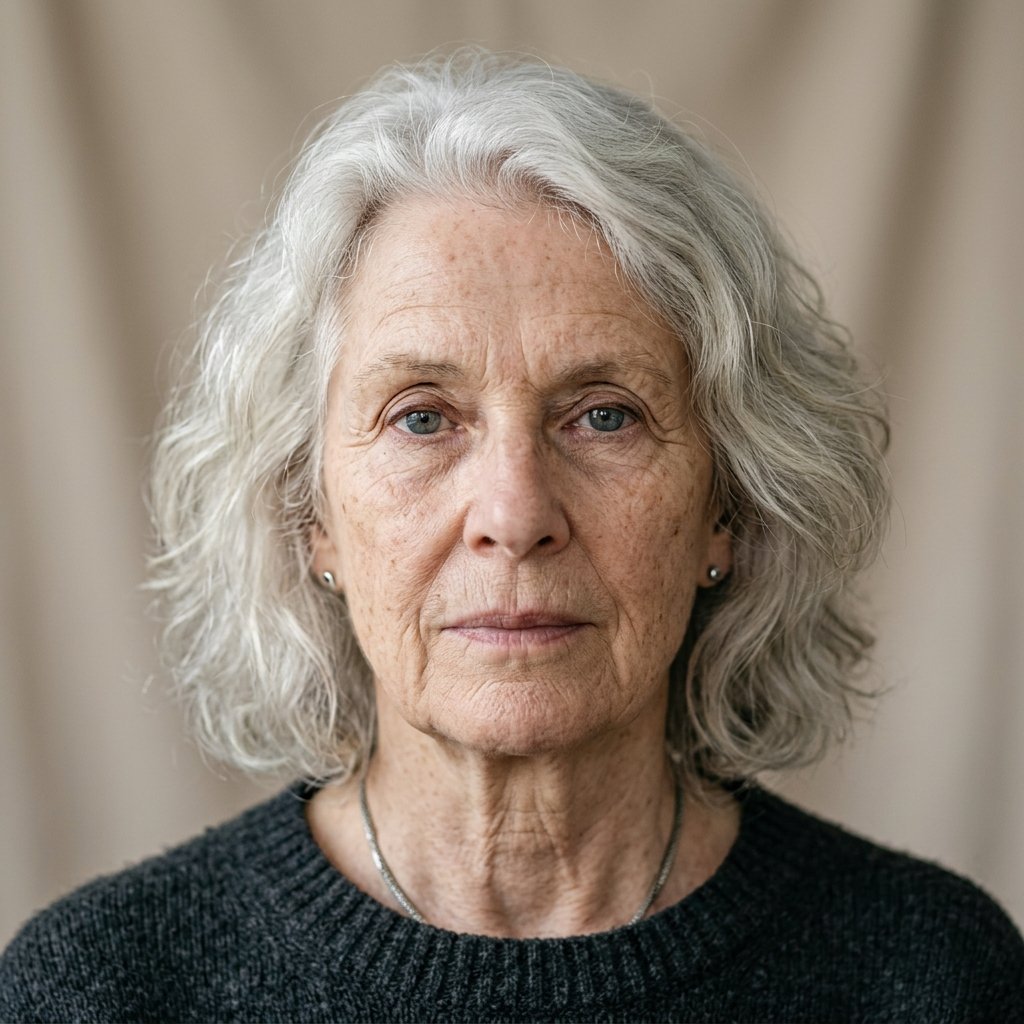
The morning we buried my husband, the sky over Millbrook was the gray of an old nickel, and I remember thinking the whole world had lost its color along with him.
Robert had been a carpenter. A good one. His hands could turn a pile of rough pine into a cradle, a cabinet, a front porch swing where we’d sat every summer evening of our marriage.
And then, on an ordinary Tuesday in October, his heart simply stopped while he was framing a barn out on the Henley property.
I was thirty-four years old. I had three children under the age of twelve, a mortgage two payments behind, and eleven dollars folded inside a coffee can on top of the refrigerator.
At the funeral, as folks filed out of the little white church on Chestnut Street, our neighbor Ruth Caldwell caught me by the sleeve.
Ruth had money. Her husband owned the hardware store and half the storefronts on Main. She wore her opinions the way she wore her pearls, out in the open for everyone to see.
“Eleanor,” she said, not unkindly, but the way you’d speak to a child who’d wandered into the road, “those three little ones are going to drag you straight into the poorhouse. You ought to think about giving them up. It’d be the merciful thing.”
I didn’t say a word. I couldn’t trust my voice not to break.
But I remember the exact feeling in my chest, like someone had lit a small, stubborn fire that refused to go out.
That night, after I’d tucked James, Sarah, and little Danny into bed, I sat at the kitchen table and I did not cry.
Instead, I threaded a needle and I started sewing.
Mrs. Abernathy down the lane needed her drapes hemmed. It was fifty cents. It was a beginning.
By the end of that first month, I was cleaning three houses a week, taking in laundry from the boarding house, and working the graveyard shift at Dot’s Diner out on Route 9.
I would come home at four in the morning, my feet swollen inside shoes with cardboard patching the soles, and I would sit on the edge of my children’s beds just to hear them breathe.
That sound was the only paycheck that ever truly mattered.
Money was a cruel and constant arithmetic. I learned to stretch a single chicken across four days. I learned which grocer in town would let a widow run a tab and never shame her for it.
The winter James turned fourteen, the furnace gave out. We slept in the front room with quilts piled high and a single kerosene heater between us, and I told the children we were camping, like pioneers.
They laughed. Lord, how they laughed. Children have a mercy in them that adults forget.
But the hardest day came the spring James was accepted into the state university.
He walked home from the mailbox holding that letter like it was made of glass, his whole face lit up brighter than I’d seen since his father passed.
And then he saw the numbers on the tuition page, and the light went out of him.
“It’s alright, Mama,” he said quietly, folding the letter away. “I’ll just get a job at the mill. It’s fine.”
But it was not fine. I had watched Robert’s talent for building things pass straight into that boy’s mind for numbers and medicine, and I would not let it die in a lumber mill.
So the next morning, before the sun was fully up, I drove into the city and I walked into a pawnshop I’d passed a hundred times but never entered.
I slid my wedding ring across the counter.
It was the only truly beautiful thing I owned. Robert had saved for two years to buy it.
The man behind the glass turned it in the light, and I turned my face away so he wouldn’t see what it cost me.
I took the money, and I paid James’s first semester in full.
When he asked me later why I’d stopped wearing my ring, I smiled and said my fingers had gotten too thin, that it kept slipping off in the dishwater.
He was seventeen. He knew better. But he was kind enough to let me keep my pride, and I have loved him for that mercy every day since.
Those were the years no one ever writes stories about. The invisible years.
Sarah wore coats that other girls had outgrown. Danny came home more than once with tears he tried to hide, because a boy at school had pointed at the patches on his jeans.
And every single night, no matter how the day had gone, I gathered them close and told them the same words.
“Listen to me now. You are not poor. Poor is a thing that happens to your wallet, not to your soul. You are simply not finished yet.”
I don’t know if I believed it every time I said it. But I said it until they did.
The years turned, the way they do, faster than you’re ready for.
James earned his degree, then went on to medical school on scholarships he’d fought for tooth and nail. Sarah became a teacher, then a principal, the first in our family to run anything at all. And Danny, my baby, learned his father’s trade and built it into a company that raised homes all across the county.
I kept cleaning houses well into my sixties, long after they begged me to stop. Work was the language I spoke best, and idleness frightened me more than labor ever had.
Ruth Caldwell and I would nod at each other in the market, two old women grown gray in the same small town, the years between us thick with everything unsaid.
Then, last month, my children told me they were throwing a party for my seventieth birthday.
Danny drove me into town in his truck, and when we pulled up to the old Millbrook town hall, I scolded him for spending too much.
“A slice of cake at the kitchen table would have done just fine,” I told him.
He just smiled and opened the door for me.
I stepped inside expecting a handful of old friends.
Instead, three hundred people rose to their feet and turned to look at me.
My knees nearly buckled. Sarah caught my arm and walked me to a seat at the front, and I could feel every eye in that room, warm as sunlight on my face.
James took the microphone first. My steady son, the surgeon whose hands never trembled in the operating room, could barely hold that microphone still.
“Most of you know me as Dr. Whitfield,” he began. “But everything I am, I owe to a woman who worked three jobs so I’d never have to choose between a dream and a meal.”
He looked right at me.
“Everything I know about not quitting, I learned by watching my mother refuse to. Mama, you are the finest surgeon I’ve ever known. You just operated on hearts instead of bodies.”
I could not breathe. I pressed my worn handkerchief to my mouth and wept without a shred of shame.
Then Sarah stepped up, holding a small velvet box.
“Mama, you told us for twenty years that your ring slipped off in the dishwater,” she said, her voice cracking. “But I always knew. We all did.”
She opened the box.
There, catching the light, was my wedding ring. The very one. Robert’s ring.
“It took me a year,” Sarah whispered. “I found the old pawnshop’s records. I tracked it through three owners. And I bought it back, Mama. It’s yours. It was always yours.”
She slid it onto my finger, and for the first time in thirteen years, my hand felt whole again.
I thought I had no more tears left to give. I was wrong.
And then came Danny. My youngest, the boy who’d cried over patched jeans, now a broad-shouldered man with sawdust permanently under his nails.
He knelt down in front of me and pressed a single brass key into my palm.
“You remember the house on Chestnut Street,” he said softly. “The one the bank took from us the winter I was ten. The one Dad built the porch swing for.”
I nodded, unable to speak.
“I bought it back last spring. I’ve spent every weekend since fixing it up with my own two hands, just the way Dad would have. Mama, you’re going home.”
The whole room was standing, weeping, applauding, and I sat in the middle of it, an old widow who had once counted eleven dollars in a coffee can, now the richest woman in the state of Ohio.
It was then, through the blur of my tears, that I saw her.
Ruth Caldwell. Older, smaller, folded into a chair in the very back row.
When the speeches ended and the crowd began to mingle, she made her way slowly toward me, leaning on a cane.
Her eyes were wet.
“Eleanor,” she said, and her voice was nothing like the one that had cut me at the churchyard forty years before. “I was wrong about you. I was wrong about everything. You raised the three finest people this town has ever seen.”
I reached out and took her trembling hand in both of mine.
“We were never poor, Ruth,” I told her gently. “There were nights I went without supper so they could eat. But we always had faith, and we always had each other. That’s not poverty. That’s a fortune most people never touch.”
She held onto my hand and cried, and I held her right back, because I have lived long enough to know that pride is a heavy thing to carry, and forgiveness is the only way to set it down.
That evening, my children drove me to the house on Chestnut Street.
The porch swing was there, sanded smooth and painted fresh, swaying gently in the breeze exactly the way it had when Robert was alive.
I sat down on it as the sun went low and gold over Millbrook.
My three children crowded around me, no longer little, and yet still, in the quiet of that porch, my babies.
I turned my wedding ring on my finger and I thought about that stubborn little fire someone had lit in my chest all those years ago at the churchyard.
It had never once gone out.
And I understood, finally, that the poorest I had ever been was also the richest, because I had spent every hard year of it surrounded by love.
So if you are a mother tonight, tired to your very bones, working quietly for children too young to understand what you give up for them, I want you to hear an old woman clearly.
You are not invisible.
You are not finished yet.
And one day, sooner than you think, they will stand up in a crowded room and tell the whole world your name.