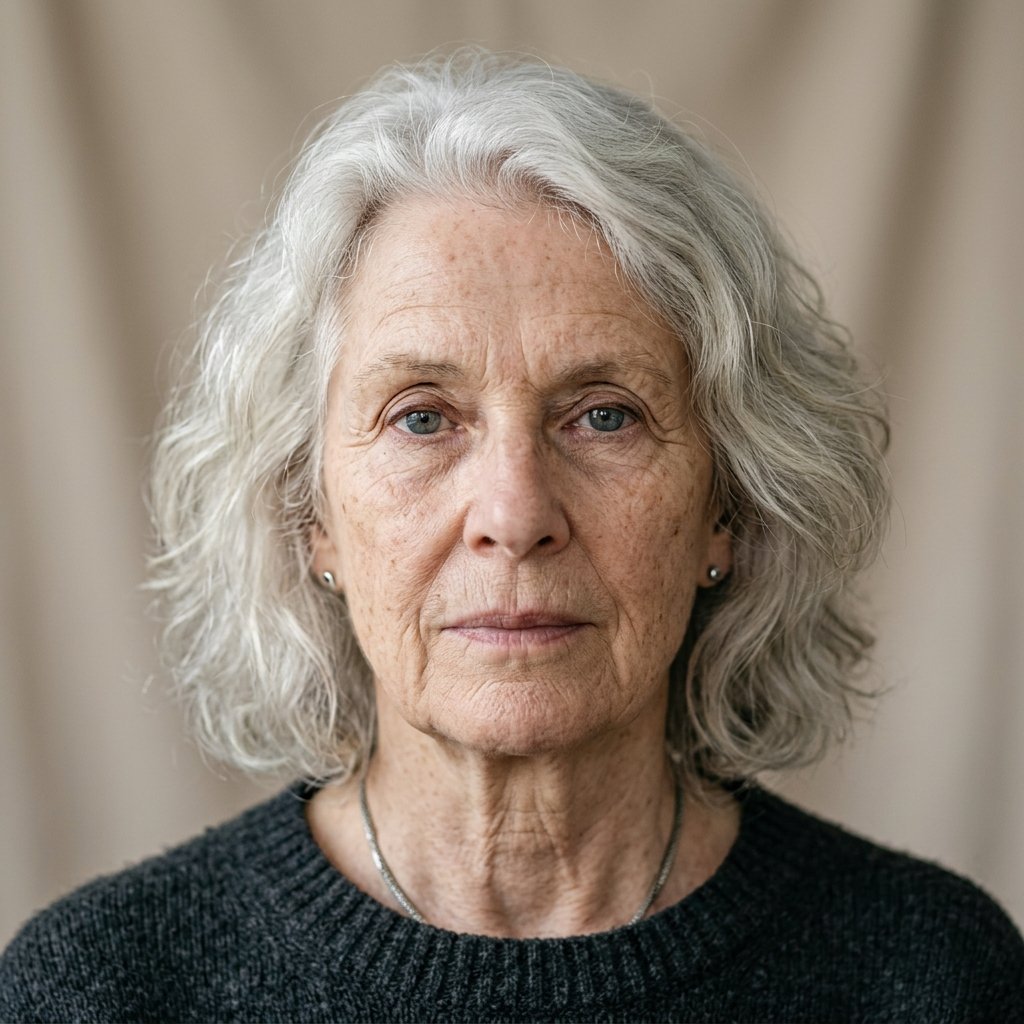
My name is Eleanor Whitfield, and for seven years I set two plates at my Thanksgiving table. One for me, and one for the son who stopped answering my calls.
I never once touched that second plate. I just looked at it. Sometimes for a few minutes. Sometimes for hours, until the candles burned down and the house grew cold and dark around me.
People in Millbrook, Ohio, used to call us a lucky family. Two boys, a good husband, a white house with a porch swing. They didn’t know that luck can crack right down the middle in a single afternoon.
It all fell apart on the worst day of my life, the day we laid my husband Robert to rest.
Robert and I had been married forty-one years. He was the quiet kind of man who fixed everything with his hands and said very little, but the little he said always mattered.
When the cancer took him, I felt like half of my own body had been buried in that cold Ohio ground.
We had two sons. Michael, the older one, was smooth and charming, the kind of boy who could talk his way out of anything. Daniel, my younger one, was shy and stubborn and had his father’s rough, gentle hands.
Robert and Daniel built a little cabin together up by Turner Lake when Daniel was just a teenager. They spent every summer there, hammering boards and laughing until the sun went down. That cabin was their whole world.
But Daniel always believed, deep down, that I loved Michael more. I don’t know where that idea took root. Maybe because Michael was louder, or because he demanded more attention. A mother loves her children equally, but children don’t always feel it equally, and I failed to see how much that wound had grown inside him.
On the morning of the funeral, we all gathered at the house before the service. My hands were shaking so badly I could hardly button my black coat.
Michael came up beside me and pressed something into my palm. It was Robert’s gold pocket watch, the one his own father had carried.
“Mom,” he whispered, “Dad told me a few weeks ago that he wanted me to have this. I think he’d want you to give it to me today, in front of everyone.”
I was so drowned in grief that I never questioned it. I simply nodded, and later, standing before the family, I handed that watch to Michael.
I didn’t see Daniel’s face until it was too late.
He stood across the room, near the doorway, and all the color drained out of him. His jaw tightened. His eyes filled, not with sadness, but with something worse. Betrayal.
Because here is the thing I didn’t know that day. Robert had never given that watch to Michael. Not with words, not in any promise.
What Robert had actually told me, in his last clear week of life, was that he wanted Daniel to have the cabin. “That’s their place,” he’d said, squeezing my hand. “Ours and Daniel’s. Make sure he gets it.”
But I never got the chance to tell Daniel a single word of it.
Because before the last hymn had even finished, my youngest son turned and walked straight out of the church. He drove away before the service ended.
He didn’t come to the burial. He didn’t come to the meal afterward. And when I called him that night, he didn’t pick up.
He never picked up again.
At first I thought he just needed time. Grief does strange things to people, and I told myself he would come around in a month, maybe two.
But a month became a year. A year became three. Three became seven.
I wrote to the last address I had. The letters came back stamped “return to sender.” I called numbers that had been disconnected. I asked Michael, over and over, if he had heard from his brother.
“He wants nothing to do with us, Mom,” Michael always said with a sad shake of his head. “You have to let him go. He’s made his choice.”
So I did the only thing a heartbroken mother knows how to do. I waited. I prayed. And every holiday, I set that second plate, just in case the door ever opened.
It never did.
I grew older. My hair went from gray to white. My hands, once so steady, began to tremble when I poured my morning coffee. I began to accept, quietly, that I might leave this world without ever seeing my son’s face again.
And then, one soft afternoon last spring, everything changed.
I was on the porch when a car I didn’t recognize pulled into the drive. A young woman stepped out. She was maybe nineteen, with dark hair pulled back and eyes that made my breath catch, because they were Daniel’s eyes.
She walked up the steps holding a worn cardboard box against her chest.
“Are you Eleanor Whitfield?” she asked, her voice trembling. “I’m Lily. I’m your granddaughter. Daniel is my dad.”
I had to grip the railing to stay standing. A granddaughter. I had a granddaughter, and I had never even known her name.
I brought her inside and made tea with shaking hands. She told me her father almost never spoke about me, and when he did, his eyes would go dark and he’d leave the room.
But something had happened, she said. Something she couldn’t stay silent about.
Her uncle Michael had recently sold his house and moved down to Florida. While helping clean out his attic, Lily had found a box shoved into the far corner beneath old insulation.
She set that cardboard box on my kitchen table and opened the lid.
Inside were letters. Dozens and dozens of them. Every single one written in Daniel’s careful, familiar handwriting.
And every single one was addressed to me.
My hands began to shake as I lifted them out. They were still sealed. Unopened. Some dated only a year after the funeral. Some as recent as last winter.
I didn’t understand. “Why does he have these?” I whispered. “Why weren’t they sent to me?”
Lily’s eyes filled with tears. “They were, Grandma. Look at the addresses.”
I looked closer, and my heart turned to ice. Daniel had mailed them to Michael’s house, believing Michael would pass them along to me. My address had changed once, years back, and Daniel only had the old family contact through his brother.
Michael had received every one of them.
And Michael had kept them. Hidden them. For seven long years.
I sank into a kitchen chair and began to read. I read until the sun went down and Lily quietly turned on the lamp.
In those letters, my son poured out his whole broken heart. He wrote about how sorry he was for leaving the funeral. He wrote that he understood if I was angry, but he needed me to know he still loved his father, still loved me.
He wrote about Lily’s first steps. Her first day of school. A drawing she made of a house with a porch swing, “just like Grandma’s,” she had told him, though she’d never seen it.
He wrote, again and again, “Please, Mom, just write me back. Even one line. I need to know you don’t hate me.”
And because I never answered a single letter I never received, my son had come to believe the cruelest lie of all. That his own mother had given up on him.
At the same time, Michael had been telling me that Daniel wanted nothing to do with us.
Two lies, from one mouth, keeping a mother and son apart for nearly a decade. To this day I don’t fully understand why Michael did it. Jealousy, maybe. Or the fear that if Daniel and I reconciled, the truth about that cabin and that watch would finally come out.
That night, with Lily sitting beside me, I dialed the number she gave me. My whole body shook as it rang.
When Daniel answered, I could barely form a word.
“Danny,” I finally breathed. “It’s your mother.”
There was a long, trembling silence on the line. Then I heard him break. My grown son, in his fifties now, weeping like the little boy who once ran to me with skinned knees.
“I thought you didn’t want me,” he choked out. “I wrote you so many times, Mom.”
“I never got a single one,” I told him through my tears. “Not one, my boy. I have been setting a plate for you every holiday for seven years.”
We talked until nearly three in the morning. We said the things we should have said the day we buried his father.
One week later, we met at the cabin by Turner Lake. It was the first place he wanted to see me.
He was gray now, with lines around his eyes. I was old and small. We stood on that dock where he and his father had fished a thousand times, and we simply held each other and cried.
Then I took out the deed to the cabin, the one I had kept safe all those years, and I placed it in his hands.
“This was always meant to be yours,” I said. “Your father asked me himself. I just never got the chance to tell you before you drove away.”
Daniel held that paper against his chest and sobbed. “All this time,” he whispered, “I thought you chose him over me. I thought I didn’t matter to you.”
“You mattered every single day,” I said, cupping his weathered face in my old hands. “Not one morning went by that I didn’t pray for the door to open.”
We lost seven years. Seven years of birthdays and Christmases and ordinary Tuesdays. Seven years I will grieve for the rest of my life, because no one can ever give them back to us.
All of it, gone, over a misunderstanding that no one ever said out loud. A watch. A missing conversation. And the silence of a man who should have been building bridges instead of walls.
But here is what I have learned, sitting on my porch swing with my granddaughter Lily now visiting every week, and my son calling every Sunday night.
Most families are not torn apart by hatred. They are torn apart by things left unsaid. By assumptions we never checked. By pride that whispers, “If they loved me, they would call first.”
All those years, Daniel and I were both waiting for the other one to reach out. Both of us convinced we were the one who had been abandoned. Both of us wrong.
One honest conversation, seven years too late, undid a heartbreak that never needed to happen at all.
This Thanksgiving, my table will be full. Daniel will carve the turkey in his father’s chair. Lily will sit beside me. And that second plate, the one I set for so long in the dark, will finally hold a warm meal for the son who came home.
If there is someone you have lost to silence, please, don’t wait like I did. Don’t assume you know what is in their heart.
Pick up the phone. Say the words. Because the misunderstanding keeping you apart may be nothing more than a story that was never even true.