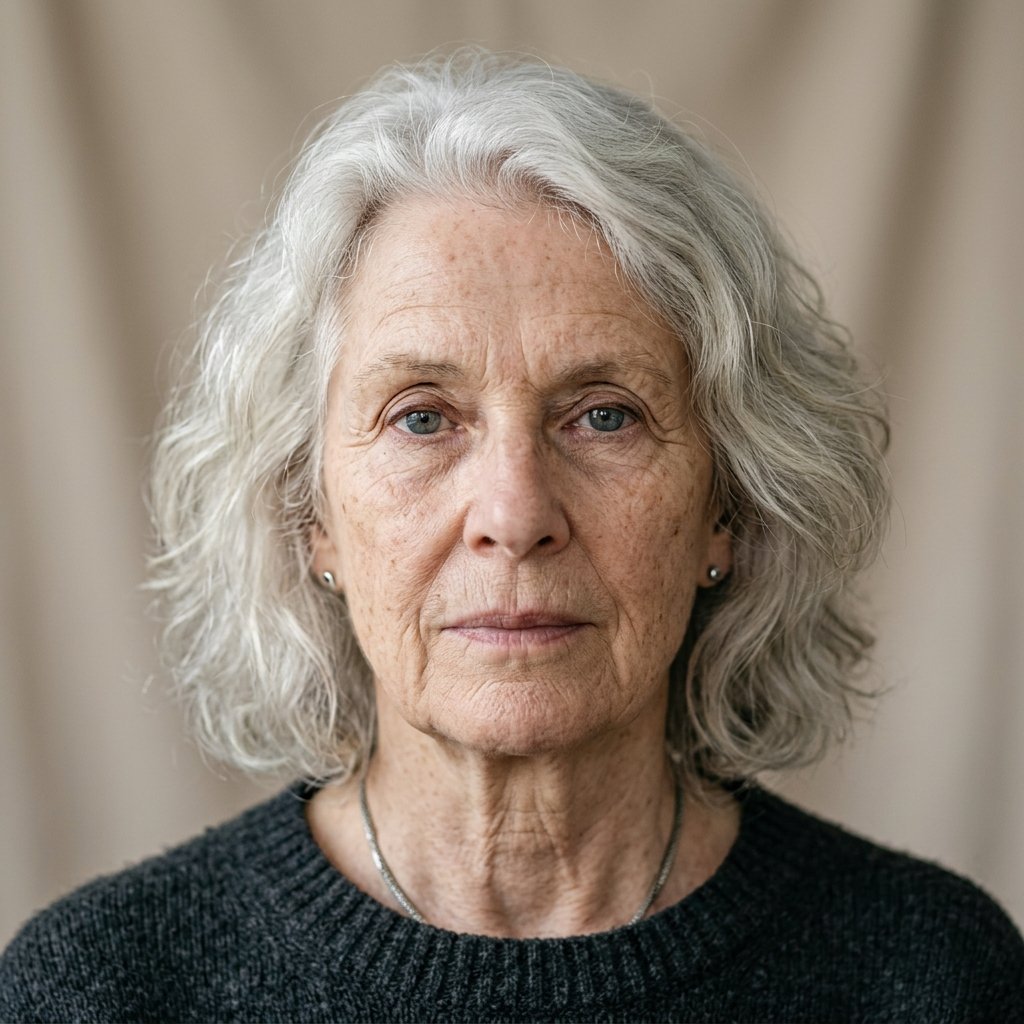
The morning Ruth walked back into my life, I was eighty-two years old, and I was certain that nothing in this world could ever surprise me again.
I have never been so wrong about anything.
It happened at the little diner on Maple Street in Lorain, Ohio, the same one I had visited every single morning since my wife Carol passed two winters ago.
I ordered my black coffee and two eggs, and I took my seat by the window, watching the quiet town slowly wake up.
Then the bell above the door rang.
I looked up out of habit, the way old men do when they have nowhere else in the world to be.
And there she stood.
Fifty-one years vanished in the space of a single breath.
Her hair had turned to silver, pinned back the same way her mother used to wear it. But those eyes. I would have known those eyes at the bottom of the ocean.
The coffee cup slipped right out of my fingers and shattered on the tile floor.
She turned at the sound, and when her gaze found mine, the color drained clean out of her face.
“Thomas?” she whispered.
I had not heard her say my name since I was thirty-one years old.
Let me tell you about Ruth.
In the summer of 1963, Ruth Callahan was the prettiest girl in our whole county, and by some quiet miracle, she had chosen me.
She could have had any boy in three counties. The banker’s son courted her for a whole summer with roses and picture-show tickets.
But Ruth Callahan chose the mechanic’s son with grease under his nails and forty dollars to his name.
I never once understood it. I only knew I would spend my whole life trying to be worthy of it.
We used to sit on the hood of my old Ford down by the reservoir and talk until the stars came out.
She used to hum old church hymns while I fiddled with the radio dial, and I swear the whole world went soft and golden around her.
I can still hear that humming, all these years later, on the nights when sleep will not come.
I bought a ring. It wasn’t much, just a thin gold band with a stone so small you had to squint to see it.
But I saved six months for it, skipping my lunches, working double shifts at my father’s garage.
I was going to ask her on the Fourth of July, right there under the fireworks.
Then her mother got sick.
Real sick, the kind that empties a family’s savings and their hope all at once.
Ruth’s people were from Charleston, and they needed her back home to help care for her mother through what everyone knew would be her final months.
She left on a Tuesday morning. I still remember the rain streaking down the bus station window.
She held my face in both her hands and swore she would write me every week, and that she would come back to me the moment she was able.
“Wait for me, Thomas,” she said. “Promise me you’ll wait.”
I promised. And I meant it with everything I had inside me.
The letters came at first. Long, beautiful letters full of her handwriting and her whole heart.
I wrote back twice as often, pouring out every foolish thing a young man in love could think to say.
And then, one month, the letters simply stopped.
I waited. I told myself the mail was slow, that her mother had taken a turn, that any day now an envelope would surely arrive.
But weeks turned into months, and my mailbox stayed empty.
I wrote and I wrote. I begged. I asked what I had done wrong.
Nothing ever came back.
By that autumn, I had convinced myself of the only thing a heartbroken young man can bring himself to believe.
She had found someone better. A city man, maybe, with clean hands and money in the bank. Someone truly worthy of a girl like Ruth.
The pain hardened into something bitter, and I let it.
I never went to Charleston. My pride would not let me go chasing a woman who no longer seemed to want me.
Two years later, I married Carol, a kind and gentle woman who deserved far more of my heart than the piece I had left to give her.
We built a good life together. We raised three children. I loved her, truly, in the quiet and steady way you love someone who stays.
Carol knew, I think. Not the details, but the shape of it. A wife always senses when a small corner of her husband’s heart belongs to a ghost.
She never once asked me about it, and she never once made me feel small for it. That was the kind of woman she was.
When she was dying, she held my hand and told me, “Thomas, don’t you dare spend your last years alone. Promise me that.”
I thought it was just the fever talking. Now I wonder if she saw something coming that I never could.
And now that same girl from the reservoir was sitting across from me in a diner booth, her hands trembling around a cup of tea.
“I thought you were gone from my life forever,” I finally managed to say.
Ruth looked down at the table for a long moment. When she looked back up, her eyes were shining.
“Thomas,” she said, “I wrote you every week for an entire year. I never once stopped.”
I felt the floor tilt beneath me.
“That’s not possible,” I said. “The letters stopped. You stopped.”
“No,” she said, and a tear slipped down her cheek. “I never stopped.”
And then, piece by aching piece, the truth came out.
Ruth’s mother had lingered far longer than any doctor expected, nearly three long years in all.
Ruth had stayed to nurse her, sleeping in a chair beside her bed, mailing me letters from a little post office two towns over.
She never received a single reply from me. Not one.
She thought I had abandoned her. She thought I had grown tired of waiting for a girl trapped by grief a thousand miles away.
We sat there, two old people in a diner booth, staring at each other while fifty-one years of misunderstanding hung heavy in the air between us.
If she wrote, and I wrote, then where on earth had all of those letters gone?
It took us both a while, but slowly the answer rose to the surface, and it broke my heart all over again.
My father.
My proud, stubborn father, who had raised me alone after my mother left, and who had never once trusted the notion of a woman who leaves town.
He had been the one to collect the mail from our box every afternoon while I worked in the garage below.
I remembered the day we cleared out his house after the funeral. I was fifty years old, and I found a bundle in the bottom drawer of his dresser, tucked beneath his old army things.
The twine had gone brittle with age. I very nearly tossed the whole drawer’s contents into the burn barrel out back.
Something stopped me, though I could not have told you what. I set the bundle aside and never looked at it again.
It had sat in my attic for over thirty years, unopened, holding the answer to the great question of my entire life.
I understood now, sitting across from Ruth, exactly what that bundle had been.
He had hidden her letters. Every single one. And he had made certain that mine never left the house either.
He thought he was protecting me from a girl who would only break my heart the moment she found something better in the city.
He thought he knew best. And his silence stole fifty-one years from two people who only ever wanted each other.
I told Ruth about the bundle in the drawer, and she pressed her hand to her mouth and wept without a single sound.
“All this time,” she whispered. “All this time, I thought you had stopped loving me.”
“And I thought the very same thing about you,” I said.
We should have been angry. Lord knows we had every right to be.
But when you are eighty-two years old, you learn that anger is a heavy thing to carry, and it only ever weighs down the one who holds it.
My father did a terrible thing. But he did it out of a broken kind of love, the only kind he ever knew how to give.
Carrying hatred for a man long in his grave would not return a single one of those stolen years.
So I did the only thing left that could set us both free.
I reached across that worn diner table and I took Ruth’s hand in mine, the very way I had held it under the fireworks so many summers ago.
“I forgive him,” I said. “And Ruth, I need you to know something. I never stopped either. Not for one single day.”
She held my hand tighter than I ever thought her frail fingers could manage.
“I forgive him too,” she said. “Because if I hold on to what he took, I’ll lose whatever time we have left. And I will not lose you twice, Thomas.”
“Do you still have them?” she asked, her voice barely there. “The letters?”
“I do,” I said. “I never knew what they were. I never had the courage to look.”
That afternoon, I drove home and climbed those attic stairs with my old knees protesting every single step.
I found the bundle exactly where I had left it. And when I finally untied that brittle twine, her handwriting spilled out across three decades of silence.
We read the very first one together, sitting on my porch as the sun went down.
“My dearest Thomas,” it began. “I miss you more than the words on this page could ever hold.”
Ruth wept. And this old man, who had not cried at his own father’s grave, wept right along beside her.
We talked for four hours in that booth that first morning.
The waitress kept our coffee full and kindly pretended not to notice two old fools crying into their napkins.
Ruth had married too, a good man named Walter who had passed the year before.
She had come back to Lorain only to visit her cousin’s grave, never once imagining she would find me still here, still in the same little town.
We had both spent our lives loving people who deserved that love, and we were grateful for them.
But God, or fate, or whatever gentle hand guides these things, had chosen to give us one more chance.
That was three years ago now.
Ruth and I were married the following spring, in a small chapel with our children and our grandchildren filling the pews.
Some folks thought it was foolish, two people in their eighties starting a marriage.
Let them think it. I have never felt anything so very far from foolish.
Every morning I wake up beside the girl I lost by the reservoir, and I thank the good Lord for the mercy of a second beginning.
We keep that bundle of letters now, hers and mine, finally united in a box on our mantel.
Sometimes, on quiet evenings, we read them aloud to one another and laugh at how young and how certain we once were.
Forgiveness did not give me back the fifty-one years that we lost.
Nothing on this earth could ever do that.
But forgiveness gave me back Ruth. And it gave me back the peaceful man I might have poisoned into bitterness without it.
And it taught me that love, real love, does not die when it is buried.
It only waits, patient and quiet, for the day someone is finally brave enough to dig it back up.
If I had held on to my anger, I would have died a lonely man, never once knowing the truth.
Instead, I get to hold her hand every single night.
And I have learned this, in my old age, more surely than I have ever learned anything at all.
The people who hurt us are so often just broken people, doing the very best that they knew how.
And the day we finally choose to forgive them is the day we truly set ourselves free.