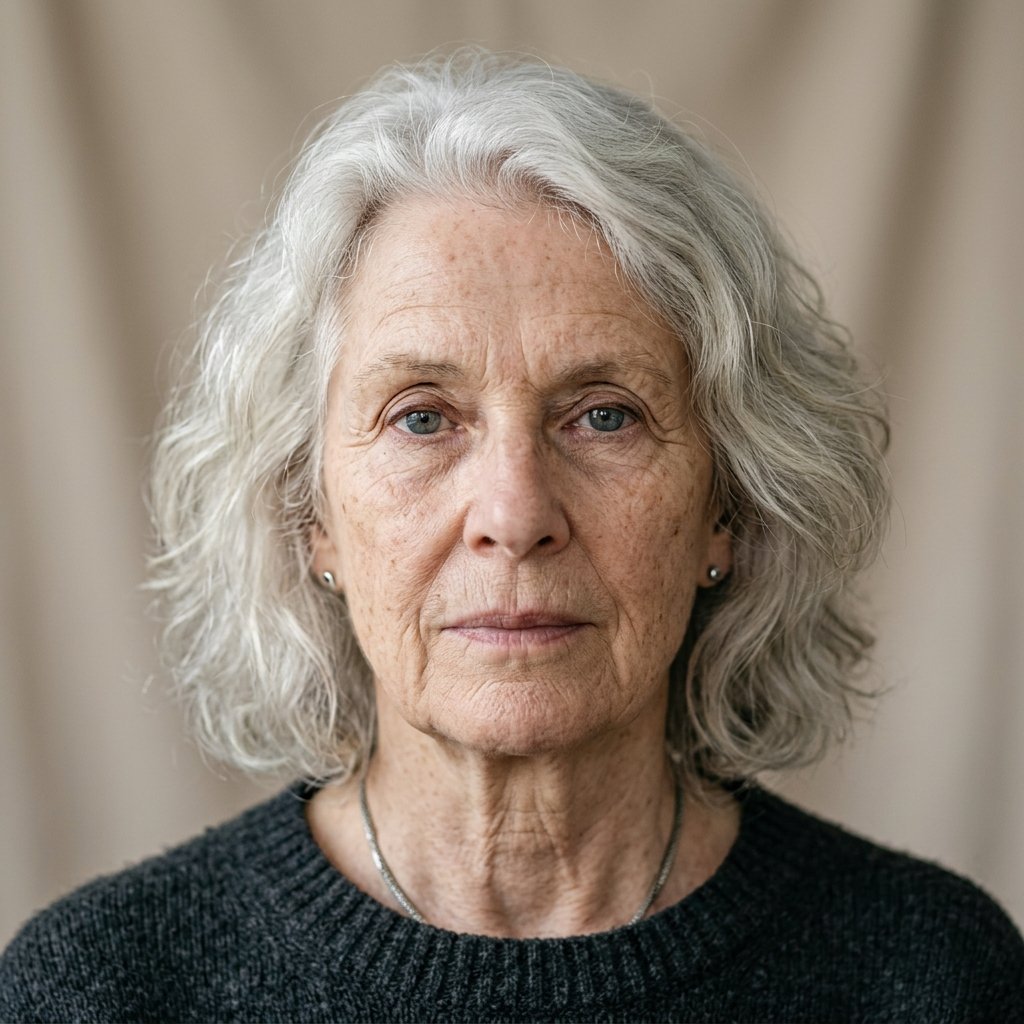
The morning of my son’s medical school graduation, he pulled me aside in the parking lot, held my rough hands in his soft ones, and asked me to wait outside the auditorium.
“Just for a little while, Mom,” he said. He wouldn’t look at me when he said it. He looked at his polished shoes instead.
And in that single moment, twenty years of scrubbing other people’s floors came rushing back into my chest like cold water.
My name is Margaret Whitfield. I am seventy-one years old now, and I am telling you this story because I promised myself I never would, and some promises are meant to be broken.
Let me take you back to the beginning.
I was thirty-four the winter my husband Thomas passed away. He was a good man, a carpenter with sawdust always in his hair and a laugh that filled our little house on Maple Street in Cedar Falls, Iowa.
One icy morning he went to work and never came home. The truck slid on black ice out on Route 9. Just like that, my whole world went quiet.
I stood at his graveside with three children clinging to my coat. Daniel was nine. Ruth was six. Little Samuel was barely four, sucking his thumb, too young to understand why everyone was crying.
When the funeral was over and the casseroles stopped coming, I sat at my kitchen table and counted what we had left. Eleven dollars. It was folded inside an old coffee can that Thomas used to toss his loose change into.
Eleven dollars, three hungry children, and a mortgage due in nine days.
I remember I did not cry that night. I think I was too frightened to cry. Instead I made a decision that would shape the rest of my life.
I decided that my children would never, not for one single day, feel the weight of what I was about to carry.
The next morning I put on my only good dress and I walked to the wealthy homes up on Grandview Avenue, the ones with the wide porches and the shiny cars. I knocked on doors and I asked if they needed a woman to clean.
Mrs. Abernathy was the first to say yes. She handed me a bucket and a scrub brush, and I got down on my knees and I cleaned her marble floors until I could see my own tired face in them.
By day I cleaned houses. By night, after my children were asleep, I took in sewing. Hemming trousers, mending torn coats, stitching wedding dresses for brides who would never know the woman who made them beautiful.
My hands, which had once been soft, turned rough and red. The skin cracked in the winter. But those hands kept the lights on. Those hands put food on the table.
There were nights I told my children I wasn’t hungry, that I had eaten while cooking, so their plates could hold a little more. The truth was my stomach was as empty as that coffee can had been.
I never let them see it. A mother learns to smile through hunger.
Daniel, my oldest, was different from the other boys. While they chased baseballs, he chased books. I would find him under his blankets at midnight, reading by the light of a flashlight, whispering the words to himself.
“You’re going to wear out those batteries,” I would tease him.
“I’m going to be a doctor, Mama,” he told me one night, his eyes shining. “I’m going to fix people so they don’t leave their families the way Daddy left us.”
My throat closed up. I kissed his forehead and I made him a promise right there in the dark. “Then you will be a doctor, my boy. I don’t know how. But you will.”
The years passed the way years do, slow in the living and fast in the remembering.
Ruth grew into a kind young woman and became a schoolteacher. Samuel joined the fire department and married a sweet girl from church. I was proud of them beyond words.
But Daniel carried the biggest dream, and the biggest dream costs the most.
When the time came for college applications, there was a fee for each one. Money I simply did not have. I lay awake for three nights, staring at the ceiling, praying for an answer.
On the fourth morning, I quietly took off my wedding ring. It was the last thing of Thomas I still wore, thin gold worn smooth by twenty years of love.
I drove to the pawn shop on Fifth Street and I sold it. The man gave me enough to cover the application fees, with a little left over for stamps.
I never told Daniel. When he asked where the money came from, I told him I had been saving. Some lies are just love wearing a disguise.
He got into a fine university. Then into medical school. Every scholarship he earned, he earned with his own brilliant mind. But I like to think a mother’s prayers helped carry those letters through the mail.
While he studied in the city, something began to change. His phone calls grew shorter. His visits home grew rarer.
He was moving in a new world now, a world of educated people and important families. And I began to feel him growing embarrassed of the mother who spoke plainly and whose hands were rough from other people’s dishes.
One Thanksgiving, he brought a girlfriend home. I saw him wince when I told her, honestly, that I cleaned houses for a living. He changed the subject quickly, his cheeks red.
That night I cried into my pillow so he wouldn’t hear. Not because I was ashamed of my work. I was never ashamed of honest work.
I cried because my son was ashamed of me.
Still, I told myself it didn’t matter. I had not raised him for gratitude. I had raised him to fly, and if flying meant he flew far from me, then so be it. That is the terrible arithmetic of a mother’s love.
Which brings me back to that graduation morning.
When he asked me to wait outside, I understood exactly what he meant. The auditorium would be full of doctors and their elegant families. And I, in my fifteen-year-old dress with my cracked hands, did not belong.
So I said what mothers always say. “Of course, sweetheart. You go on. I’ll be right here.”
And I stood in that cold marble hallway, alone, while the doors closed in front of me.
I could hear it all through those doors. The music. The dean’s voice reading names. The applause washing over each new doctor like a wave.
I pressed my hand flat against the wooden door, as if I could feel my son’s moment through the grain. I told myself I was happy just to be near it. A mother doesn’t need a seat to love her child.
But oh, my heart ached in that hallway. Twenty years of scrubbing, of sewing, of skipped meals and sold rings, and here I stood, on the wrong side of the door.
Then I heard my son’s name called. Daniel Thomas Whitfield.
The applause rose. And then, strangely, it stopped. The whole room went silent.
And the great doors in front of me swung open.
Daniel stood there in his graduation robe, and his eyes were already wet. He walked straight to me, took both my rough hands in his, and without a word, he led me down the long aisle toward the stage.
Every face in that auditorium turned to watch us. I wanted to shrink. I wanted to disappear. “Daniel, what are you doing,” I whispered.
He didn’t answer. He just held my hand tighter and helped me up the steps.
Then he took the microphone from the stunned dean, and he turned to that sea of strangers.
His voice trembled. “Before I accept this diploma, there is someone you all need to meet.”
He looked at me, and the tears spilled over.
“This is my mother. She has no college degree. She cleaned houses in our town for over twenty years. She scrubbed floors on her knees so that I could one day stand in an operating room and hold a scalpel.”
The room was utterly silent. You could have heard a pin drop on that stage.
“Every steady stitch I will ever make to close a wound,” he said, “she taught me first, at our kitchen table, with a needle and thread, mending coats by lamplight so I could eat.”
He drew a shaking breath.
“I found out last year that when I couldn’t afford my college applications, my mother sold her wedding ring. The last piece of my late father she owned. And she never told me. She let me believe I had done it all myself.”
I gasped. I had never told a living soul. To this day I do not know how he learned it.
Daniel turned to face me fully now, ignoring the crowd, ignoring the cameras.
“I asked you to wait outside, Mama, and I will regret those words forever. But I didn’t ask because I was ashamed of you.”
“I asked because I wanted you to walk in last. I wanted the whole world to rise to its feet for the greatest doctor I have ever known. And that has never been me.”
“It is you, Mama. It was always you.”
And then it happened.
One by one, then all at once, that entire auditorium rose to its feet. Doctors, deans, strangers, families. Every single one of them stood and turned toward a worn old cleaning woman in a fifteen-year-old dress.
And they clapped. They clapped and clapped, and grown men wiped their eyes, and women I had never met were weeping for a life of sacrifice they had never seen but suddenly understood.
I stood in the center of that stage, trembling, and for the first time in twenty long years, I let my tears fall in front of the world.
My son wrapped his arms around me and whispered into my ear, so only I could hear.
“Thank you for waiting for me, Mama. Thank you for never giving up.”
I had spent two decades believing my suffering was invisible. That my aching back and my empty stomach and my sold ring had vanished into the silence, unseen and unremembered.
But on that stage, my boy made certain the whole world saw every bit of it.
Daniel is a fine surgeon now. He bought me a small white house with a garden, and he replaced the wedding ring I sold with one just like it. I wear it every day.
Ruth still teaches. Samuel still runs into burning buildings to save people, just like his brother heals them.
And me? I am seventy-one, and I keep that old empty coffee can on my mantel, right in the center, where anyone can see it.
People ask me why I keep such a shabby old thing on display in a beautiful home.
I tell them it once held everything we had in the world. Eleven dollars and a mother’s stubborn hope.
And it turned out that hope was worth more than all the money in Cedar Falls.
We do not raise our children for the applause. We raise them for the quiet miracle of the moment they turn around, look us in the eye, and reach for our tired hands.
If you are a parent giving everything in silence right now, believing no one sees it, I need you to hear me.
They see you. And one day, they will thank you.
Just keep waiting outside that door a little while longer. I promise you, it opens.