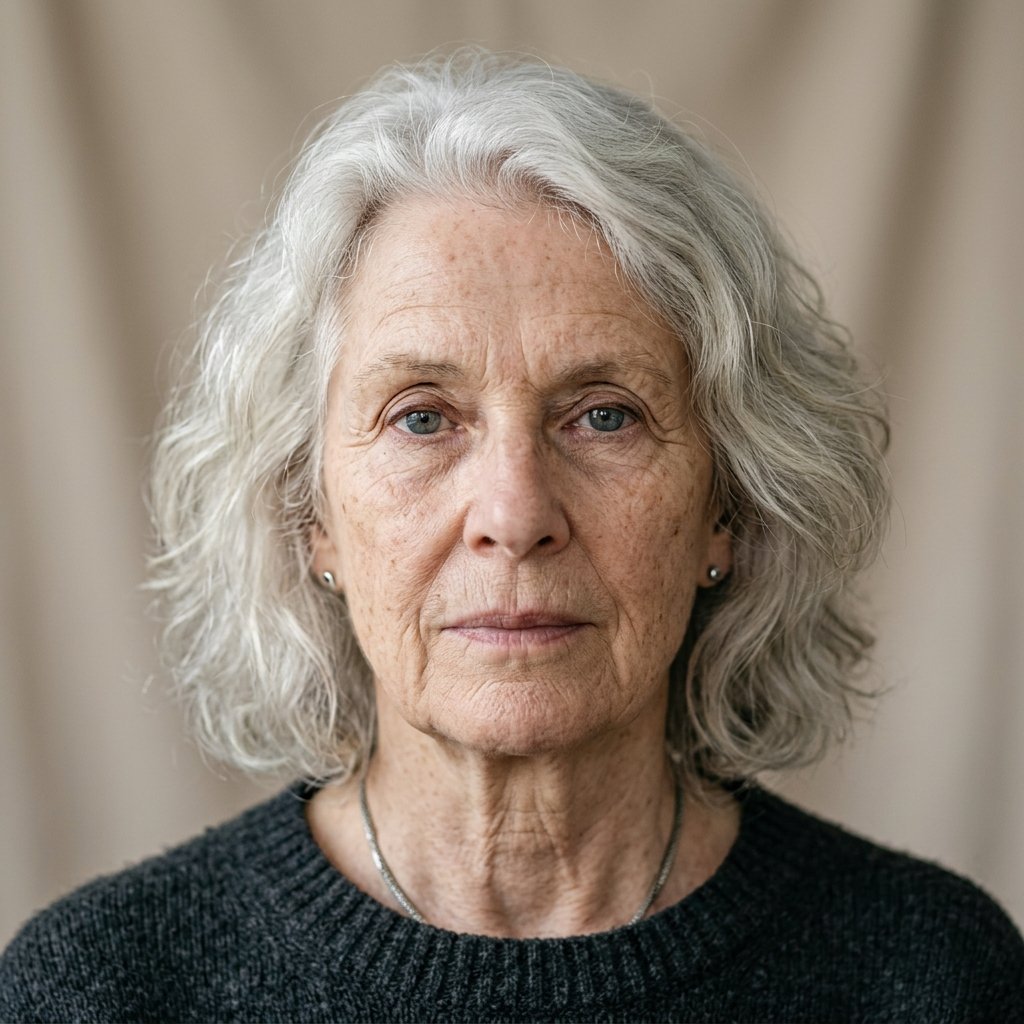
For thirty years, my mother wore the same faded brown coat so that I could wear a cap and gown. And I am ashamed to admit I never once said thank you.
My name is Daniel Carter. I grew up in a small rented house on the outskirts of Marion, Ohio, where the winters bit hard and the walls were thin enough to hear the wind arguing with the roof.
My father passed away when I was seven years old. One morning he kissed my forehead, went to the factory, and never came home. A machine had failed. And in a single afternoon, my mother Ruth became both parents to a frightened little boy.
I was too young then to understand what she carried. I only knew that she never let me see her cry.
Every morning, long before the sun touched our street, she walked to Dot’s Diner on Center Street and stood over a hot griddle flipping eggs and pouring coffee for truckers and farmers.
By the time I woke, there was always breakfast on the table and a note in her careful handwriting. “Have a good day, my sweet boy. I love you to the moon.”
In the evenings she took in mending. She sat by our one good lamp, squinting at hems and buttons, her fingers cracked and rough from cold water and endless needlework.
Some nights I would wake to use the bathroom and see her still there at midnight, stitching a stranger’s dress so that I could have new sneakers for school.
I remember one winter clearly. Money was tighter than ever. I needed textbooks I knew we could not afford, and I stopped asking, pretending I didn’t need them.
A few days later, the books appeared on my desk. I noticed, weeks after, that the thin gold wedding ring my mother had worn my whole life was gone from her hand.
When I asked her about it, she just smiled and waved me off. “Oh, that old thing. It didn’t fit anymore.” I believed her because I wanted to. Children are good at believing the lies that keep them comfortable.
She wore that same brown wool coat every single winter I could remember. The buttons changed as she replaced the ones that fell off. The lining wore thin. But the coat stayed, year after year, while I somehow always had something warm and new.
I was a bright kid, and she made sure everyone knew it. “My Daniel is going to be somebody,” she told the whole diner. “You watch.”
And I was. I earned a scholarship, then took out loans, then worked nights, and finally I made it into law school. The day my acceptance letter came, my mother sat down at the kitchen table and cried for the first time in front of me. This time, they were happy tears.
I graduated near the top of my class. I moved to Columbus. I joined a respected firm and started earning more money in a month than my mother had seen in a year of standing over that griddle.
And there, in that shining new life, I met Caroline.
Caroline came from a family with money, with country club memberships and the kind of easy confidence that comes from never once worrying about a bill. Her manners were polished. Her world was smooth. And I wanted so badly to belong to it.
We married in a beautiful ceremony. My mother came in a dress she had sewn herself, sitting quietly in the second row, dabbing her eyes with a handkerchief.
I wish I could tell you I was proud of her that day. But somewhere deep down, a small and ugly part of me was embarrassed. Embarrassed of her homemade dress among all those designer gowns.
And that shame, once I let it in, began to grow.
Caroline never said anything cruel out loud. But I saw the tightness in her smile when my mother saved little packets of jam from restaurants “for later.” I saw her glance at Mom’s worn shoes and simple cardigan.
So I started visiting less. I told myself I was busy. Big cases, long hours, an important life to build.
I called less too. When I did, I rushed her off the phone. “I’ve got to run, Mom. I’ll call you soon.” And soon kept getting further away.
Mom never once complained. Every card she sent ended the same way. “I’m so proud of you, my sweet boy. I love you to the moon.”
I would read them for two seconds and toss them in a drawer.
On her seventieth birthday, I forgot. I want you to understand that fully. My mother, who gave up everything she ever had for me, turned seventy years old, and her only child did not call.
I remembered three days later, standing in my kitchen. My stomach dropped. And then, God forgive me, I told myself I’d make it up to her sometime. Sometime soon.
A week after that, my phone rang at the office. It was the diner. My mother had collapsed while carrying a tray of coffee. She was seventy years old and still refused to leave the job that had raised me.
I drove to that little county hospital faster than I have ever driven anything. My hands were shaking on the wheel. All the way there, I kept saying, “Please, not yet. Please.”
When I arrived, an older waitress named Betty was waiting in the hallway, holding a battered cardboard shoebox against her chest.
“Your mama asked me to keep this safe,” Betty said, her eyes red. “She wanted you to have it if anything ever happened. She never wanted you to know while she could still see your face.”
I took the box and sat down on a cold plastic chair. And when I opened it, my whole life fell apart and then slowly rebuilt itself.
Inside were receipts. Hundreds of them. Faded, folded, taped where they’d torn. Every tuition payment. Every deposit for my dorm. Every bus ticket she’d bought so I could come home for holidays. Every pair of sneakers, every winter jacket, every textbook.
Beneath them was a small spiral notebook, its cover soft from years of handling. On the first page, in her careful handwriting, she had written a single line.
“Saving so Daniel never feels less than anyone.”
Page after page tracked pennies. Extra shifts taken. A ring sold. A coat kept another year. And little notes scattered throughout. “Daniel got an A.” “Daniel’s first suit.” “Daniel is going to be somebody.”
I sat on that hospital floor, a grown man in an expensive suit, and I wept like the seven-year-old boy who once held her hand at his father’s grave.
All those years I had been embarrassed of her worn shoes. And she had worn them so that mine would always be new.
When they finally let me in to see her, she was small and pale against the white sheets. Her eyes fluttered open, and the first thing she did, weak as she was, was smile at me.
“There’s my boy,” she whispered.
I took her rough, cracked hands in mine, the same hands that had stitched and cooked and carried and sacrificed for three decades, and I finally said the words I had swallowed for a lifetime.
“Thank you, Mama. For everything. I’m so sorry. I see it all now.”
She reached up and touched my cheek. “You never had to thank me,” she said softly. “Loving you was the best thing I ever got to do.”
Something in me broke open that day, and something better began to grow.
The doctors said it was exhaustion and a weak heart, decades of standing and skipping meals and giving her rest away. She needed care. Real care. And I swore to myself she would never again lift a finger for anyone.
I did not put her in a nursing home. I bought a bright little house with a garden and a porch, just three doors down from my own.
And Caroline, to her great credit, changed too. The day she saw those receipts, she cried as hard as I did. She started sitting with my mother for hours, learning her recipes, writing down her stories, holding her hand.
Our children, my mother’s grandchildren, adored her. They called her the best cook in all of Ohio, and she beamed every single time.
Every Sunday we gathered on that porch. Mom sat in her rocking chair, a warm quilt over her knees, watching the grandkids chase fireflies across the lawn as the sun went down.
One evening she looked over at me with tears in her eyes and said, “I used to dream of a evening exactly like this one. I just never let myself believe I’d get to live it.”
And she did live it. For six more wonderful years, my mother finally lived happily, surrounded by love, wanting for nothing, spoiled the way she had spoiled me.
When she passed, it was in her sleep, in that little house with the garden, with a smile on her face and a lifetime of love finally returned to her.
I kept her old brown coat. It hangs in my closet where I see it every morning.
Because it reminds me of the hardest lesson I ever learned, and I learned it far too late. The people who give us everything are usually the ones who ask for nothing at all.
Don’t wait for a shoebox of receipts. Don’t wait for a phone call from a hospital. Call the people who sacrificed for you, and say the words while they can still hear your voice.
I got my second chance. Not everyone does. And I will spend the rest of my life grateful that I did not learn to love my mother a single day too late.