The last words I ever spoke to my husband were: “I hope your lies keep you warm at night.”
I was thirty years old when I said them. I would spend the next forty-one years learning how cruelly, how completely wrong I had been.
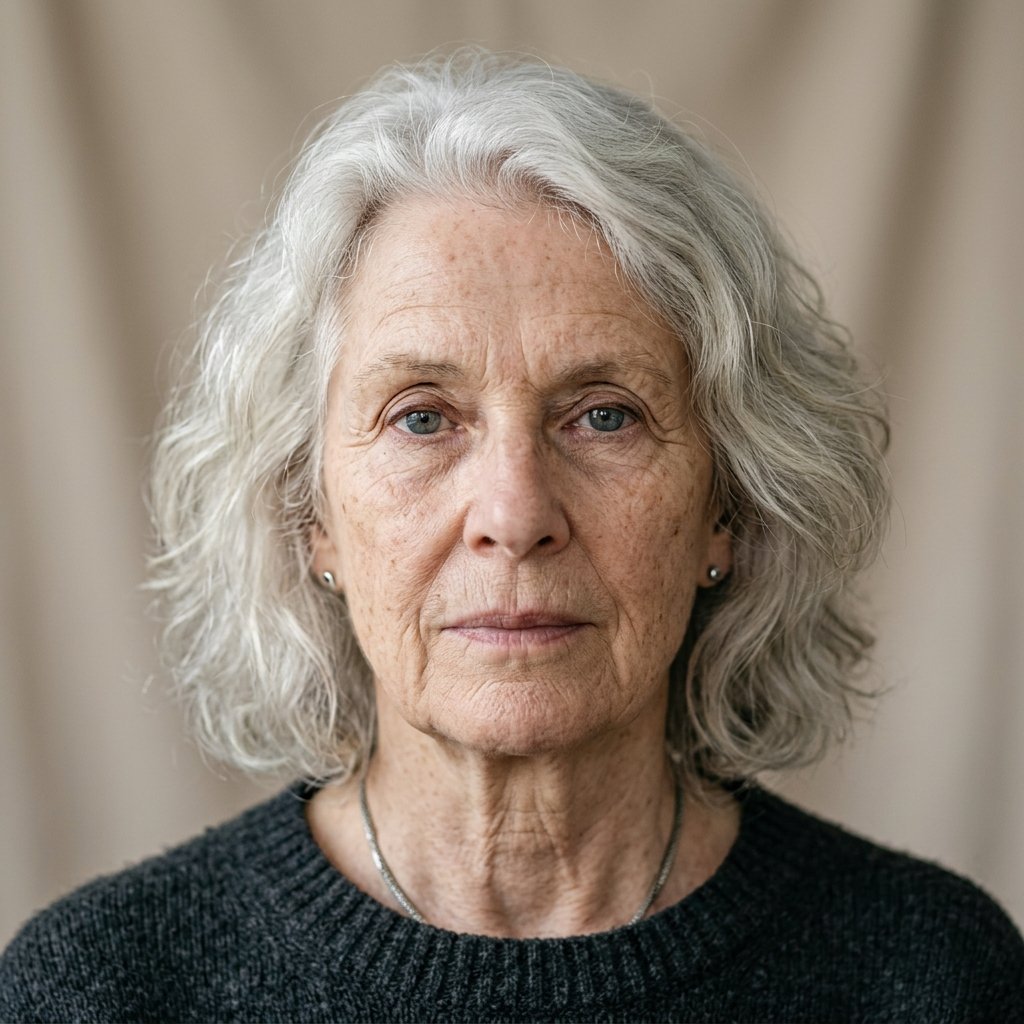
My name is Margaret Whitfield. I am seventy-one now, and I live alone in a small clapboard house in Millbrook, Vermont, the same town where I once believed I had everything a woman could ever want.
I married Thomas in the autumn of 1974. He was a quiet man with big, careful hands and a habit of humming under his breath when he thought no one could hear.
He wasn’t the kind of man who said pretty things. He was the kind who fixed the porch step before you noticed it was broken, who warmed your side of the bed on winter nights so you wouldn’t shiver climbing in.
We had our daughter, Ruth, in 1976. For a while, our little house felt like the center of the whole bright world.
But every marriage has its shadows, and mine had one I planted with my own two hands. Its name was my mother, Eleanor.
My mother and I had fallen out years before. It was over something so small I can barely remember the shape of it now, only the heat of it.
Words were said that could not be taken back. I told her I never wanted to see her face again, and God forgive me, I meant it.
I forbade her name in our home. When Thomas gently tried to bring her up, I would leave the room. Eventually, he stopped trying.
I thought that was the end of it. I thought I had closed a door and thrown away the key. I had no idea my husband had quietly picked that key up off the floor.
It began in the spring of 1985. Small things at first, the kind a woman notices before she can name them.
Thomas started leaving on Thursday nights, coming home Saturday mornings. “Work,” he’d say. “An old friend needs a hand.”
Then I found the first hotel receipt in the pocket of his good coat. The Maple Rest Inn, two towns over, in a place called Harlow.
My stomach turned to ice, but I told myself there was an explanation. There is always an explanation, until suddenly there isn’t.
A week later, doing his laundry, I found a woman’s silk scarf tucked in his overnight bag. Pale blue, soft, smelling of a perfume I did not own.
Then came the collar. Lipstick, faint but unmistakable, and that same perfume clinging to it like an accusation.
And the money. Every single month, a sum vanished from our savings account. Never enormous, but steady, deliberate, like a slow bleed.
I confronted him on a Sunday evening while Ruth slept upstairs. I laid the receipt, the scarf, the bank statement across the kitchen table like evidence in a courtroom.
“Who is she, Thomas?” My voice shook. “How long?”
He went white. He sat down slowly, and he pressed his hands flat on the table as if to steady the whole spinning world.
“Margaret,” he said, “I am begging you. Trust me. There is no other woman. But I cannot tell you where I go. Not yet. Please.”
“Not yet?” I laughed, and it came out ugly. “You want me to trust a man who won’t even look me in the eye?”
He looked me in the eye then. And what I saw there was not guilt. It was a grief so deep I mistook it for shame.
He never raised his voice. He never once said an angry word to me. He simply repeated, softly, “I can’t. I gave my word.”
To whom? I screamed inside. To her. It had to be her.
I packed two suitcases that night. I woke Ruth, wrapped her in a blanket, and carried her to the car.
Thomas stood in the doorway. The porch light caught the tears rolling down into the stubble on his jaw.
He didn’t fight me. He didn’t grab my arm or block the door or make a single promise. He just said, in a voice barely above a breath, “I’ll be here, Margaret. Whenever you’re ready to hear it. I’ll be right here.”
And my last words to him, the words I would carry like a stone in my chest for four decades, were: “I hope your lies keep you warm at night.”
Then I drove away, and I did not look back.
The divorce was quiet. He gave me the house, though I refused it and moved closer to my sister. He gave me everything I asked and asked for nothing in return.
For forty-one years, I built my life around a single, poisonous certainty: that Thomas Whitfield was a liar and a cheat.
I told the story so many times it became true to me. I told it to Ruth. I told it to neighbors. I told it to myself every night before sleep.
Thomas never remarried. I heard this from mutual friends and felt, God help me, a flicker of grim satisfaction. Let him be lonely, I thought. He earned it.
He never stopped reaching out. Every year on my birthday, a card arrived in his careful handwriting. I mailed each one back, unopened, the way you’d return a package to a stranger.
When Ruth graduated, when Ruth married, when my grandchildren were born, he sent gifts. I let Ruth keep them but I would not speak his name.
Pride is a warm coat in a cold life. It kept me upright. It also kept me hollow.
And then, last month, everything I thought I knew came apart in a single afternoon.
Ruth called me on a Tuesday. Her voice was thin and frightened, the little-girl voice I hadn’t heard in years.
“Mom,” she said. “Dad’s had a stroke. It’s bad. He’s asking for you.”
My hand tightened on the phone. Forty-one years of practiced anger rose up in me like an old reflex.
“He made his choices, Ruth,” I said. “I’m sorry, but I can’t.”
She was quiet. Then she said, “You never even let him explain, did you?” and she hung up.
I sat in my kitchen shaking. I told myself I was right. I told myself for the ten-thousandth time.
But a week later, a package arrived at my door. A wooden box, worn smooth at the corners, the kind a man makes with his own hands.
There was a note taped to the lid in Ruth’s writing: “He wanted you to have this. He’s been keeping it for you the whole time.”
I opened it at my kitchen table, the same kind of table where I had once laid out my evidence like a prosecutor.
Inside were letters. Hundreds of them. Every one addressed to me. Every one sealed. Every one unsent.
They were dated, oldest to newest, going all the way back to the spring of 1985.
My fingers trembled as I broke the seal on the very first one. And there, in Thomas’s steady hand, the truth I had run from for four decades finally reached me.
“My dearest Margaret,” it began. “By the time you read this, I pray you can forgive an old fool for keeping a promise longer than he should have.”
“Those nights in Harlow were never spent with another woman. They were spent at the Maple Rest Nursing Home. I was sitting beside your mother.”
I stopped breathing. The paper blurred. My mother.
“Eleanor was dying, Margaret. Cancer. She was alone, and too proud to call you, and too frightened to face the daughter she believed hated her.”
“I found out by accident, from an old friend of hers. I couldn’t leave her there with no one. So I went. And then I kept going.”
The scarf. The perfume. My mother’s scarf. My mother’s perfume, the lavender water she’d worn my whole childhood.
The lipstick on his collar was from her kissing his cheek in gratitude, an old woman thanking the only person on earth who still came to see her.
The money that vanished each month had paid for her medicine, her comfort, a private room with a window that looked out on the maple trees she loved.
And the reason he never told me? The next letter answered that, too, and it broke me clean in half.
“She made me swear, Margaret. On her life, on Ruth’s future, she made me promise never to tell you where I went.”
“‘Let her keep her anger if it keeps her strong,’ she said. ‘I lost the right to her love. Don’t let her lose you fighting over an old woman’s mistakes.'”
“I begged her to let me bring you. She refused until the very end. And then the end came too fast, and I had already lost you, and it was too late for all of us.”
I don’t know how long I sat on that kitchen floor. Long enough for the light to change. Long enough to read every letter he had written across forty-one years of loving a woman who called him a cheat.
He had held my mother’s hand as she passed. He had paid for her burial. He had done the one thing I could never bring myself to do. He had forgiven her, quietly, for me.
I drove four hours that same night. I did not pack. I did not think. I just went.
I found him in a hospital bed in Harlow, of all the places on this earth. Thin and gray, one side of his face gone still, his big careful hands lying open on the blanket.
His eyes found me in the doorway. And after forty-one years, after all my cruel and certain words, those eyes filled with the same tears I had walked away from in 1985.
I crossed the room and took his hand and pressed it to my wet cheek. “Forty-one years, Thomas,” I wept. “I threw us away over the kindest thing a man has ever done.”
His good hand squeezed mine, weak but sure. His lips fought and fought to shape a single word.
“Stayed,” he finally breathed. He had stayed. He had waited. All this time, the door he’d promised to keep open had never once closed.
The doctors give us eleven weeks, maybe a few more. Eleven weeks, against forty-one wasted years.
Every morning now I feed him his breakfast. I read him his own letters aloud, and we laugh at the young fools we were, and we cry at the old ones we became.
I kiss his forehead the way my mother once kissed his cheek in gratitude, and I whisper the words I should have said a lifetime ago. “I trust you. I always should have. I’m sorry.”
I cannot get those years back. No amount of tears will buy a single one of them returned.
But I have his hand in mine again. I have his humming, slower now, but still there. And somewhere, I have to believe, my mother is finally at peace, knowing the man she made a promise to kept it until it nearly cost him everything.
Forgiveness came late to my house. But it came. And it turns out it can find its way home even after forty-one years in the dark.
So let me ask you, from one aching heart to another: have you ever accused someone you loved of the very worst, only to learn they were doing something quietly beautiful? Would you have gone back after all those years, or would your pride have held the door shut forever? Tell me. I truly need to know I am not the only one.