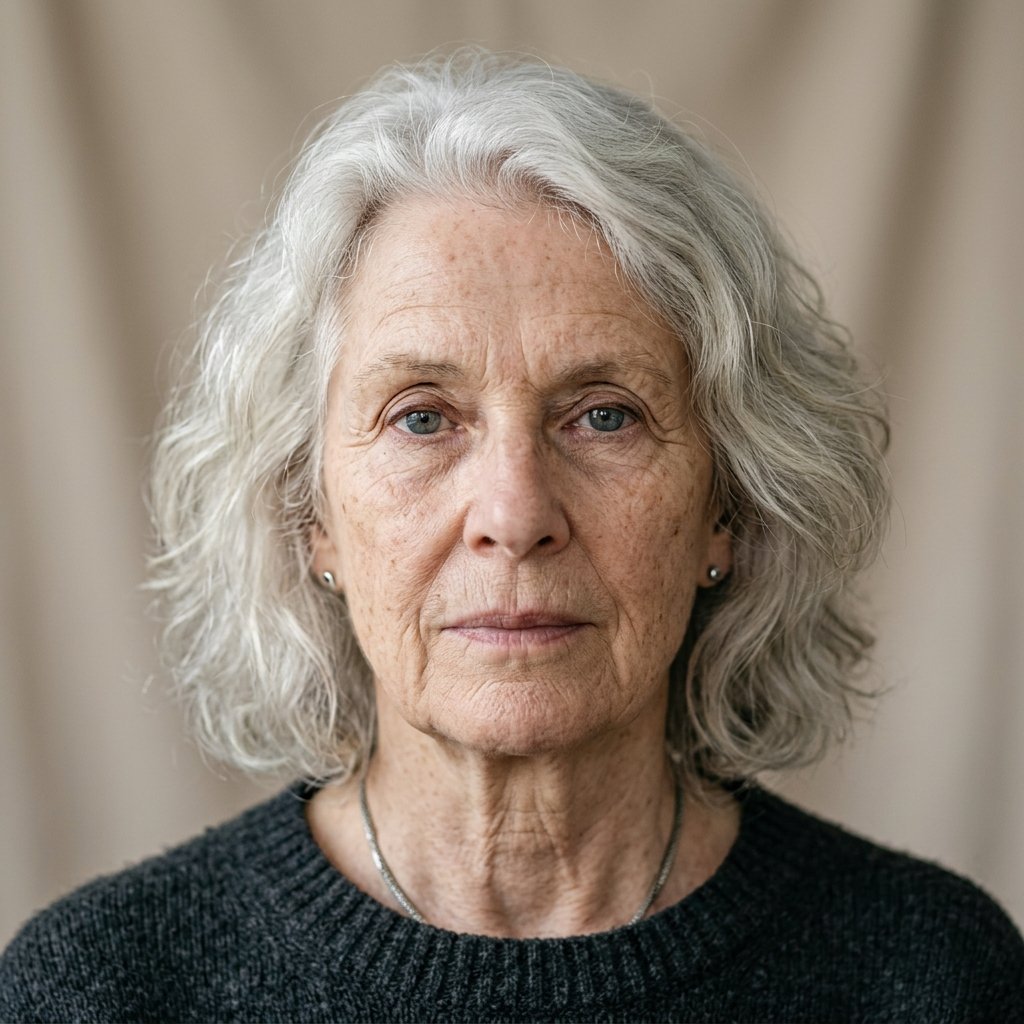
The old woman set four plates on the dinner table every Sunday evening, even though no one had walked through her front door in nine long years.
Four plates. Four glasses. Four folded napkins pressed flat with the same care she’d used when we were small and all still living under her roof.
I know this now. I didn’t know it then. Back then, I only knew my own anger, and anger is a loud thing. It drowns out everything, even the sound of a mother crying alone in an empty kitchen.
My name is Thomas Whitfield. I grew up in a white clapboard house on Cedar Lane in Millbrook, Ohio, a town so small the whole place felt like one big front porch.
My mother, Eleanor, raised the three of us there. Me, my sister Katherine, and my younger brother David. My father, Robert, worked the hardware store on Main Street until the day his heart gave out on a cold morning in November.
That was the day our family began to break.
Grief does strange things to people. It should have pulled us closer. Instead, it turned us into strangers fighting over scraps.
There was the house. There was the small savings account Dad had left behind. There was the old truck he loved, and Mom’s wedding ring that Katherine wanted and I insisted should be sold and split three ways.
I am ashamed of the man I was in that living room after the funeral. I raised my voice at my own mother. I accused Katherine of being greedy. David slammed a door so hard a picture fell off the wall and the glass shattered across the floor.
And my mother, God forgive us, just sat in her chair by the window with her hands folded in her lap, saying softly, “Please. Your father isn’t even cold yet. Please don’t do this.”
We did it anyway.
By the end of that week, all three of us had scattered like leaves in a hard wind. Katherine moved to Denver. David went south to Georgia. I took a job in Pittsburgh and told myself I’d never look back.
I didn’t call. Not on her birthday. Not at Christmas. Not once.
The silence stretched into one year, then three, then five. Somewhere along the way it stopped feeling like a decision and started feeling like a wall I couldn’t climb over even if I wanted to.
I told myself she’d taken sides. I told myself she cared more about the others. I told myself a hundred small lies, because each lie was easier to carry than the truth.
The truth was that I had abandoned the one person who never once abandoned me.
Nine years passed like that.
I got older. My hair started to gray at the edges. My own children, Michael and Sophie, grew up barely knowing they had a grandmother in Ohio.
When they asked about her, I changed the subject. I was a coward wearing the mask of a busy man.
Then one gray afternoon this past autumn, my phone rang. It was Katherine. I hadn’t heard her voice in nearly a decade.
She was crying so hard I could barely understand her. “Tommy,” she said, using the name only family used, “it’s Mom. A neighbor called me. She’s been in the hospital. Her heart. Tommy, we almost lost her.”
Something inside me that had been frozen for nine years cracked wide open.
I didn’t pack a bag. I didn’t plan. I just got in the car and drove west through the night, my knuckles white on the wheel, praying to a God I hadn’t spoken to in years.
Millbrook looked exactly the same when I rolled in at dawn. The same water tower. The same diner. The same sleepy Main Street where my father once sold nails and garden hoses to half the county.
Mom was already back home from the hospital, resting, the neighbor told me. Stable, but weak.
I let myself into the house on Cedar Lane with the spare key still hidden under the same loose brick by the steps, and the moment I stepped inside, the smell of that house hit me like a wave.
Lemon polish. Old books. Something baking, faint and sweet.
It was the smell of my entire childhood, and it brought me to my knees right there in the hallway.
The house was quiet. She was sleeping in the back bedroom. I walked slowly through the rooms of my youth, touching the walls, the banister, the door frame where Dad had penciled our heights every year.
Then I walked into the kitchen, and that’s when I saw it.
On the counter sat a wooden box, the kind Dad used to keep his tools in. Beside it, a stack of envelopes, hundreds of them, tied with faded ribbon.
I opened the top one with trembling hands.
It was a letter, written in my mother’s careful, looping handwriting. It was dated three weeks after we all left, nine years ago.
“My dear children,” it read. “The porch light is still on. I roasted a chicken tonight, the way you all like it, with the rosemary from the garden. The table looked so empty. I miss the noise you used to make. Come home whenever you’re ready. I will be waiting. All my love, Mom.”
I set it down and picked up another. And another.
There was one for every single week we had been gone. Every week. For nine years.
Some were short. Some were long. In some she told us about the seasons, about the tomatoes in the garden, about the neighbor’s new grandbaby.
In others she simply wrote, “I love you. I’m not angry. Please come home.”
And not one of them had ever been mailed.
I found out later why. She told me herself. She never sent them because she didn’t want us to feel guilty. She didn’t want to burden her children with her loneliness.
So instead she wrote her heart onto paper every Sunday night, sealed it, and placed it in the box, waiting for a day she wasn’t even sure would come.
I was still standing there, my face wet, when I noticed a folder underneath the box. Inside were bank statements and receipts.
And slowly, the second half of the truth revealed itself to me.
All those years I had struggled, and I struggled plenty, there had been moments when I was truly drowning. The winter the furnace died. The month I lost my job and couldn’t make the mortgage. The year Sophie got sick and the bills piled higher than I could count.
And every single time, out of nowhere, a gift would arrive. A cashier’s check with no name. Money slipped into an account by an anonymous sender. I always assumed it was some program, some charity, some clerical mistake in my favor.
It was her.
My mother, living on almost nothing, wearing the same winter coat for a decade, quietly reaching across the miles to catch each of her children before we hit the ground.
Katherine had gotten it too. So had David. She had saved us all, over and over, and never once asked for a word of thanks. Never once told us. Never once used it to guilt us home.
I have never in my life felt so small, and so loved, at the very same time.
That’s when I heard the front door open.
I turned, and there she was.
My mother stood in the doorway, smaller than I remembered, thinner, her hair now fully silver and pinned back the way she always wore it. A canvas grocery bag hung from one frail arm.
We stared at each other across nine years of silence.
The bag slipped from her fingers and hit the floor. Apples rolled out across the old linoleum, bright red, spinning to a stop against my shoes.
Neither of us breathed. I opened my mouth but no words came. What do you say? How do you apologize for nine years?
But my mother didn’t want an apology.
Her lip trembled, her tired eyes filled, and in a voice no louder than a breath she said the only words that mattered.
“You came home.”
Not “where were you.” Not “how could you leave me.” Not “do you know what you put me through.”
Just three soft words, full of a forgiveness I had done absolutely nothing to earn.
I crossed that kitchen and I fell into her arms like a little boy, like the six-year-old who used to crawl into her bed during thunderstorms.
And she held me exactly the same way, one hand stroking my graying hair, whispering, “There now. There now. My boy is home.”
I called Katherine that night. Then David. I read them one of the letters over the phone, my voice breaking, and I heard my grown brother weep like a child a thousand miles away.
That Thanksgiving, for the first time in nearly a decade, we all came home to Cedar Lane.
Katherine drove in from Denver with her husband. David flew up from Georgia. I brought Michael and Sophie, who finally got to meet the grandmother who had been secretly protecting them their whole lives.
The old house filled with noise again, the beautiful chaos of family, children thundering up and down the stairs, the smell of that same roast chicken with rosemary drifting through every room.
And when we sat down to eat, I looked at the dinner table and my heart nearly burst.
Because for the first time in nine long years, every plate my mother set had someone sitting behind it.
She looked around at all of us, her family whole again, and she pressed her napkin to her eyes and simply smiled.
We had that Thanksgiving. We had Christmas. We had one more spring.
My mother passed away peacefully last April, in her own bed, in the house she loved, with all three of her children holding her hands and her grandchildren nearby.
She was not afraid. She was not alone. She squeezed my hand at the very end, and with the last of her strength she whispered, “See? It was worth the wait.”
Then she was gone, and the porch light finally went dark.
I kept the wooden box of letters. I took it home with me, and every Sunday evening now, I open it and read just one.
Her voice comes alive in that looping handwriting, patient and gentle, and I am reminded of the fiercest, quietest love I have ever known.
I also learned something I will carry until my own last day.
I wasted nine years being right. Nine years defending my pride, my hurt, my version of an old argument that didn’t matter to anyone but me.
Nine years I can never get back.
And all that time, a good and gentle woman kept a light burning in the window, waiting for children too stubborn to come home.
So now I keep my own porch light on. Every single night.
Because if my Michael and my Sophie ever get lost out there in the world, if they ever let pride build a wall between us, I want them to know that no matter how long it takes, no matter what was said, there is a light still burning, and a table still set, and a father who will only ever say three words.
You came home.