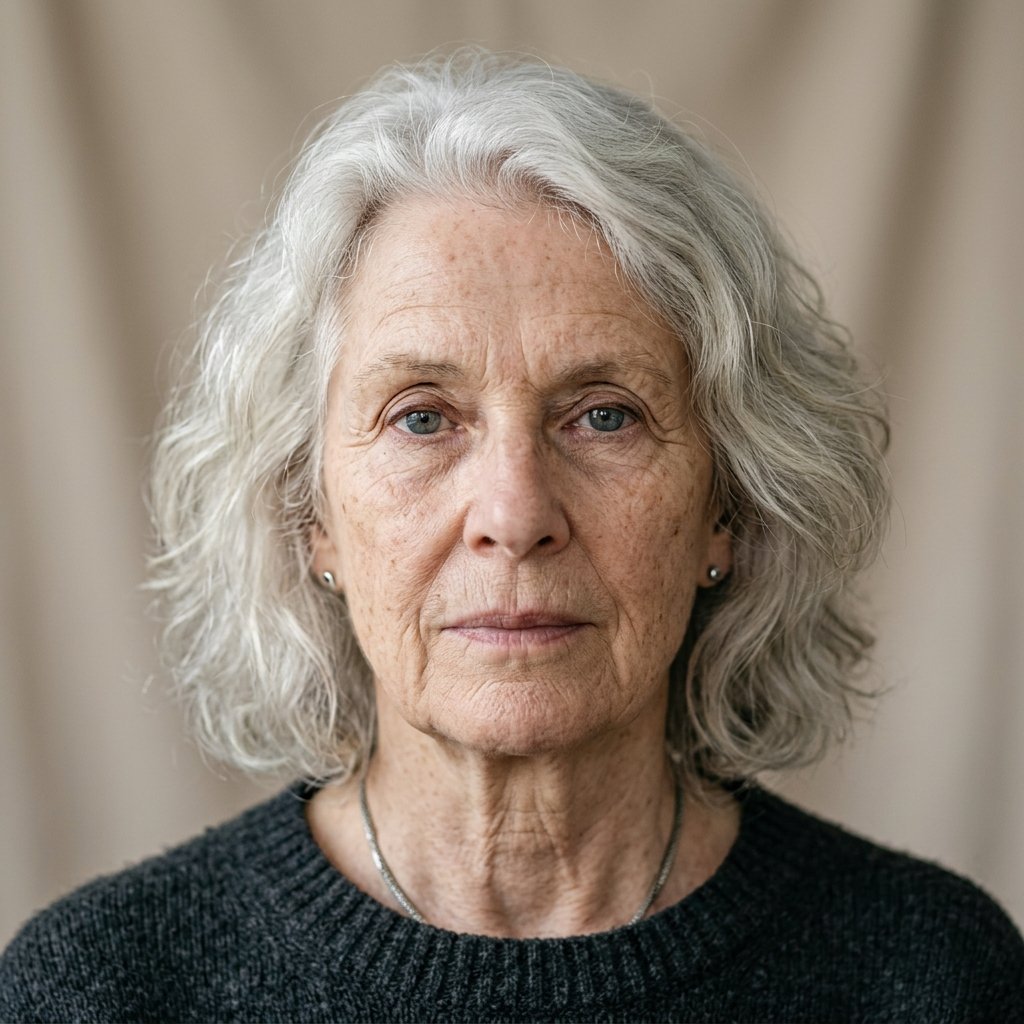
For nine years, I told people the woman who raised me was our housekeeper.
I need you to sit with that before I tell you the rest, because I am not proud of it.
Her name is Ruth Callahan. And she is my mother.
I grew up in Millbrook, Ohio, in a house that leaned slightly to the left, like it was tired of standing.
My father, Walter, passed away when I was eight years old. A machine at the mill did what machines sometimes do, and one Tuesday morning he simply never came home.
I remember my mother at the funeral. She did not wail. She did not collapse. She stood very straight in a black dress she had sewn the night before, holding my hand and my little sister Emily’s hand, and she stared at that grave like she was making it a promise.
Later I understood what the promise was. She was going to raise us alone, and she was going to do it without letting the world break us.
We had almost nothing. There were eleven dollars in her purse and a stack of bills on the counter that she moved from one pile to another, as if they might get smaller if she just rearranged them enough.
The next Monday, she put on her only good coat and walked three miles to the big houses on Chestnut Hill, and she knocked on doors until someone let her scrub their floors.
That became her life. She cleaned houses in the morning. She took a shift at the diner in the afternoon. And at night, under a lamp that buzzed like a trapped fly, she sewed dresses and mended clothes for anyone who would pay.
I would wake at two in the morning and see her still there, needle moving, glasses sliding down her nose, a cup of cold coffee beside her.
“Go back to sleep, Daniel,” she would whisper. “Tomorrow’s a big day.”
She said that every night. To her, every day her children woke up healthy was a big day.
There was a winter I will never forget. I was ten, and I came down with pneumonia. We could not afford a doctor, so my mother carried me the whole way to the clinic in her arms, through snow that came up to her knees.
She sat by my bed for three nights without sleeping. When the bill came, she took a second job washing dishes until midnight. I only knew that I got better, and that my mother’s eyes had dark circles under them for months.
She sold her wedding ring the winter the furnace broke. I did not learn that until years later. She told us she had lost it doing dishes.
She ate the burnt edges of the bread so we could have the soft middle. She wore the same two dresses for a decade. And she never, not once, let us feel poor.
My little sister Emily was the quiet one. She would sit and help our mother sew, her small fingers learning the stitches.
“We’re a team,” my mother would tell us. “The Callahans don’t quit. We just keep going, one stitch at a time.”
On my birthday she would somehow produce a chocolate cake, and she would sit back and watch me eat it with a look on her face like she was witnessing something holy.
I did not understand her sacrifice then. Children rarely do. We take the sun for granted until the day it stops rising.
I was a good student. It was the only gift I could give her, so I gave it with everything I had. I studied until my eyes burned.
When the letter came saying I had earned a scholarship to study medicine, my mother sat down on the kitchen floor and cried into her apron.
“Your father would be so proud,” she whispered. “My boy. A doctor.”
I promised her that day that I would spend my life making her proud.
I broke that promise faster than I would like to admit.
Medical school was a different world. My classmates came from families with lake houses and last names carved into hospital wings. They talked about ski trips and summers abroad.
And there I was, in secondhand shoes, with a mother who smelled of bleach and cheap soap.
The first time she visited, she came on a bus that took nine hours, carrying a cooler of homemade food because she was terrified I wasn’t eating enough.
She showed up on campus in her good coat, the one with the fraying cuffs, her hands red and cracked from work.
One of my classmates, a young man named Preston whose father owned half the county, looked her over and asked, “Daniel, who is this?”
And I heard myself say it. God forgive me, I heard the words leave my mouth.
“Oh, that’s just our housekeeper. She’s dropping something off.”
I watched my mother’s face. She understood immediately. Something flickered in her eyes, a small light going dim.
But do you know what she did? She smiled. She played the part.
“Just dropping off the young man’s supper,” she said gently, and she set the cooler down, and she left.
She rode nine hours home on that bus without a single complaint. She never told me how much it hurt. She simply let me keep my pride, because that was the kind of love she had. The kind that bleeds quietly so you don’t have to.
That night, after she left, Preston clapped me on the back. “Good help is hard to find,” he laughed. And I laughed too. I laughed with him about my own mother.
I went back to my dorm and I could not eat the food she had driven nine hours to bring me. I sat on the floor and felt something rotting inside my chest, and I did not have the courage to name it.
I called her that Sunday, like I always did. “Did you get home okay, Mama?”
“Oh, just fine,” she said, as if nothing had happened. “You eating that stew? You looked thin, honey.”
She was worried about me feeding myself, right after I had denied her existence to a stranger. That was my mother. There was no bottom to her forgiveness.
For nine years, I kept the lie going. When friends asked about my family, I was vague. When there were events with parents, I said mine had passed away. I let people believe I was a self-made man who owed nothing to anyone.
I sent her money sometimes, and I told myself that was love. It was not love. It was a receipt I was paying to quiet my conscience.
The turning point came the night I was honored.
I had become the youngest chief resident in the history of St. Bartholomew’s Hospital in Columbus. There was a gala. Crystal glasses, a live band, donors in tuxedos.
I stood at the podium, accepting my award, and I gave a beautiful speech about hard work and determination. I did not mention my mother once.
And then, from the back of that grand ballroom, an elderly woman in an evening gown rose from her seat, pointing.
It was Mrs. Abernathy, one of the wealthiest donors, the matriarch of the family that had funded the entire east wing.
My heart stopped. Because I recognized her too. Hers was one of the houses my mother had cleaned for twenty years.
“I know that woman,” Mrs. Abernathy said, and every head turned. But she was not pointing at me. She was pointing at a small figure standing near the kitchen doors, in a borrowed navy dress, holding her purse with both hands.
My mother had come. Someone from my old hometown had told her about the gala, and she had taken the bus again, nine hours, just to stand in the back and watch her son be honored. She had not even planned to let me see her.
“That is Ruth Callahan,” Mrs. Abernathy announced to the entire room, her voice trembling. “For twenty years, that woman cleaned my home. And in twenty years, I never once saw her buy a single thing for herself. Every dollar went to her children. She used to tell me about her son. The one who was going to be a doctor.”
The room went silent. Every eye moved from Mrs. Abernathy, to my mother, and then to me, standing frozen at that podium.
Mrs. Abernathy looked directly at me. “Young man,” she said, “do you have any idea who that woman is?”
And there it was. Nine years of lies balanced on a single moment.
I looked at my mother. She was shaking her head at me, silently, giving me one last gift. She was telling me I could deny her again. She would let me. She would smile and disappear and protect my pride one more time.
And that is exactly why I could not do it anymore.
I set down my award. I stepped off that stage. And in front of every powerful person in that city, I walked the length of that ballroom to the woman standing by the kitchen doors.
My voice broke on the first word.
“This,” I said, turning to the room, tears running down my face, “is Ruth Callahan. She is not a housekeeper. She is my mother.”
“Everything I am, every letter after my name, every life these hands have saved, belongs to her. She scrubbed floors so I could hold a scalpel. She sold her wedding ring so I could stay warm. And nine years ago, I was a coward who called her the help. Tonight I am telling the truth. I am the son of a cleaning woman, and I have never been prouder of anything in my life.”
Then I got down on my knees in front of my mother, in my expensive suit, on that cold marble floor, and I took her worn hands and I kissed them.
“I’m sorry, Mama,” I whispered. “I’m so sorry.”
She cupped my face the way she did when I was a boy. “Oh, my Daniel,” she said. “I never needed the world to know. I only needed you to remember.”
The room erupted. People were standing, applauding, wiping their eyes. But I did not hear any of it. I only heard my mother’s heartbeat as I held her.
Later, in the parking lot, I helped her into a cab I insisted on paying for. She held my hand through the window.
“I always knew you’d tell the truth someday,” she said. “A mother knows her child’s heart, even when he forgets it himself.”
My sister Emily grew up to become a schoolteacher, the kind children remember for the rest of their lives. She says she learned everything about patience from watching our mother thread a needle at midnight.
My mother is seventy-four now. She lives in a warm house with a garden she loves, and she has finally stopped working, though she still mends the neighbors’ clothes because she says idle hands make her nervous.
I bought her a new wedding ring last year. She wears it every day. When people ask about it, she tells them the whole story, the bus rides, the bleach, the burnt bread. She tells them proudly.
These days I run a free clinic on the east side of Columbus, one afternoon a week, for families who cannot pay. I named it after my father, but it was built on my mother’s hands.
Every time a tired woman walks in with a sick child and no money, I see my mother in the snow, carrying me to that clinic. And I treat that child like my life depends on it, because once, someone’s quiet sacrifice saved mine.
I learned something that night that no medical school ever taught me. The people who love us most are often the ones we are most tempted to hide, simply because they remind us where we came from.
But where we came from is not our shame. It is our foundation. And the calloused, cracked, hardworking hands that lifted us up deserve to be kissed in the light, not hidden in the dark.
So if your mother is still here, call her. Thank her for the burnt bread and the cold coffee and the nights she stayed awake so you could dream.
Do not wait for a ballroom full of strangers to remind you who she is.