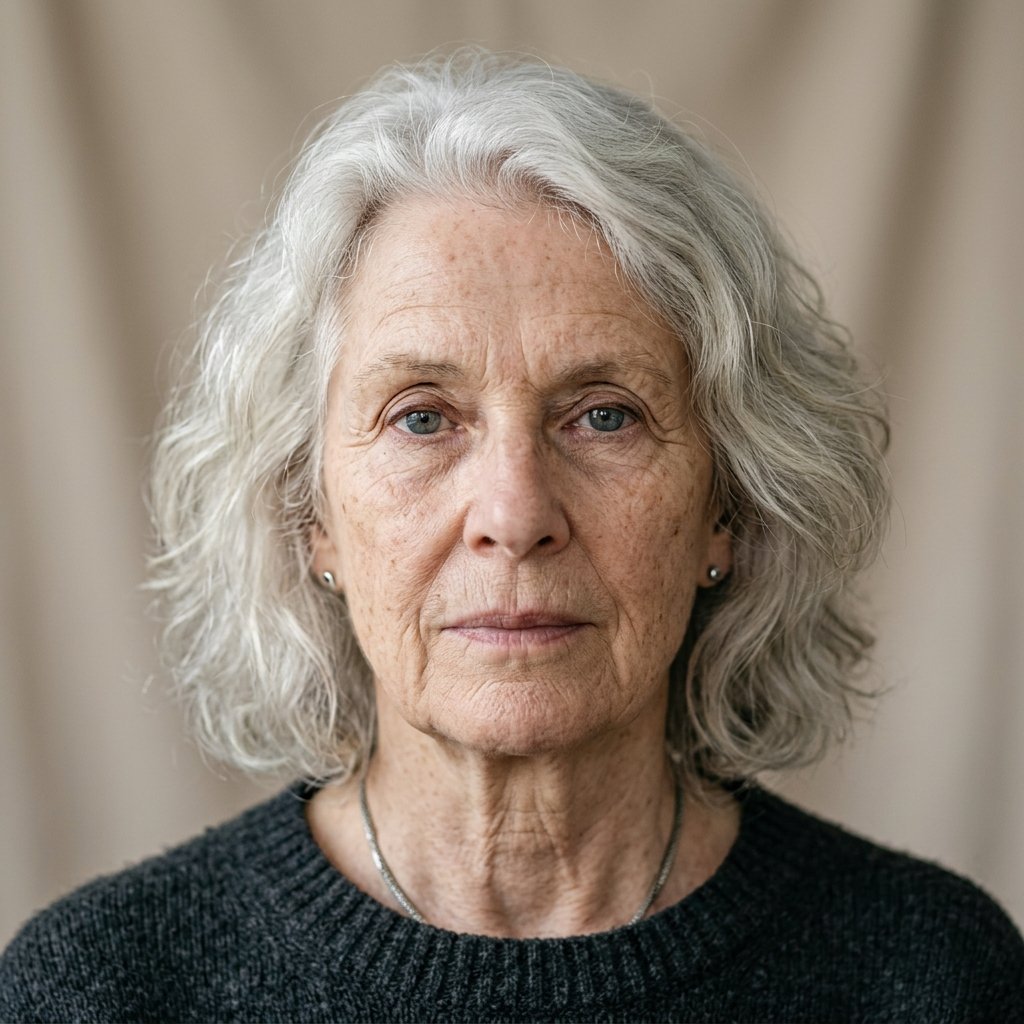
I was sixty-one years old the morning I decided to leave the only man I had ever loved.
The suitcase was the same one we’d carried on our honeymoon to Niagara Falls back in 1988. The leather handle was cracked now. So was I, in a way. Worn soft in some places, split open in others.
My name is Margaret, and for thirty-eight years I was married to a man named Walter in a small white house on Chestnut Lane, right on the edge of Millbrook, Vermont.
From the outside, we looked like a photograph. The tidy lawn. The porch swing. The two grown children who came home for Thanksgiving.
But a photograph doesn’t show you what happens inside the frame.
Walter was not a cruel man. I want to be honest about that, because the truth is rarely as simple as we’d like it to be. He never raised his hand to me. He never gambled away our savings or looked at another woman.
He simply never saw me.
For thirty-eight years, I was the woman who kept the world running while he sat in his brown recliner reading the evening paper.
I cooked ten thousand dinners. I never once heard him say the food was good.
I washed his shirts and pressed his collars and laid his clothes out every single morning. He stepped over the pile of laundry I folded on the stairs like it had grown there on its own.
When his mother, Eleanor, grew ill in the winter of 2009, it was me who moved into the guest room beside hers. Me who bathed her, fed her, held her hand through the long nights when the pain made her cry out.
Walter would come to the doorway sometimes, stand there a moment, and say, “You’re good at this kind of thing, Margaret.”
Then he’d go back downstairs to his chair.
When Eleanor passed away that spring, holding my hand and not his, he thanked the funeral director. He thanked the neighbors for the casseroles. He never thanked me.
I told myself patience was a virtue. My own mother used to say a good wife keeps the peace and swallows the hurt.
So I swallowed it. For decades I swallowed it, until it filled me up so completely there was no room left for anything else. Not joy. Not anger. Not even me.
Our children, Daniel and Susan, grew up and moved away, one to Boston and one to Portland. The house went quiet.
And in that quiet, I finally heard the truth I had been drowning out for years.
I was lonely. I had been lonely for a very long time. And I was running out of years to be anything else.
There is a particular ache that comes when the children leave. You look across the dinner table at the man you married, and you realize the two of you haven’t had a real conversation in months.
He asked me to pass the salt. I asked if he wanted more coffee. That was our marriage now, boiled down to its bones.
One night I set a beautiful dinner on the table. Pot roast, the way his mother taught me, and biscuits from scratch, and a pie cooling on the sill.
Walter ate every bite without looking up from the television. When he finished, he stood, stretched, and said, “I’m going to bed.”
Not a word about the meal. Not a glance at the candles I had lit.
I sat alone at that table until the candles burned down to nothing. And somewhere in the dark, a small, tired voice inside me said, enough.
So I made a plan.
I didn’t tell anyone. Not my daughter, not my sister, not the friends at church who thought Walter and I were the picture of a lasting marriage.
I simply began, quietly, to imagine a life where I mattered to someone. Even if that someone was only myself.
On a gray Tuesday morning in October, I climbed the stairs to the attic and brought down the old suitcase.
My hands were shaking as I folded my sweaters into it. My reading glasses. The photograph of my children when they were small. My mother’s Bible.
Thirty-eight years, and everything that was truly mine fit into one honeymoon suitcase. That fact alone nearly broke me.
I carried it downstairs and set it by the front door. I planned to leave a note and drive to my sister’s house in Burlington by noon.
But first I walked into the kitchen. My kitchen. The room where I had spent half my life. I wanted to say goodbye to it, silly as that sounds.
I ran my hand along the counter. I looked out the window at the maple tree Walter and I planted the year we married.
And that was when I heard the front door open.
My heart stopped. Walter was supposed to be at the hardware store until five. He never came home early. Not once in thirty-eight years.
I stepped into the hallway, and there he was. Standing perfectly still. Staring down at the suitcase by the door.
He looked up at me, and I braced myself for anger. For accusations. For the storm I was sure was coming.
But Walter didn’t yell. Walter did something I had never seen him do in nearly four decades of marriage.
His face crumbled.
This tall, quiet, unshakable man looked like a little boy who had just realized he was lost.
“Margaret,” he whispered. His voice cracked on my name. “Where are you going?”
I couldn’t speak. So I just looked at him, and I let him see all of it. All the years. All the silence. All the swallowed hurt finally rising to the surface.
“How long,” he said slowly, “have you felt like this?”
And the words came out of me before I could stop them.
“You never noticed,” I said. “So what did it matter?”
What happened next I will remember until the day I die.
Walter’s knees seemed to give out. He didn’t fall so much as sink, right down onto the hallway floor, his back against the wall by the coat closet.
And this man who had never cried at weddings, never cried at his own mother’s funeral, put his face in his hands and wept.
Great, heaving sobs that shook his whole body.
“I thought staying was enough,” he choked out. “My father never left my mother. Not once. I thought that made me a good husband. I thought showing up was the same as loving you.”
I stood there frozen, watching the ground shift beneath everything I believed.
“I don’t know how to do this,” he said, looking up at me with red, swollen eyes. “Nobody ever taught me. My father never once told my mother he loved her that I saw. I thought that was just how men were.”
“You could have asked,” I whispered. “You could have looked at me. Just once, Walter. Just once I wanted you to look at me and see the woman who gave you her whole life.”
He reached out and took my hand, and I felt how badly he was trembling.
“Don’t go today,” he said. “Please. Give me a chance to see you. If I fail, I’ll drive you to your sister’s myself. But please. Give me a chance to be the man I should have been all along.”
I did not unpack that suitcase.
I left it sitting by the door, because I needed him to know I was serious. I needed him to know that the woman he had ignored for thirty-eight years was capable of walking out that door.
That night, Walter made me a cup of tea. He did it badly. The water wasn’t hot enough and he used too much sugar.
But he brought it to me with both hands, like it was something precious.
Then he sat across from me at the kitchen table, the one where I’d eaten so many meals alone in his company, and he asked me a question he had never asked before.
“Tell me about your dreams, Margaret. The ones you had before you married me.”
I laughed, because I had almost forgotten I ever had any.
But slowly, I began to talk. About how I once wanted to teach music. About the garden I always meant to plant. About the ocean I hadn’t seen in twenty years.
He listened. Really listened, leaning forward, his eyes never leaving my face.
We talked until three in the morning. I hadn’t stayed up that late with my husband since our children were born.
The next morning, I came downstairs and stopped dead at the bottom of the stairs.
Walter was at the stove. An apron I didn’t know we owned was tied crooked around his waist. Smoke was curling up from a pan.
He turned around, holding a spatula, looking utterly helpless and completely determined at the same time.
“I don’t know how you like your eggs,” he admitted. “I’ve eaten your cooking for thirty-eight years and I never once learned to make a single thing you like. But I’d like to learn. If you’ll teach me.”
And right there, in the kitchen where I’d felt so alone for so long, I began to cry.
Not from sadness. From something I hadn’t felt in years. Hope.
The change did not happen all at once. Real change never does.
There were mornings he forgot. Old habits are stubborn things. But every time he caught himself, he would stop and correct course.
He started holding the door for me again, the way he had when we were courting.
He said thank you so many times it felt strange at first, almost rehearsed. But slowly it became real, became him.
He took my hand at church, in front of everyone, and I saw the ladies in the pew behind us whispering and smiling.
He planted me a garden that spring. Got down on his bad knees in the dirt and planted every rose himself.
And two summers ago, he surprised me with two tickets to the coast of Maine. We sat on the sand and watched the ocean I hadn’t seen in twenty years, and he held my hand and said, “I’m sorry it took me so long to bring you here.”
We have had four good years since that gray October Tuesday. And I will tell you the truth, because the truth matters.
The best years of our marriage came after I decided to leave it.
I don’t say that to be cruel to the woman I used to be. I say it because I finally understand something.
Sometimes love isn’t loud. Sometimes it just needs to be woken up before it’s too late.
Walter is eighty-three now, and his hands shake when he pours the tea. But he still pours it. Every single evening.
And every single evening, he looks me in the eyes and says thank you. For the meal. For the years. For staying.
I still have that old suitcase. It sits in the attic, empty now.
Sometimes I climb up there and look at it, and I say a quiet prayer of thanks that Walter came home five minutes early on the one day it mattered most.
Because I was truly going to leave. My heart was set.
And I lie awake some nights and wonder about the other version of my life. The one where he came home just a little too late, and found only a note on the kitchen table where the woman who loved him used to sit.
We never know how close we come to losing the very thing that saves us.