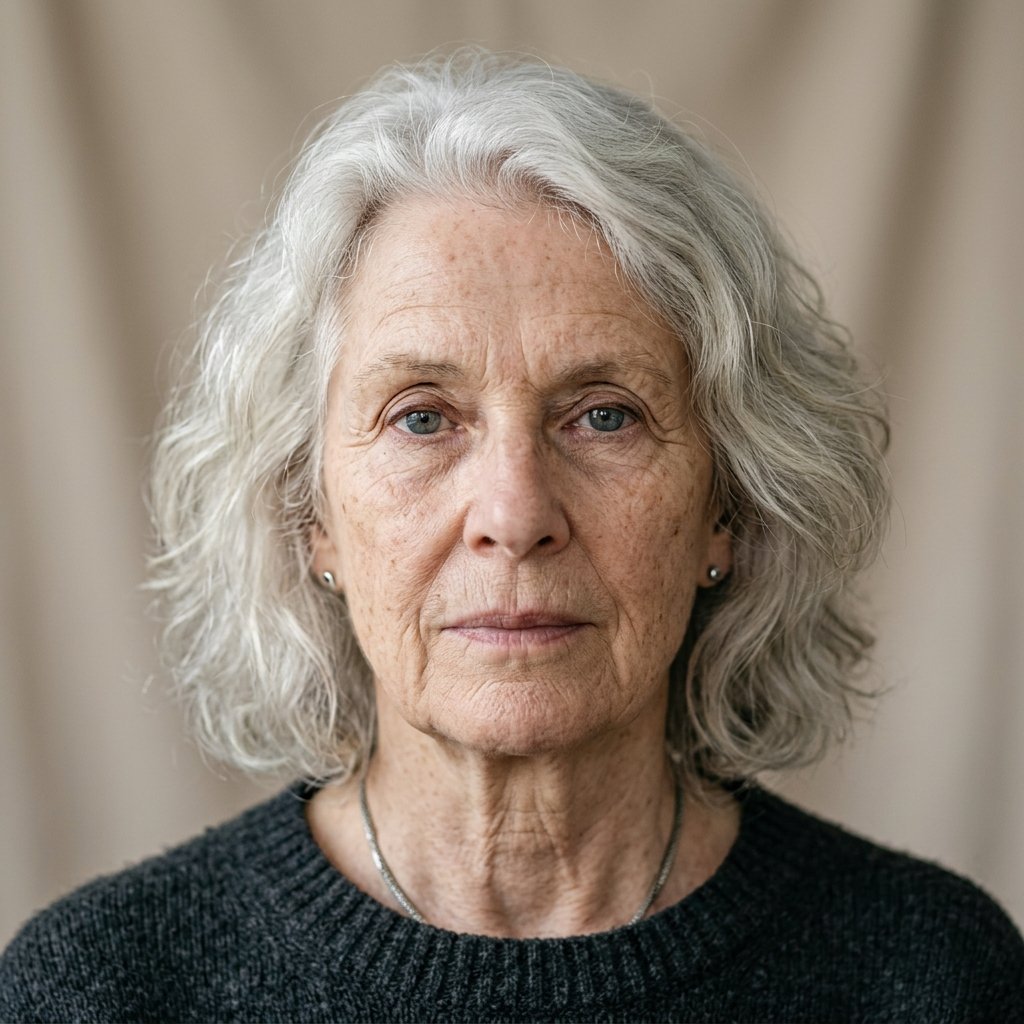
My mother set four plates at the dinner table every single night for ten years. Three of those chairs had been empty since the winter my father passed away.
I only found out the day I finally came home.
Her name is Margaret Whitfield, and she still lives in the same white farmhouse in Millbrook, Vermont, where she raised the three of us. It has a crooked porch, a garden gone wild, and a kitchen that always smelled like cinnamon and coffee.
For most of my childhood, that kitchen was the center of the whole world.
My father, Walter, was a quiet man who worked the county roads for thirty years. My mother held everything together with nothing more than patience and love. We were not rich. But we were warm.
Then Dad’s heart gave out on a cold February morning, and everything we thought was solid turned to sand.
At the funeral, the three of us stood shoulder to shoulder. Me, my sister Caroline, and our younger brother, Danny. We were a family in grief.
But grief has a cruel way of turning people against each other.
It started with the house. Then the small savings. Then Dad’s old truck, of all things. Words were said that should never have been spoken. Danny accused Caroline of being greedy. Caroline accused me of taking sides.
And our mother, standing in the middle of it all, begged us to stop.
We didn’t listen.
Within a year, we had scattered like dry leaves in a hard wind. I took a job in Denver and told myself the distance was about opportunity. Caroline moved to Chicago and buried herself in her career. Danny disappeared into his own resentment and stopped answering anyone’s calls.
We told ourselves we were simply busy. Grown adults with grown lives.
The truth, the one I could not admit for years, was that we were running.
Running from the memory of Dad. Running from each other. And, God forgive me, running from the sad and hopeful eyes of the woman who had given us everything.
Every few weeks, a letter would arrive in my mailbox. That careful, looping cursive I would know anywhere.
“The porch light is still on, honey. Your room is just the way you left it. I made your favorite pie last Sunday and thought of you the whole time.”
I read the first ones. They made my chest ache so badly that I eventually stopped opening them at all. I told myself I would answer when things calmed down. When the wound wasn’t so raw. When the time was right.
The time was never right.
Birthdays passed. Christmases came and went. My mother turned seventy, then seventy-five, and I marked each one with a phone call that lasted five polite minutes before I found some excuse to hang up.
I convinced myself she was fine. She had her church, her garden, her neighbors. She sounded cheerful enough.
I did not let myself imagine what her evenings actually looked like.
Then, last spring, my phone rang with a number I didn’t recognize. It was Mrs. Abernathy, the neighbor who lived down the road from the farmhouse.
“David,” she said gently, “your mother took a fall in the kitchen. She’s all right, but she’s shaken. She really shouldn’t be alone right now.”
I don’t remember packing. I don’t remember the flight. I only remember the gravel crunching under my rental car as I pulled into that driveway for the first time in ten years.
The porch light was on. Even in the middle of the afternoon.
When I stepped through the front door and walked into that kitchen, my knees nearly buckled beneath me.
The table was set for four.
Four clean plates. Four glasses. Four sets of silverware laid out with careful precision. Cloth napkins folded into neat triangles. And in the very center, a single white candle, unlit, waiting.
My mother sat in her chair by the window, a small bruise on her cheek, a blanket over her thin legs. She looked up at me, and her face broke open into the most beautiful, trembling smile I have ever seen.
“You came,” she whispered. “I knew you would.”
I could barely speak. I gestured at the table, at all those empty places. “Mom,” I managed, “why is it set for four?”
She reached out and patted the chair beside her, the way she used to when I was small.
“I always keep it ready,” she said, as if it were the most natural thing in the world. “A mother never stops setting a place for her children. I never knew which night one of you might walk through that door. I didn’t want you to feel like a stranger in your own home.”
Ten years. She had set that table every single evening for ten years.
I sat down hard in the chair and tried to hold myself together. I failed.
Over the next few days, as I helped her around the house, I began to understand the full shape of what she had been carrying alone.
I found the pie plates she still used, though she now baked for one. I found the calendar on the wall where she circled each of our birthdays in red ink and wrote little notes beside them. “David is 45 today. My sweet boy.”
And then, on the top shelf of her bedroom closet, I found a shoebox.
Inside were the birthday cards.
Ten years of them. One for each of her children, every single year. Thirty cards in all, each one carefully written, sealed, and stamped. But never sent.
I opened one addressed to me from three years back. Inside, in that familiar hand, she had written: “Happy birthday, my darling David. I don’t send these because I’m afraid they will make you feel guilty, and I could never bear to be the reason for your sorrow. I just needed to write them so I could feel close to you. All my love, always. Mom.”
I sat on the edge of her bed and wept like a small boy who had lost his way in the dark.
All those years, I had believed I was protecting myself from pain. And all those years, she had been protecting me from hers.
That night, after she had gone to sleep, I made two phone calls I should have made a decade earlier.
Caroline answered on the third ring. When I told her about the table, about the shoebox, about the unsent cards, she went completely silent. Then I heard her begin to cry, three states away.
“I thought she was angry with us,” she whispered. “I thought she’d given up on me.”
“She never gave up,” I said. “Not for one single day.”
Danny was harder to reach. It took me two days and half a dozen tries. When he finally picked up, his voice was cold and guarded, braced for another fight.
But I didn’t fight. I just told him the truth. About the candle. About the cards. About the mother who had spent ten years keeping his place ready at the table.
The line went quiet for a long, long time.
“Is she going to be okay?” he finally asked, and his voice cracked on the last word.
“She will be,” I said. “If we come home.”
We chose her seventy-eighth birthday.
I didn’t tell her. I wanted her to think it would be just another quiet evening. That afternoon, I helped her into her good blue dress, the one she saved for church, and told her a small fib about a neighbor stopping by.
Then I stepped out onto the porch to wait.
At half past five, three cars turned off the county road at nearly the same moment and came rolling up that long gravel drive, one behind the other, a small parade of everything she had waited for.
Caroline stepped out first, clutching a bouquet of wildflowers. Then Danny, older and grayer than I remembered, carrying a wrapped gift with hands that shook.
We stood together in the driveway, the three of us, reunited for the first time since our father’s funeral.
Then the screen door creaked open.
My mother stepped onto the porch. She saw Caroline. She saw Danny. She saw all three of her children standing on the grass in the golden evening light.
She pressed both hands to her mouth. She did not say a single word.
She simply opened her arms.
We crossed that yard like the years had never happened. We wrapped ourselves around her, all of us at once, and she held on with a strength that seemed impossible for such a small woman.
“My babies,” she kept saying into our shoulders. “All my babies, home.”
That evening, for the first time in ten years, the candle in the center of the table was lit.
Four chairs, filled. Four voices, talking over one another. Four plates, no longer waiting.
Danny set down his fork halfway through supper. He looked at Mom, and then at the two of us, and his eyes filled.
“I’m sorry,” he said, his voice breaking. “For all of it. For the things I said. For the years I stole from us.”
Caroline reached across the table and took his hand. I put mine over both of theirs.
And our mother, our stubborn, patient, unbreakable mother, just smiled at us through her tears.
“There’s nothing to forgive,” she said. “You’re here now. That’s the only thing I ever prayed for. I always knew you’d come. I never once stopped believing it.”
We stayed up until nearly midnight, laughing and crying and remembering Dad without any of the old anger.
Somewhere in that long, healing night, I understood how close we had come to losing everything. We had wasted ten years over pride, over money, over wounds we were all too stubborn to let heal.
Ten years she had waited, setting that table, keeping that light on, mailing herself nothing but hope.
We almost let her carry that quiet ache all the way to the end.
Mom is doing better now. The bruise healed weeks ago. But the real healing was something none of us expected.
We call every Sunday now, all three of us. And whenever I can, I make the trip back to that white farmhouse in Vermont.
The table is still set for four.
Only now, more often than not, those chairs are full.
If there is one thing I have learned, it is this. The people who love us most are almost always the ones we take for granted the longest. And the door we keep telling ourselves we’ll walk through someday may not stay open forever.
Don’t wait like we did. Make the call. Drive the miles. Say the words while there is still someone left to hear them.