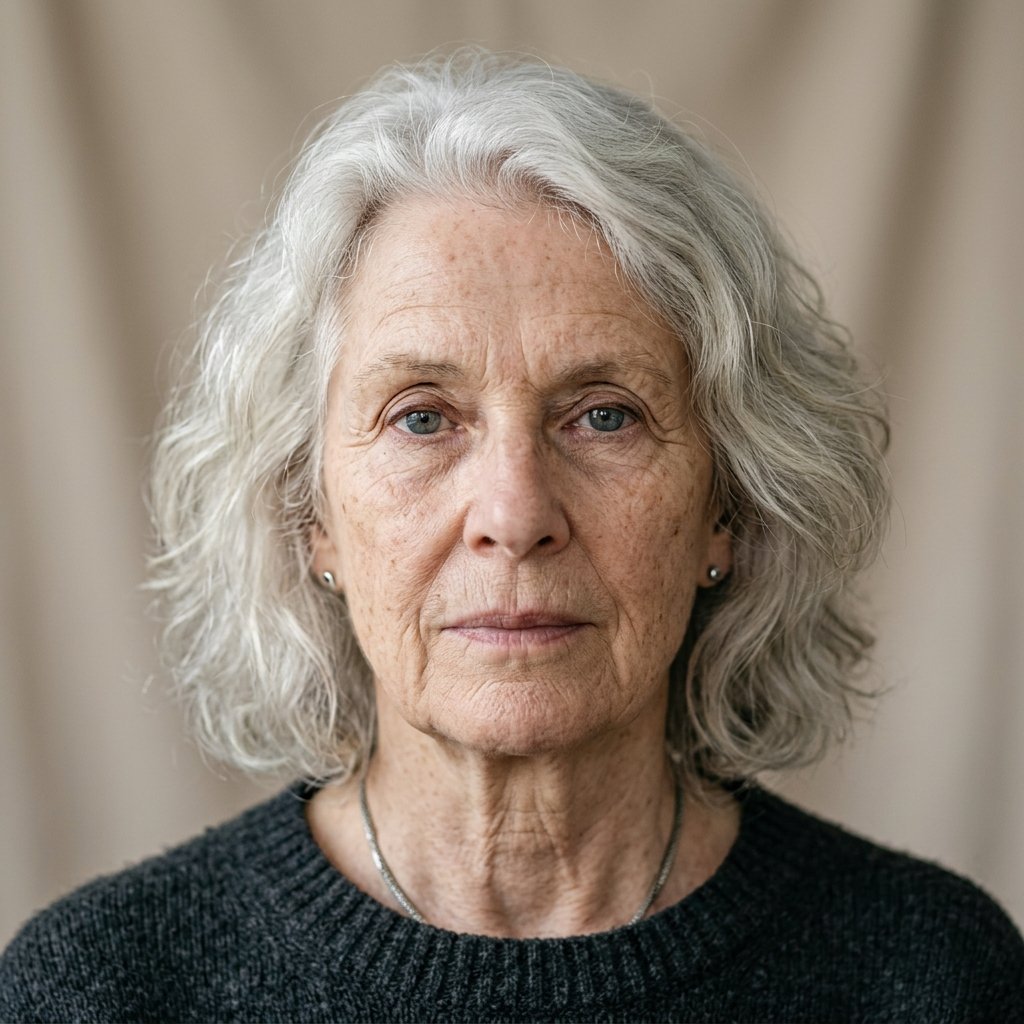
My mother’s dying words were a plea I couldn’t understand.
She was barely conscious, her hand like a fragile bird’s wing in mine.
The cancer had taken everything from her.
It had stolen her strength, her laugh, the light in her eyes.
But in that final hour, a fierce urgency flickered.
“Promise me,” she whispered, her voice paper-thin.
“Diane cannot stand beside my coffin.”
I leaned closer, my heart lurching.
“Mom, what are you saying? That doesn’t make any sense.”
She only shook her head, her thin gray hair rustling against the pillow.
“Please. Keep her away from me.”
Those were the last clear words she ever spoke.
My mother, Margaret, had been the quiet center of our little world.
After my father, Thomas, walked out the door in the summer of 1985, she didn’t cry.
Not in front of us, at least.
I was ten years old, and my younger sister Diane was just eight.
We lived in a small, tired house on Maple Street in Millbrook, Ohio, a place where everyone knew your name and your business.
Mom worked two jobs for as long as I could remember.
She was a waitress at the corner diner from six in the morning until two in the afternoon, and then she cleaned offices downtown until nine at night.
When she came home, she would tiptoe into our room, kiss our foreheads, and whisper, “Everything’s going to be just fine, my darlings.”
And somehow, she made it true.
The refrigerator was never empty.
The lights stayed on.
And on Sundays, she would take us to the little white church on the corner, her voice rising above all others as she sang the old hymns.
Diane and I were as close as two sisters could be.
We shared a tiny bedroom with faded floral wallpaper, and at night we would whisper stories to each other until Mom gently scolded us through the wall.
“Girls, you need your rest. The sun will be up before you know it.”
We giggled and pulled the quilt over our heads, promising to be best friends forever.
But time has a way of pulling people apart.
After high school, I stayed in Millbrook.
I attended the community college in the next town over, and then I took a job at the local library.
It wasn’t a glamorous life, but it was quiet and steady, and it allowed me to stay close to Mom.
Diane, on the other hand, had bigger dreams.
She was always the brilliant one, the one with her eyes on the horizon.
She earned a scholarship to a university in California, and she left Ohio in a swirl of ambition and excitement.
“I’m going to make something of myself,” she said, hugging me tightly at the airport.
“And I’ll send for you and Mom when I make it big.”
Mom watched her go with a smile, but I saw the sadness pooling in her eyes.
“Go on, my girl. Chase those stars,” she said.
Diane did make something of herself.
She became a successful marketing executive in San Diego, with a sleek apartment and a life filled with business dinners and weekend getaways.
Her phone calls became less frequent, but Mom never complained.
Whenever I mentioned that Diane hadn’t called in weeks, Mom would gently pat my hand.
“She’s busy, dear. That’s a blessing. It means she’s happy.”
But I saw her sitting by the phone some evenings, her fingers tracing the receiver as if willing it to ring.
Then, three years ago, Mom became seriously ill.
It started with a persistent cough that wouldn’t go away, a tiredness that clung to her bones.
The doctor’s face was grave when he called us into his office.
“I’m so sorry,” he said, his voice heavy. “It’s advanced. We can try treatments, but you should prepare yourselves.”
My world tilted on its axis.
I called Diane immediately.
“Oh my God,” she breathed through the phone. “I’ll be on the next flight.”
But the next flight never came.
There was always a reason.
A major client meeting.
A sudden staff shortage.
A bout of the flu that left her too weak to travel.
“I’ll be there soon, I promise,” Diane would say each time, her voice cracking with what sounded like genuine anguish.
“Take care of her for me. I love you both so much.”
I took a leave of absence from the library and moved back into my childhood bedroom.
The wallpaper was still there, but the flowers seemed fainter now, drained of color by decades of sunlight.
I became Mom’s full-time caregiver.
I learned to administer her medications, to help her bathe when she was too weak to stand, to read aloud from her favorite worn copy of Little Women when the pain kept her awake at night.
Those days were the hardest of my life, but they were also filled with a strange, aching tenderness.
Mom and I talked about everything and nothing.
She told me stories about her own childhood, about the first time she met my father at a county fair.
“He had the kindest eyes,” she recalled, a ghost of a smile on her lips. “People change, I suppose. But I don’t regret a thing, because he gave me you two.”
I asked her once if she was angry at Diane for staying away.
She was quiet for a long moment, watching the rain trace patterns on the window.
“Anger is a heavy weight to carry, sweetheart,” she finally said. “I’d rather carry love.”
But in her final weeks, something shifted.
The medication made her confused, and fear began to creep into her eyes.
She would startle awake from restless dreams, whispering names I didn’t recognize.
And whenever I mentioned Diane’s promised visit, a strange expression would cross her face—something between terror and deep, profound sorrow.
“Don’t let her…,” she murmured once, then caught herself.
I thought it was the illness talking.
Now I know better.
The night before she passed, the house was thick with silence.
I was sitting in the old wooden rocking chair beside her bed, reading softly from the Psalms, when her hand suddenly shot out and gripped my wrist.
Her fingers were cold, but her grip was fierce.
Her eyes, so cloudy for weeks, were suddenly sharp and clear.
“Promise me,” she rasped.
I set the book aside, my heart hammering.
“Anything, Mom. You know I will.”
“Don’t let Diane stand beside my coffin.”
The words hung in the air between us, impossible and chilling.
I stared at her, convinced I must have misheard.
“Mom, what are you talking about? Diane is your daughter. She loves you.”
She shook her head weakly, a tear slipping from the corner of her eye.
“Please. Keep her away from me. I’m begging you.”
“But why?” I pressed, desperation clawing at my throat.
She didn’t answer.
Her eyes drifted closed, and her breathing became shallow.
A few hours later, she was gone.
In the blur of grief that followed, I convinced myself it was the painkillers.
I told myself that Mom would never truly want to banish her own child from her farewell.
So when the day of the funeral arrived, I didn’t stop Diane.
The morning was gray and cold, the kind of November day that seeps into your bones.
The little white church was filled with the scent of lilies and old hymnals.
Diane arrived in a sleek black town car, her face already wet with tears as she stepped out.
She wore an impeccably tailored black dress and clutched a pristine white handkerchief.
When she saw me, she rushed forward and collapsed into my arms, sobbing so hard she could barely catch her breath.
“I’m so sorry I wasn’t here,” she cried. “I should have been here. I loved her so much.”
Every instinct in me wanted to hold her and tell her it was alright.
Mom’s whispered plea still echoed in the back of my mind, but looking at my sister’s shattered face, I pushed it away.
How could I deny a grieving daughter the right to say goodbye?
As the organist began to play “Amazing Grace,” I walked toward the front of the chapel with Diane clinging to my arm.
The open coffin stood at the altar, surrounded by a cascade of white roses and baby’s breath.
Mom looked peaceful, her hands folded over her favorite blue dress, the one she wore to church every Easter.
Diane broke away from me and stepped up to the casket, her fingers reaching out to touch Mom’s icy cheek.
“Oh, Mama,” she wept. “I’m so sorry.”
I stood a few feet back, my heart splintering.
And that’s when it happened.
The heavy wooden door at the back of the chapel creaked open.
A few people turned, expecting a late mourner.
But an elderly woman I had never seen before stepped inside.
She was stooped with age, leaning heavily on a polished wooden cane.
She wore a faded navy coat that was far too thin for the weather, and her silver hair was pulled back in a tight bun.
Her pale blue eyes scanned the room, and when they landed on Diane standing beside the coffin, she froze.
Every ounce of color drained from her face.
She looked as if she had seen a ghost.
For a moment, no one moved.
Then she began to hurry down the aisle, her cane tapping urgently against the worn floorboards.
Murmurs rippled through the small gathering.
She made her way directly toward me, her eyes never leaving my face.
When she reached me, she pressed a sealed envelope into my hand.
The paper was yellowed and soft, as if it had been held for a very long time.
“Your mother was terrified this would happen,” she whispered, her voice thin and reedy.
I stared down at the envelope, my fingers trembling.
“Who are you?” I managed to ask. “What is this?”
But she only shook her head, her expression filled with a deep and terrible sadness.
“She told me to give you this. She said you’d understand when the time came.”
Before I could say another word, she turned and limped back down the aisle, disappearing through the heavy door as quietly as she had come.
I stood frozen in the center of the chapel, the envelope burning in my palm.
Diane was still weeping beside Mom, oblivious to everything.
The pastor stepped up to the pulpit and began to speak comforting words about eternal peace.
But I couldn’t hear a single one of them.
All I could feel was the weight of that envelope—and the echo of my mother’s dying plea.
What had she been so afraid of?
What secret had she carried to her grave, hidden so carefully that even I, her devoted daughter, had never glimpsed it?
And why, after all these years, did the sight of Diane standing beside her casket fill a stranger with such unutterable dread?
The organ swelled, and the congregation rose to sing.
I sat down heavily in the front pew, my legs no longer able to support me.
I turned the envelope over in my hands.
There was no name written on it, only a small smear of ink where a pen had rested too long.
The seal was old-fashioned, the paper thick.
It felt like holding a piece of a story that had been waiting decades to be told.
I looked at Diane, still draped dramatically over the coffin, and for the first time, I saw not my beloved little sister but a stranger acting a part.
Had her grief always been this lavish, this public?
Had her love for Mom ever been more than a long-distance apology?
A cold dread settled in my stomach.
I didn’t open the envelope that day.
Some part of me already knew that whatever was inside would change everything.
And I wasn’t ready.
Not yet.
So I tucked it into the pocket of my black coat and sat through the rest of the service in a daze.
When the pastor invited the family to come forward for the final viewing, I walked up to the coffin one last time.
Diane was still there, her shoulders shaking with sobs.
I gently placed my hand over hers.
“Let’s say goodbye together,” I whispered.
She nodded, new tears spilling down her cheeks.
We stood there, side by side, as the soft afternoon light filtered through the stained-glass window, casting jewel-toned patterns over Mom’s peaceful face.
I thought of all the nights she had stayed up late sewing our Halloween costumes.
I remembered the way she used to hum while she kneaded dough in the kitchen, flour dusting her nose.
I thought of her quiet courage, her boundless forgiveness, and the terror that had darkened her last lucid moments.
“I love you, Mom,” I breathed.
And then I stepped back, the envelope still heavy and secret in my pocket.
Later, at the small reception in the church basement, Diane held court.
She accepted condolences with the practiced grace of someone used to being the center of attention.
Neighbors and distant relatives flocked to her, patting her hand and telling her how sorry they were.
“You poor dear,” Mrs. Henderson from three doors down said, her eyes misty. “You must be heartbroken.”
“I am,” Diane replied, dabbing at her eyes. “I just can’t believe she’s gone.”
I watched from a folding chair in the corner, a cup of cold coffee untouched in my hands.
The elderly woman’s face kept flashing before my eyes.
I looked around the room, hoping to spot her, but she was nowhere to be seen.
Had anyone else noticed her?
I stopped Mr. Lawson, our elderly mail carrier who had known Mom for forty years.
“Mr. Lawson, did you happen to see an older woman at the service? In a navy coat, using a cane?”
He creased his brow thoughtfully.
“Can’t say I did, dear. But these old eyes aren’t what they used to be. Why do you ask?”
“No reason,” I said quickly, forcing a smile.
As the afternoon wore on, the crowd began to thin.
Diana hugged me tightly before climbing back into her town car.
“I’ll call you soon,” she promised. “We need to go through Mom’s things together. There are probably some keepsakes I should take back with me.”
I nodded woodenly and watched her car disappear down the tree-lined street.
Then, at last, I was alone.
I drove home slowly, the envelope resting on the passenger seat like a living thing.
The little house on Maple Street was quiet, filled with the lingering scent of Mom’s lavender soap.
I sat down at her kitchen table, the one she had scrubbed clean every night for decades.
I placed the envelope before me.
My hands were shaking so badly I could barely feel my fingers.
What could possibly be inside?
A confession?
A secret about Diane that would shatter my memories of our childhood?
A truth so dark that Mom could only face it by keeping her own daughter from her coffin?
I thought of opening it.
My fingers brushed the edge of the seal.
But then I stopped.
Some truths, once learned, can never be forgotten.
And I had a feeling that whatever was written on that yellowed paper would rewrite the entire story of my family.
So I set the envelope in the small wooden box where Mom kept her most precious things—an old locket with a picture of my father, a dried rose from her wedding bouquet, a letter I had written to her when I was nine.
I closed the lid gently.
“I’ll open it when I’m ready, Mom,” I whispered to the empty room.
And for now, that would have to be enough.
But the question haunted every quiet moment.
Why was my mother terrified of her own daughter saying goodbye?
And what, dear heaven, was I about to discover?
Thank you for reading my story. If it touched your heart, please like our page, follow us for more, and share this post with someone who might need to hear it. Sometimes the truth takes time, but it always finds its way. What would you have done in my shoes? I’d love to hear your thoughts in the comments below.